fol. 41v
Book two, chapter two: On concerted counterpoint
sincopa sobre la primera nota deçendiente.
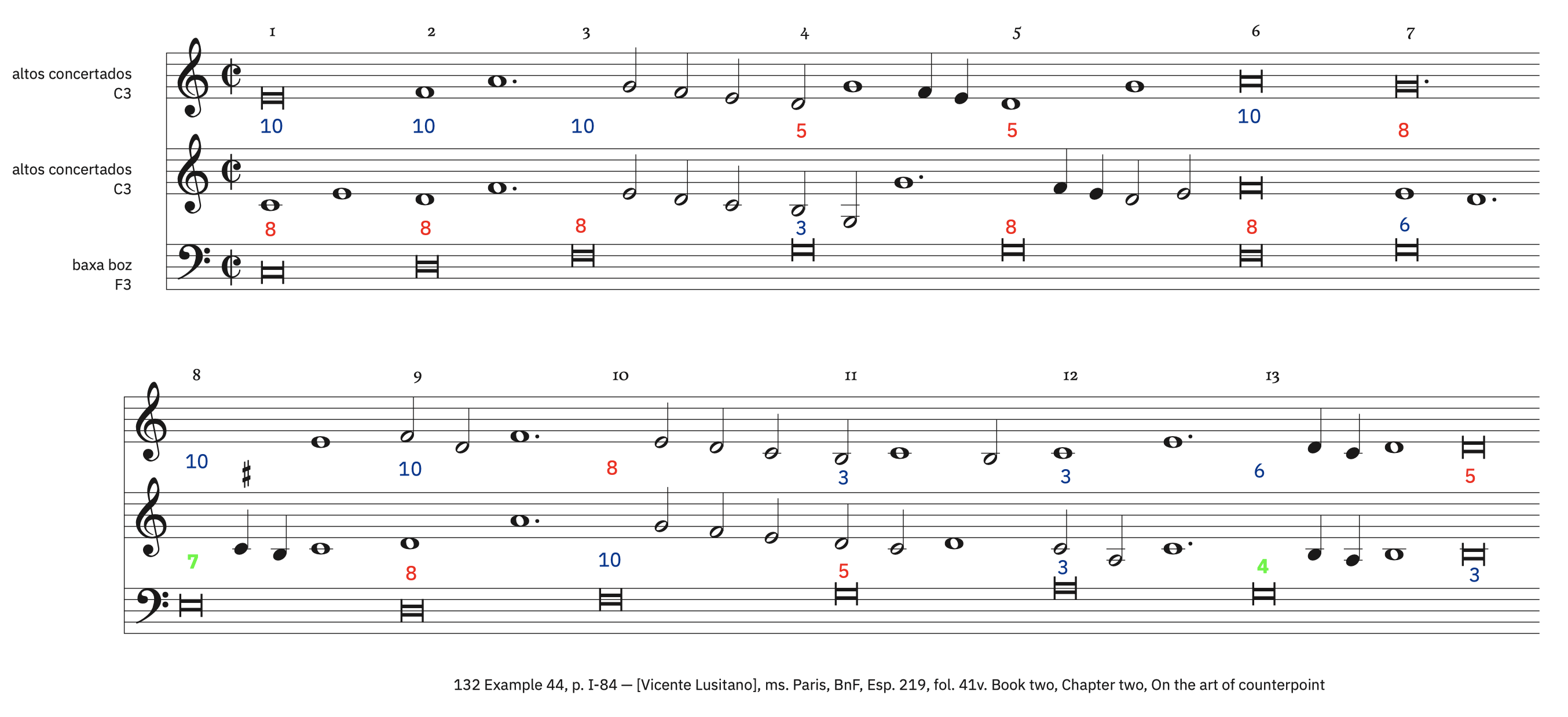
Y de esta manera pueden conçertarse las dos bozes sobre dichas, y para maior evidencia se ponen aqui abaxo por exemplo.
[Ex. 44] Exemplo
syncopation on the first descending note. In this way can the two above-mentioned voices make a concerted counterpoint, and for greater clarity, an example is given below.
[Ex. 44] Example
syncope sur la première note descendante. De cette manière, les deux voix susdites peuvent concerter, et pour une plus grande clarté, on en donne un exemple ci-dessous.
[Ex. 44] Exemple
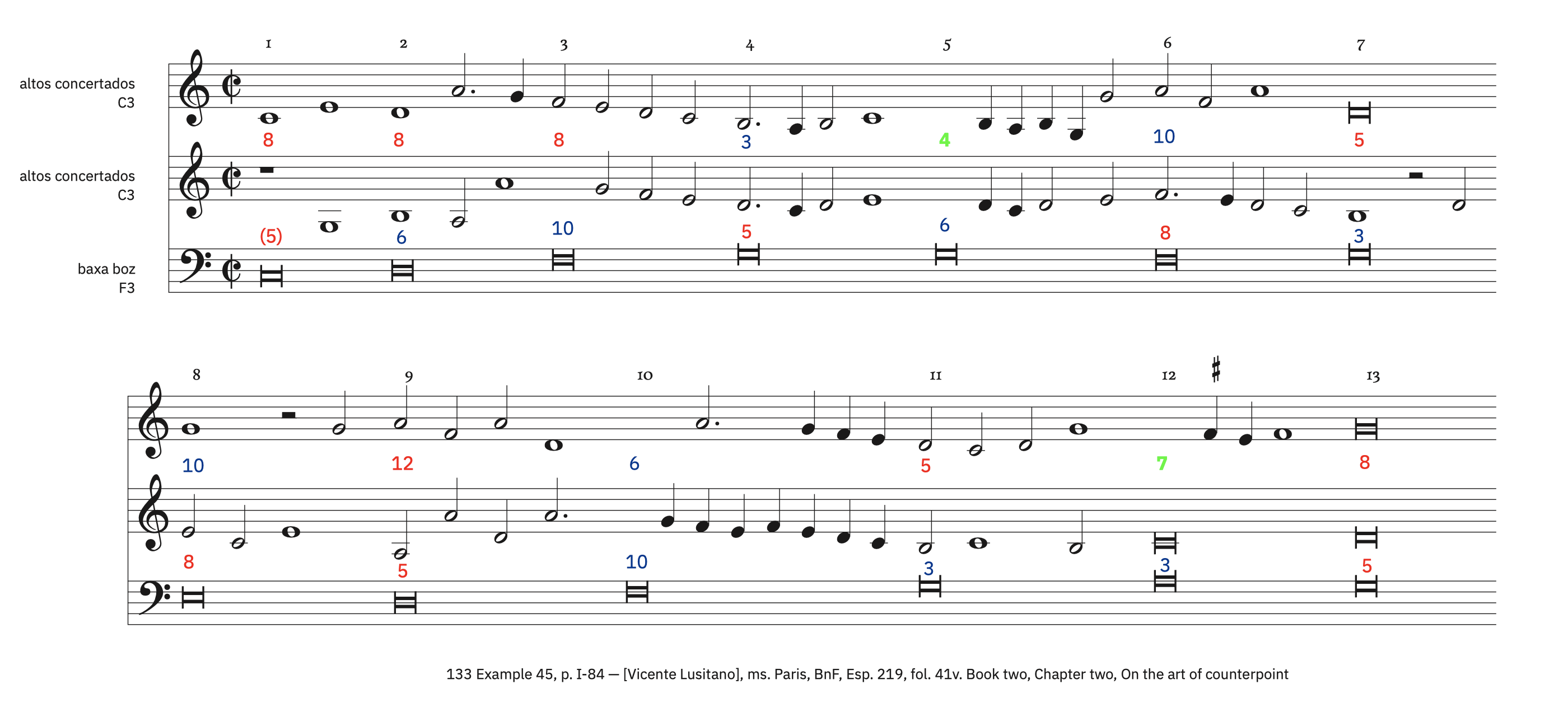
Este contrapunto puede ser muy mas ymytado de pasos semejantes, una boz con la otra, como abaxo se veera.
[Ex. 45] Exemplo
Such counterpoint can contain more imitations and similar motives among the two voices as shown below.
[Ex. 45] Example
Les deux voix de ce contrepoint peuvent s’imiter bien davantage par des formules semblables, comme on le voit ci-dessous.
[Ex. 45] Exemplo
[Marg. Nota: conçertado a quatro]
Estas tres bozes, scilicet tiple, alto y tenor, guardando cada uno su orden, pueden cantar en conçierto en este modo: tiple sigira la via de sus dezenas y hara las clausulas de dezenas, y el tenor dara sus quintas, terçeras, huiendo que no de dos terçeras ny dos sextas, y hara las clausulas de terçeras con quinta antes de la terçera, la qual viene ser clausula de octava con el tiple, [f. 42] y el contralto…
[Marg. Note: Four-part concerted counterpoint]
These three voices, i.e., soprano, alto, and tenor, keeping their order, may sing concerted counterpoint in the following way: the soprano will make tenths, and will make a tenth in the cadences; the tenor will make fifths and thirds, avoiding two consecutive thirds or sixths, and will make a third in the cadences, with a fifth before the third, which in turn makes an octave cadence with the soprano, [f. 42] and the alto…
[ Marg. Concert à quatre voix]
Les trois voix de soprano, alto et ténor, chacune conservant ses propriétés, peuvent chanter de concert de la façon suivante : le soprano suivra la voie de ses dixièmes, et fera les cadences de dixièmes ; le ténor fera ses quintes et ses tierces, en évitant de faire deux tierces ou deux sixtes consécutives, et il fera les cadences de tierces avec la quinte avant la tierce, laquelle forme une cadence d’octave avec le soprano ; [f. 42] l’alto…