Credits
Project context, research infrastructure, and audio credits
- Project context and translations
- Audio credits
- Linking and citation of examples
- Previous research and editorial context
4.1 On the FABRICA project
4.2 “Singing upon the book”: a 2011 article
4.3 Chanter sur le livre: a 2013 book
4.4 Bibliographic information on the manuscript source - Thanks
1. Project context and translations
This website forms part of a broader research infrastructure centred on the project platform improvisedcounterpoint.com, devoted to the study and practical reconstruction of Renaissance improvised counterpoint. Within this framework, the present site functions as a source-specific research environment dedicated to Vicente Lusitano’s manuscript treatise (F-Pn Esp. 219).
The materials presented here include:
- A provisional English translation of Lusitano’s counterpoint chapters from F-Pn Esp. 219, with a major editorial revision scheduled for 2026
- Modern transcriptions and analytical editions of all musical examples
- Multiple layers of audio material (MIDI realisations, ensemble recordings, and research recordings)
- Navigational tables and editorial documentation
The English translation was commissioned by the Centre d’Études Supérieures de la Renaissance (CESR, Tours) and completed in June 2021. It is presented here as a work in progress pending substantial revision. In its current form, the translation broadly follows the strategy adopted in Philippe Canguilhem’s 2013 edition, prioritising fidelity to the source over stylistic fluency and therefore remaining relatively close to Spanish syntax and idiom. It has not yet undergone full editorial revision and should not be cited in scholarly work in its present form. The transcription of the Spanish text and the French translation derive from Canguilhem’s edition, to whom I am grateful for providing access to these materials.
The parallel presentation of the text in multiple languages, together with the visualisation and audio rendering of the musical examples, aims to facilitate close engagement with Lusitano’s contrapuntal practice while mitigating the provisional status of the current English translation.
Website and project scope
This site forms part of Vicente Parrilla’s FWO-funded doctoral project (project no. 11A9922N) at KU Leuven / LUCA School of Arts / docARTES.
The integration of analytical transcriptions, interval labelling, navigational tools, and layered audio materials is intended to support both scholarly analysis and aural-procedural engagement with Renaissance contrapuntal practice within a unified digital research environment.
2. Audio credits
Overview of available audio formats*
| Audio type | Coverage | Pitch | Purpose |
|---|---|---|---|
| MIDI realisations | All 247 examples | A = 440 Hz | Mechanically precise analytical reference providing rhythmic clarity and interpretative neutrality |
| Les Sacqueboutiers recordings | 54 selected examples | A = 440 Hz | Historically informed ensemble performances documenting an earlier modern reception of Lusitano’s treatise |
| Corpus of Recorded Counterpoint Examples | All examples (chs. 1–4) + additional material | A = 466 Hz | Complete research recordings supporting analytical study, aural training, and practice-based engagement |
*: Tap or click inside the table and scroll horizontally to view the rightmost columns.
This website brings together three complementary layers of audio material, reflecting different methodological approaches to the study and reconstruction of Renaissance improvised counterpoint.
-
Complete MIDI realisations of all 247 examples, rendered at modern concert pitch (A = 440 Hz). These mechanically generated versions provide a rhythmically exact and interpretatively neutral analytical reference.
-
Historically informed instrumental recordings by Les Sacqueboutiers, covering 54 selected examples. Produced for the companion site to the 2013 edition, these performances represent a significant stage in the modern reception of Lusitano’s treatise and offer a perspective grounded in professional ensemble practice.
-
A complete new instrumental recording of the corpus realised within the present doctoral research. These performances form part of the six-volume Corpus of Recorded Counterpoint Examples, a research audio corpus comprising 420 recordings of 276 counterpoint exempla transmitted in Renaissance theoretical sources. Recorded in a controlled home-studio environment on a Renaissance recorder consort at A = 466 Hz, this layer of the corpus is designed to support both aural-procedural training and practice-based research.
Together, these materials constitute a layered audio research environment, combining mechanically precise reference material, historically informed ensemble interpretation, and systematic research recordings intended to document and explore the procedural foundations of Renaissance contrapuntal practice.
Recordings by Les Sacqueboutiers
Of the 247 musical examples transmitted in Lusitano’s manuscript, fifty-four were recorded by Les Sacqueboutiers for the companion site to Philippe Canguilhem’s 2013 edition. These recordings, made at modern concert pitch (A = 440 Hz), are reproduced here alongside the corresponding transcriptions.
Performers
- Jean-Pierre Canihac: cornet
- Philippe Canguilhem: alto bombarde, tenor bassoon, recorder
- Daniel Lassalle: sackbut
- Laurent Le Chenadec: bassoon
With the participation of Ensemble Gilles Binchois (dir. Dominique Vellard), Anne-Charlotte Lacroix (bassoon, ex. 47), and Pierre-Yves Binard (tenor, ex. 66). Recorded in Toulouse (Gesù church), May 2011 and October 2012. Sound recording and editing: Daniel Michel (May 2011) and Jean-François Felter (October 2012).
Complete recordings: Corpus of Recorded Counterpoint Examples
](https://lusitano.improvisedcounterpoint.com/media/pages/credits/20bbc4da76-1766513930/home-studio-corpus.jpg "Home studio in Leuven during a 2025 recording session for the [*Corpus of Recorded Counterpoint Examples*](https://improvisedcounterpoint.com/recordings)")
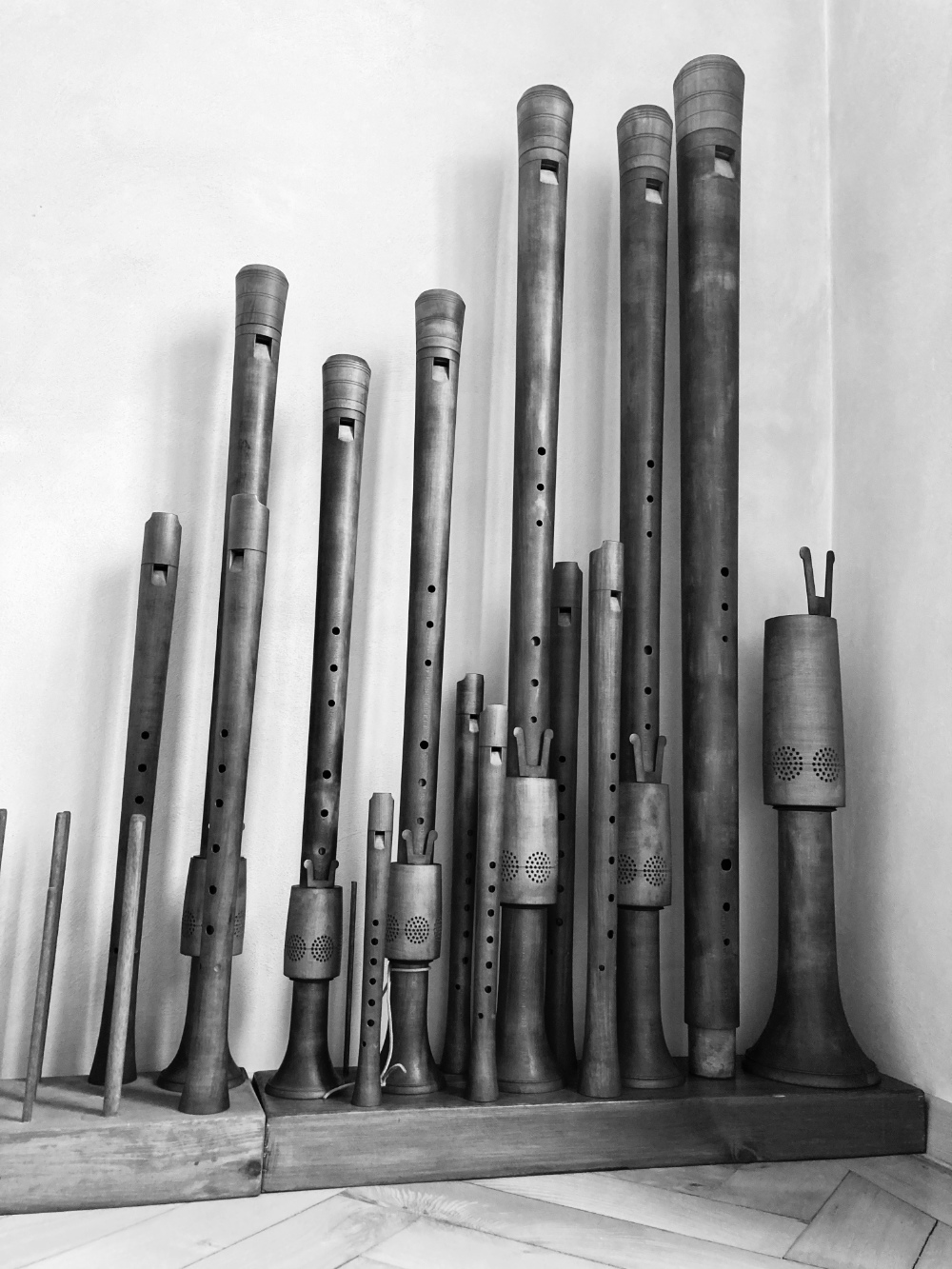
As part of the doctoral research in the arts, the complete corpus of improvised counterpoint examples from Libro segundo has been recorded and released within the Corpus of Recorded Counterpoint Examples. These performances were realised on a Renaissance recorder consort (A = 466 Hz) built by Bob Marvin.
Together with the MIDI realisations and the ensemble recordings by Les Sacqueboutiers, these performances form a stratified audio corpus designed to support analytical study, listening practice, and active engagement through play-along formats.
FWO support
The Neumann TLM 103 microphone used for these recordings was acquired thanks to the support of a Research Foundation – Flanders (FWO) doctoral fellowship (project no. 11A9922N).
3. Linking and citation of examples
Individual counterpoint examples presented on this website may be cited or referred to through stable and systematically deducible links. Each example is assigned a unique editorial number (1–247), corresponding to its order of appearance in the manuscript, and is situated within a specific chapter and manuscript folio.
In practical terms, chapter and folio references correspond to the internal URL structure of the site. Each chapter is presented as an index page listing its folios, while each folio is accessible as an individual page. Direct linking to a specific example is achieved by appending the example reference to the corresponding folio URL. For instance, since Example 125 appears on folio 38r of Chapter One, it may be accessed via:
https://lusitano.improvisedcounterpoint.com/chapter-one/f-38r#ex125
All such links point to the complete set of newly recorded instrumental realisations forming part of the six-volume Corpus of Recorded Counterpoint Examples, which documents the improvised counterpoint examples from chapters 1–4. This ensures stable and unambiguous reference to the sounding realisations of the examples, independently of the availability of MIDI renderings or the partial ensemble recordings by Les Sacqueboutiers.
This system is designed to support reproducible scholarly reference, enabling precise citation of individual contrapuntal procedures within a digital research environment that integrates editorial, analytical, and performative materials.
Recommended citation format
Example 125 (or
125 Ex. 37d)
https://lusitano.improvisedcounterpoint.com/chapter-one/f-38r#ex125
4. Previous research and editorial context
4.1 On the FABRICA project
In 2008, a collaborative research initiative involving historical musicologists from the Université de Toulouse, ethnomusicologists from the Universitat Autònoma de Barcelona, and professional musicians from Ensemble Gilles Binchois was established under the direction of Philippe Canguilhem as the FABRICA project. From its inception, the project has focused on polyphonic practices connected to plainchant in Western Europe.
One of its principal outcomes was the study, transcription, and translation of a manuscript treatise on improvised counterpoint preserved in Paris, Bibliothèque nationale de France (F-Pn Esp. 219), attributed to Vicente Lusitano and dating from around 1550. This work laid the foundations for subsequent scholarship on Lusitano’s treatise and its place within Renaissance improvisatory practice.
Further reading
- Brannon, Samuel J. (review). “Chanter sur le livre à la Renaissance: Les traités de contrepoint de Vicente Lusitano (Collection ‘Epitome musical’)”. Notes 71, no. 4 (June 2015): 716–719.
- Canguilhem, Philippe. “Le projet FABRICA : Oralité et écriture dans les pratiques polyphoniques du chant ecclésiastique (XVIe–XXe siècles)”. Journal of the Alamire Foundation 2 (2010): 272–281.
4.2 “Singing upon the book”: a 2011 article
This article presents the first published results of a collective research project devoted to Lusitano’s counterpoint treatise. An edition of the source, including a French translation, was subsequently issued by Brepols within the Ricercar programme of the Centre d’Études Supérieures de la Renaissance (Tours). The research was conducted within the framework of the FABRICA project, funded by the Agence Nationale de la Recherche.
- Canguilhem, Philippe. “Singing upon the book according to Vicente Lusitano”. Early Music History 30 (2011): 55–103.
https://doi.org/10.1017/S0261127911000052
4.3 Chanter sur le livre: a 2013 book
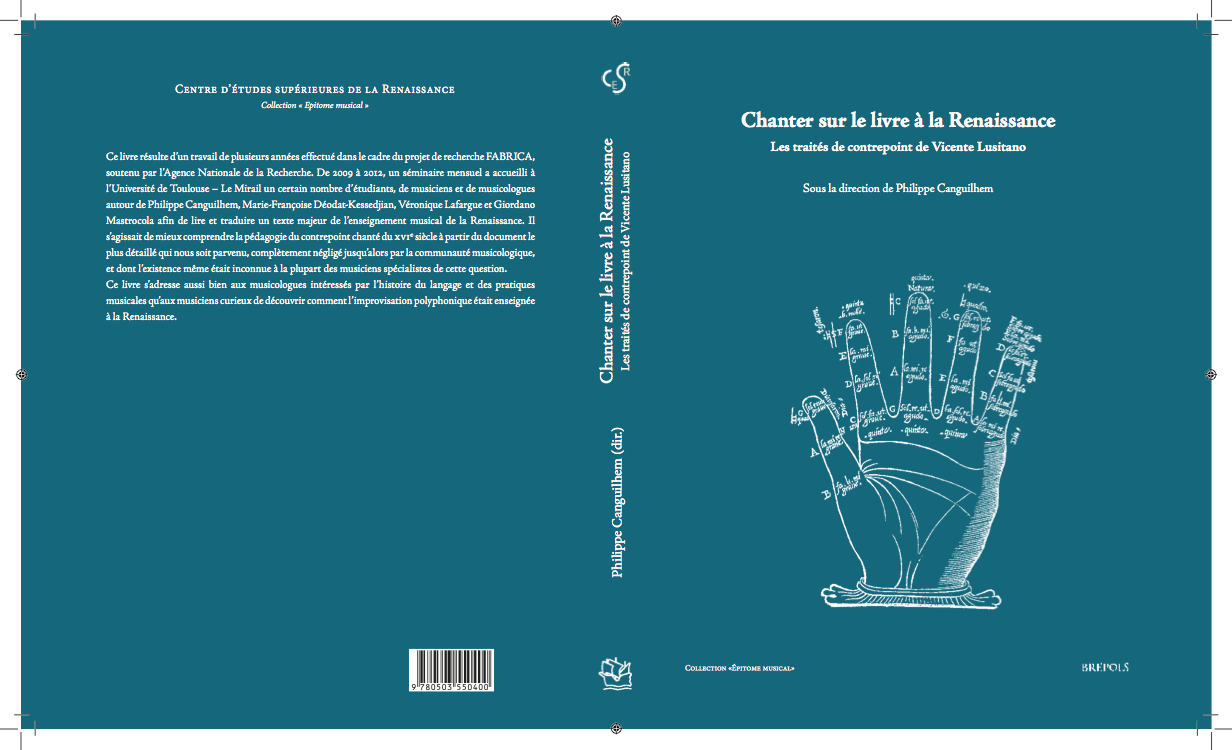
Canguilhem’s 2013 edition includes:
-
a study of the manuscript and its historical context
-
biographical information on Vicente Lusitano
-
a diplomatic transcription of the text
-
a French translation of Lusitano’s counterpoint chapters from both his 1553 printed treatise and his manuscript treatise (ca. 1550)
-
a transcription of the complete corpus of musical examples
Canguilhem, Philippe. Chanter sur le livre à la Renaissance. Les traités de contrepoint de Vicente Lusitano. Turnhout: Brepols, 2013.
Reviews and discussions
- Brannon, Samuel J. Notes 71/4 (2015): 716–719.
- Montagnier, Jean-Paul C. Revue de Musicologie 100/2 (2014): 439–441.
- Rossi, Francesco Rocco. Rivista Italiana di Musicologia 50 (2015): 258–261.
- Weber, Édith. Cahiers de sociologie économique et culturelle 56 (2013–2014): 154–156.
See also Bulletin de la Société Française d'Étude du Seizième Siècle, no. 80 (December 2014), 31–32.
4.4 Bibliographic information on the manuscript source
Descriptive notice by the Bibliothèque nationale de France (2009), derived from the retrospective conversion of Alfred Morel-Fatio’s Catalogue des manuscrits espagnols et portugais (1892). Originally written in French. See PDF.
- Shelfmark: Espagnol 219
- Former call number: Regius 7817
- Language: Spanish
- Material: paper, 85 folios
- Dimensions: 278 × 205 mm
- Bibliothèque nationale de France, Department of Manuscripts
The manuscript is divided into three books: the first (f. 1–13) treats canto d’organo; the second (f. 13–62) contrapunto; and the third (f. 62v–84) proporciones. The final book is incomplete. Marginal annotations and authorial corrections occur throughout. On f. 13, Lusitano invokes the authority of Jacques Lefèvre d’Étaples: “Y primero veamos que cosa sea consonancia, segun Yacobus Faber Stapulensis”. On f. 1 appears the name “Desporte”.
5. Thanks
The development of this research platform and the materials it presents has benefited from the generous support, collaboration, and intellectual engagement of many colleagues, scholars, and musicians.
Particular thanks are due to:
David Burn, Philippe Canguilhem, Yves Corboz, Daniel Guillan, María González, Jean-Yves Haymoz, Bernardo Illari, Ana López Suero, David Mesquita, Anne Smith, Leandro Suárez, and Mattin Zeberio.
This research was supported by a doctoral fellowship from the Research Foundation – Flanders (FWO, project no. 11A9922N).