fol. 41r
Book two, chapter two: On concerted counterpoint
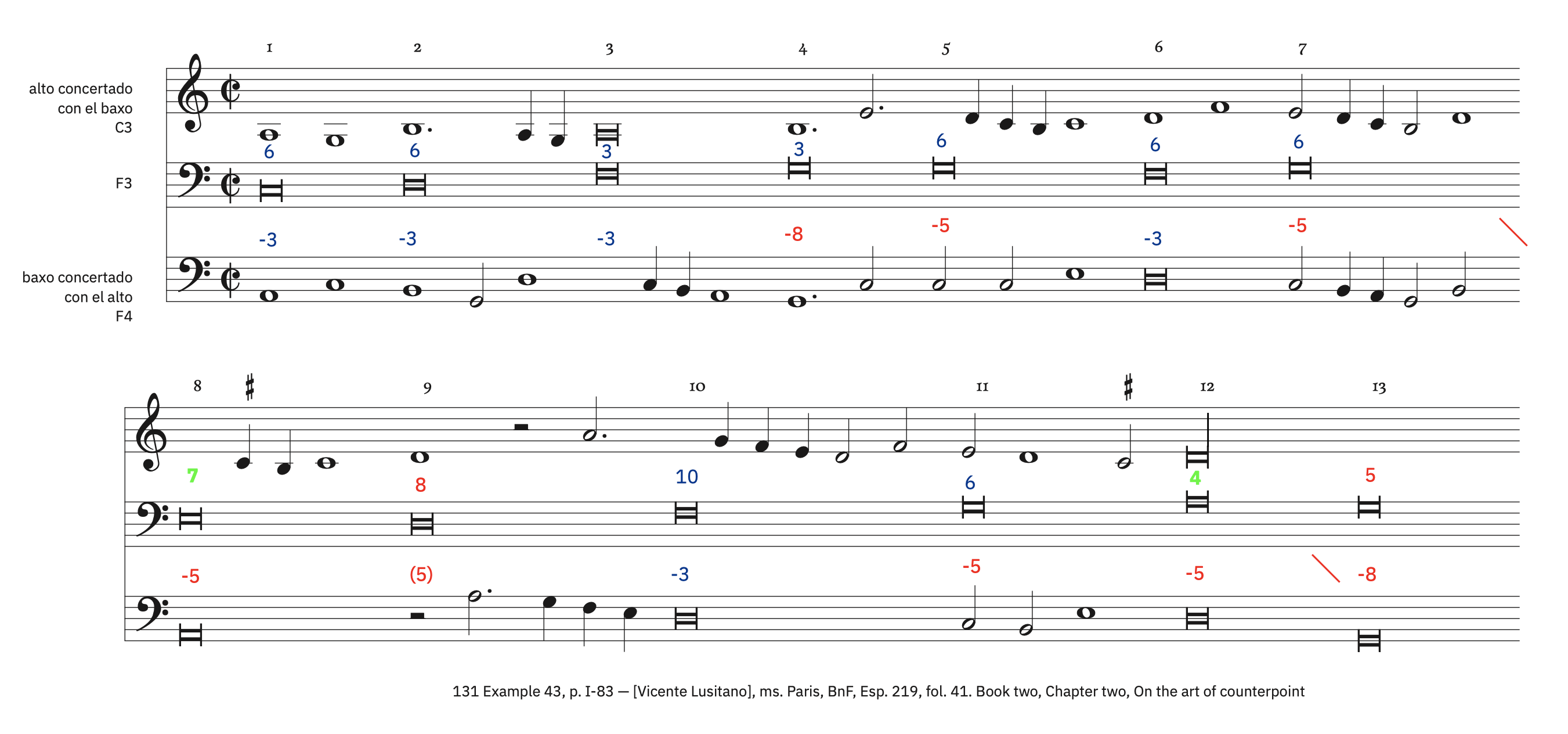
[Marg. Concierto de dos altos]
Dos contraltos pueden conçertarse sobre el canto llano en este modo que quando el uno fuere alto el otro vaia baxo. Y despues de las ymitaciones, vengan a las clausulas del modo, el mas baxo en aquella manera que el tiple las haze por arriba quando canta conçertado con alto o tenor, scilicet a las terçeras y sus acometimientos; y el mas alto, en la manera que el[^**] alto o tenor hazia con el tiple, scilicet venir a las terçeras por lo alto, dando quinta antes de dar la terçera, como se mostra en la onzena nota de canto llano.
[Marg. nota]
Y nota que quando la boz mas alta esta en quinta o octava o decima, la mas baxa podra estar en terçera o quinta o sexta o octava; mas si estuviere en dozena, no podra la baxa estar en sexta sobre el canto llano. Y no se deve admirar por ver que una boz con la otra estan en falsas, como algunas vezes veera, quando esta una octava conçertada, por que la una de la otra estan [en] quarta. Y lo que deven huir es que no haga la boz alta clausula de dozena con el canto llano, por que, si el otro la haze de octava, seran entre las dos bozes dos quintas. Mas, quando la una hiziere clausula de octava, el otro tenga la quinta o dezena o tercera; y lo que deven tener por maxima, para que se puedan bien concertar, sera aguardarse el uno al otro y venir algunas vezes en terçeras las dos bozes; quando el canto llano subiere dos puntos, el mas alto començara en dezena y vendra a la quinta, y el otro començara en octava y vendra a la tercera; mas si sobre dos puntos deçendientes, la mas alta tomare quinta y sexta, la mas baxa puede dar terçera y quarta, todas dos entrando con [f. 41v] sincopa
[Marg. Two concerted altos]
Two altos can be concerted upon a plainchant in the following way: when one goes up, the other goes down. After imitating each other, they should move on to the cadences of the mode;[^*] the lower alto should proceed in the same way the soprano cadences over it when singing concerted counterpoint together with the alto or tenor, i.e. in thirds and its compounds [acometimientos ‽]; the higher alto should proceed in the same way that the alto or tenor does with the soprano, i.e. in upper thirds, making a fifth before the third, as shown on the eleventh note of the plainchant.
[Marg. note]
And note that when the highest voice is on a fifth, an octave or a tenth, the lowest can be on a third, a fifth, a sixth or an octave; but if the high voice makes a twelfth, the lower one cannot make a sixth on the plainchant. And one should not be surprised to see that they are dissonant with each other, as sometimes happens when an octave is concerted because there is a fourth among them. The highest voice must avoid making a twelfth in the cadence with the plainchant because if the other voice makes an octave in the cadence, there would be two fifths between the two voices. Instead, if one was doing an octave cadence, the other can make a fifth, tenth or third; and the maxim that must guide them to make a good concerted counterpoint is that they must await each other, and sometimes make thirds both of them. When the plainchant goes up two notes, the highest voice will start at the tenth and go to the fifth, and the other will start at the octave and go to the third. But if the plainchant goes down two notes, the highest voice will start at the fifth and the sixth, while the lowest can make a third and a fourth, both starting with a [f. 41v] syncopation
[ Marg. Concert de deux altos]
Deux contraltos peuvent concerter sur un plain-chant de la façon suivante : quand l’un ira dans l’aigu, que l’autre aille dans le grave. Et après les imitations, qu’ils arrivent à la cadence de la façon la plus grave comme lorsque le soprano cadence par-dessus quand il chante de concert avec l’alto ou le ténor, c’est-à-dire en tierces avec leurs attaques ; ou qu’ils arrivent de la façon la plus aiguë, comme le font l’alto ou le ténor avec le soprano, c’est-à-dire en tierces par le haut, en faisant une quinte avant la tierce, comme on le montre sur la onzième note du plain-chant.
[Marg. nota]
Et remarquez que quand la voix la plus aiguë est sur une quinte, une octave ou une dixième, la plus grave pourra être sur une tierce, une quinte, une sixte ou une octave ; mais si la voix aiguë fait une douzième, la basse ne pourra faire une sixte sur le plain-chant. Et on ne doit pas s’étonner de voir deux voix faire des dissonances, comme il arrive parfois, quand une octave est concertée, parce que l’une par rapport à l’autre forme une quarte. Et ce qu’elles doivent fuir, c’est que la voix aiguë fasse une cadence de douzième avec le plain-chant, parce que si l’autre voix fait une cadence d’octave, il y aurait deux quintes entre les deux voix. Mais si l’une faisait une cadence d’octave, que l’autre tienne la quinte, la dixième ou la tierce ; et la maxime qui doit les guider pour qu’elles puissent bien concerter, est qu’elles doivent s’attendre l’une l’autre, et faire parfois des tierces entre elles. Quand le plain-chant montera de deux notes, la voix la plus aiguë commencera à la dixième et ira à la quinte, et l’autre commencera à l’octave pour aller à la tierce, mais si sur deux notes descendantes, la plus aiguë prend la quinte et la sixte, la plus grave peut faire une tierce et une quarte, les deux entrant avec une [f. 41v] syncope
[^*]: [The added punctuation in the modern transcription of the original Spanish text (and more specifically, the placement of a comma) has led to a problematic reading of this passage: modo (mode) has been translated as façon (way or manner) in French (see Canguilhem 2013, p. 219).—Tr.]
[^**]: [Canguilhem 2013, p. 219 transcribes it as la.—Tr.]