fol. 40v
Book two, chapter two: On concerted counterpoint
alto. Estas dos bozes guardaran sienpre las clausulas del modo, para que mas sin pena se acorden; y nota que el baxo dara puntos gruesos las mas vezes por que se sienta consonancia: ca, si fuese mucho diminuto y entricado el baxo, no se sigiria aquella sonoridad que conviene.
[Ex. 42] Exemplo
These two voices will always keep the cadences of the mode so that the voices are well agreed upon without difficulty; and notice that the bass voice will, most of the time, make long notes so that consonances can be heard: because, if the bass voice were very diminished and complex, the appropriate sonority would not be achieved.[^*]
[Ex. 42] Example[^*]
au-dessus. Ces deux voix garderont toujours les cadences du mode afin de pouvoir s’accorder sans peine ; et remarquez que la basse fera, la plupart du temps, des notes longues afin qu’on entende les consonances : si elle était très diminuée et complexe, la voix de basse ne respecterait pas la sonorité qui convient.
[Ex. 42] Exemple
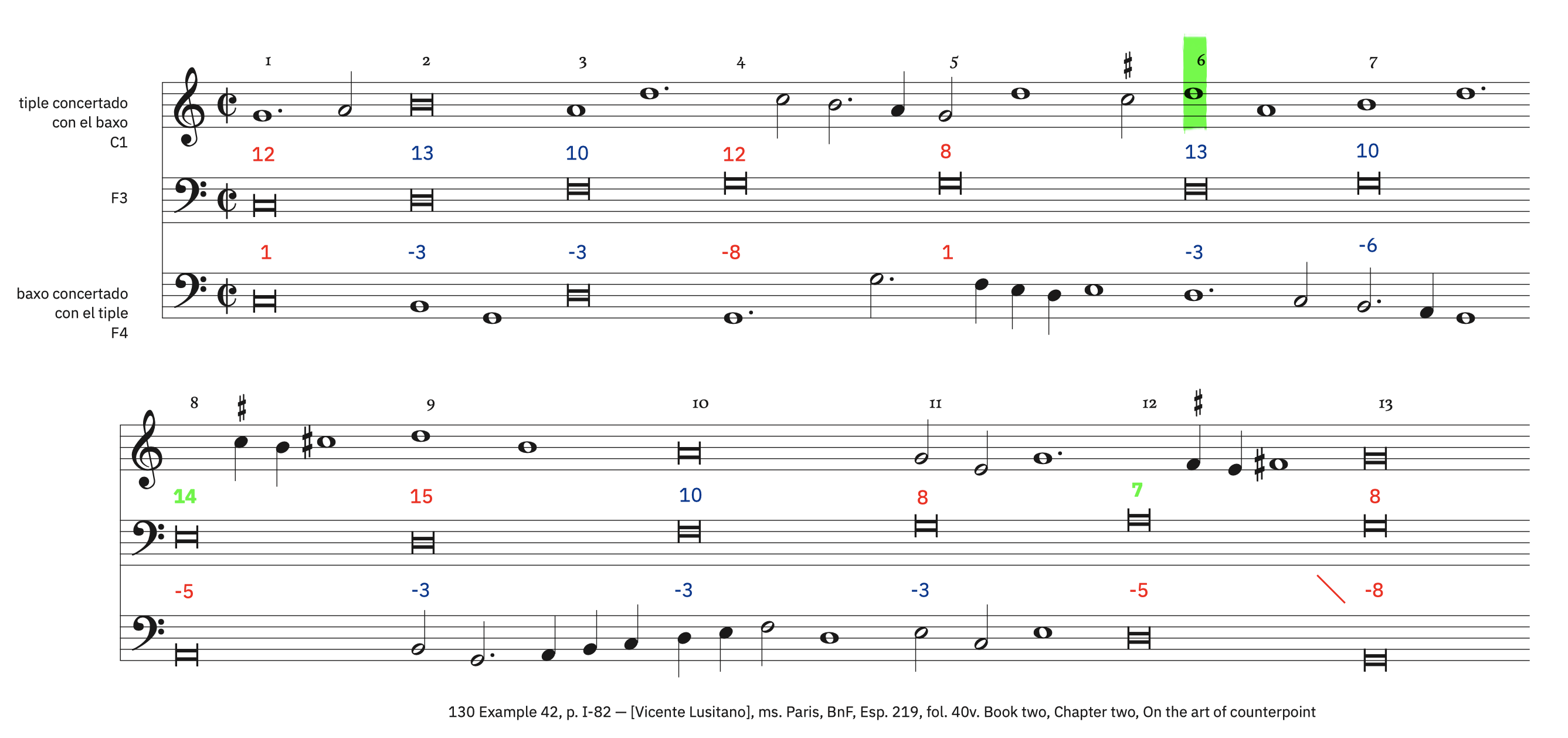
Es de notar que quando el baxo da dos terçeras en baxo del canto llano, el tiple puede [dar] una onzena sobre el canto llano, y con la otra dezena o trezena, o si mas quisiere, puede hazer la clausula con el baxo de quinzena y con el canto llano de sexta, como se hizo sobre el sexto punto de canto llano.
[Marg. Concierto de alto y baxo]
Este mismo modo tienen alto y baxo, excepto que lo que el tiple haze en alto, el contralto lo haze en octava en baxo; y aon en las partes que el baxo da quinta para hazer clausula, el alto da quarta con el canto llano y octava con el baxo, aonque puede hazer clausula de unisonus o de octava con el canto llano.[^**] Mas venir en quarta con el canto llano es para cantar a quatro, como se vera adelante. Mas veamos como el alto y baxo se conçiertan con un exemplo.
[Ex. 43]
It should be noted that when the bass makes two thirds below the plainchant, the soprano may [do] an eleventh on the plainchant, and on the second third a tenth or thirteenth, or else the cadence at a fifteenth above the bass and a sixth above the plainchant, as shown above at the sixth note of the plainchant.
[Marg. Concerted alto and bass]
The alto and bass work in the same way, except that what the soprano does in the treble, the alto does an octave lower; and when the bass makes a fifth to cadence, the alto makes a fourth with the plainchant and an octave with the bass, although it can make a unison or an octave with the plainchant to cadence.[^**] However, making a fourth with the plainchant [in the alto part] is for four-part singing, as we will see later. But let us see how the alto and the bass make a concerted counterpoint with an example.
[Ex. 43][^***]
Il faut remarquer que lorsque la basse chante deux tierces sous le plainchant, le soprano peut [faire] une onzième sur le plain-chant, puis une dixième ou une treizième, ou s’il préfère, il peut faire la cadence à une quinzième de la basse et à une sixte du plain-chant, comme on l’a fait ci-dessus à la sixième note du plain-chant.
[Marg. Concert d’alto et basse]
L’alto et la basse fonctionnent de la même manière, excepté que ce que fait le soprano dans l’aigu, l’alto le fait une octave plus bas ; et encore, lorsque la basse fait une quinte pour cadencer, l’alto fait une quarte avec le plain-chant et une octave avec la basse, bien qu’il puisse faire un unisson ou une octave avec le plain-chant pour cadencer. Cependant, comme on le verra plus loin, c’est dans le chant à quatre que l’on arrive sur une quarte avec le plain-chant. Mais voyons comment l’alto et la basse concertent, avec un exemple.
[Ex. 43]
[^*]: [The chosen spot for the addition of a comma to the unpunctuated original Spanish text in the modern transcription (see Canguilhem 2013, p. 217) slightly alters what I believe is the correct reading of this passage. I read this passage as a reference to the overall effect or sonority, instead of to a specific problem in the bass line. I would therefore add the comma after entricado el baxo[,] instead of entricado[,] el baxo. That would, in turn, require to modify the French translation (« si elle était très diminuée et complexe, la voix de basse ne respecterait pas la sonorité qui convient ») to « si la voix de basse était très diminuée et complexe, la sonorité qui convient ne serait pas obtenue ».—Tr.]
[^**]: [This highlighted passage is missing in the French translation (see Canguilhem 2013, p. 218). It has been tentatively added above, also highlighted.—Tr.]
[^***]: [Only the plainchant melody is notated at the bottom of folio 40v in the manuscript. For this reason, it is only shown here on the next page (folio 41r), as part of the three-voice example.—Tr.]