fol. 40r
Book two, chapter two: On concerted counterpoint
onzena puede ser sexta y luego quinta y venir a la clausula. La qual sexta es mejor que si fuese quarta con el canto llano y octava con el tiple, aonque uno y otro se puede dar. Mas dezimos ser mejor, por que es buena con el canto lla[no] y con el tiple, y, si ansi no fuese, seria la falsa doblada, como en el antepasado canto se muestra. Mas con la sexta fue visto antes, en la primera manera de conçertado, a la undecima figura del canto llano, ut supra.
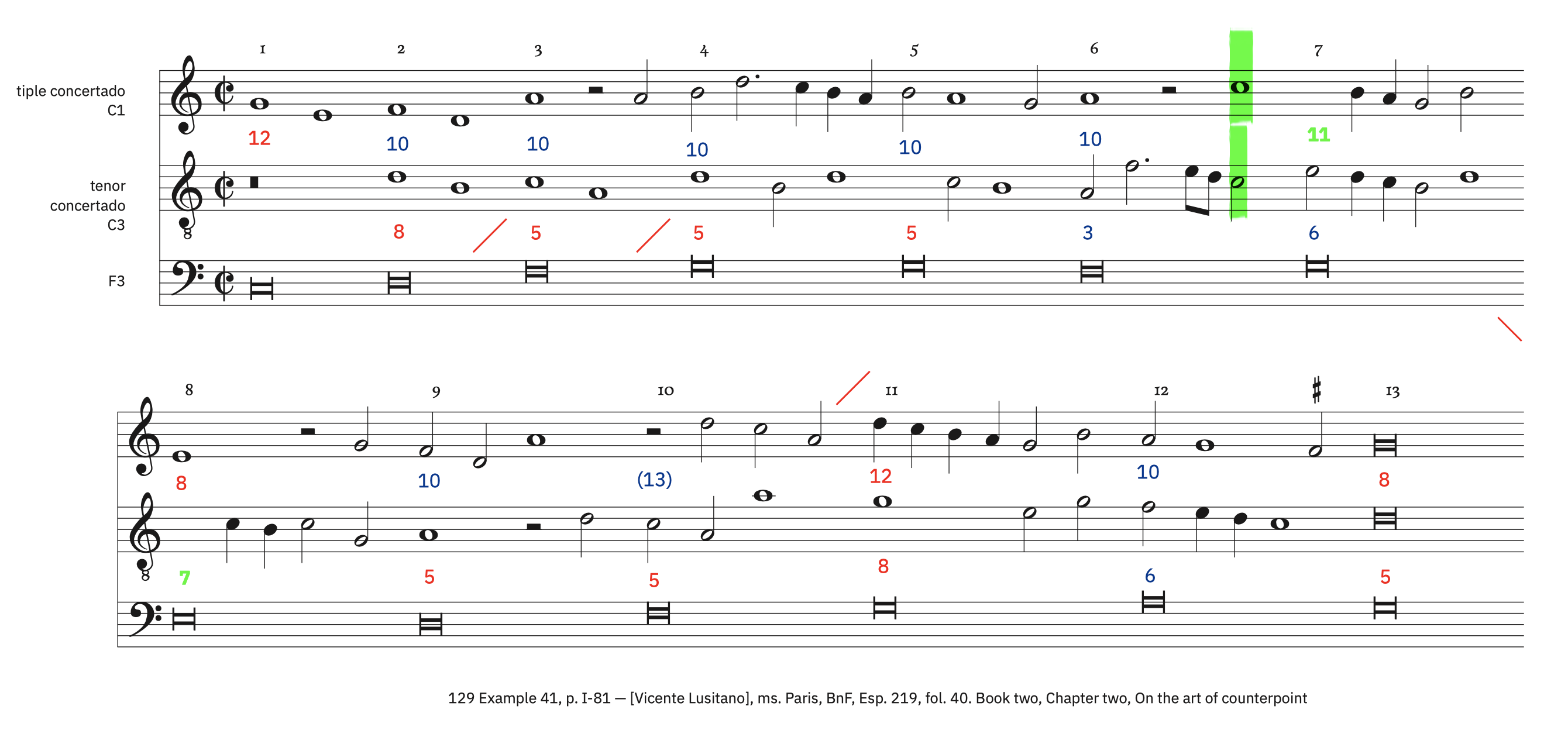
Este mismo conçierto de tiple y tenor puede hazer el canto mas fugado y artificioso, segun pareçe abaxo.
[Ex. 41] Exemplo
eleventh can be a sixth and then a fifth and come to the cadence; such sixth on the plainchant is better than a fourth, which would give an octave with the soprano, although both are possible. But we say that the sixth is better, because it is good with the plainchant and the soprano, and if it were not so, the dissonance would be doubled, as shown in the penultimate example. This was seen with the sixth before, in the first example of concerted counterpoint, on the eleventh note of the plainchant, ut supra.
This same concerted soprano and tenor [example] can be more abundant in fugues and more elaborate, as shown below.
[Ex. 41] Example
onzième peut être une sixte puis une quinte, et venir à la cadence ; il vaut mieux faire ici une sixte qu’une quarte avec le plain-chant, qui donnerait une octave avec le soprano, bien que les deux soient possibles. Mais nous disons que la sixte est meilleure, car elle est bonne avec le plain-chant et le soprano, et s’il n’en n’était pas ainsi, la dissonance serait doublée, comme on le montre dans l’avant-dernier exemple. On l’a vu avec la sixte auparavant, dans la première manière de contrepoint concerté, sur la onzième note du plain-chant.
Ce même concert de soprano et de ténor peut faire un chant plus fugué et plus élaboré, comme on le voit ci-dessous.
[Ex. 41] Exemple
El tiple y el baxo pueden hazer conçertado y es dilicada manera de conçertado mas difiçil. Mas veamos en que manera se conçertaran, i lo que deven huir y lo que segir, para que con mas osadia se cante. Paro lo qual es de notar que si el baxo tomare unisonus o 3ª o 5ª o 8ª de baxo del canto llano, o 3ª o 5ª sobre el canto llano, el tiple podra dar octava con todas ellas; mas con la quinta y 3ª en rriba del canto llano, podra dar dezena, dozena y octava; y con la 3ª [y 5ª: borrado] en baxo, podra dar octava, dezena, trezena; y con la 5ª [y 6ª] en baxo, podra dar octava, onzena, trezena; y con la octava en baxo podra dar octava, dezena, dozena.
Esto que aqui es dicho, que podra dar el tiple, se entiende con el canto llano, y nota que no dara quinta sobre el canto llano, salvo quando el baxo diere octava debaxo o sexta o 3ª en [f. 40v] alto.
Soprano and bass can make a concerted counterpoint, which is a delicate type of concerted counterpoint, but also a difficult one. But let us see how they can proceed, what they must avoid and what they must follow to be able to sing more boldly. For this, it should be noted that if the bass makes a unison, a third, a fifth or an octave below the plainchant, or a third or a fifth over the plainchant, the soprano can make an octave to all these notes; but with the fifth and the third above the plainchant, it can [also] make a tenth, a twelfth, and an octave; with the third [deleted: and fifth] below the plainchant, it can make an octave, a tenth, and a thirteenth; with the fifth [and sixth] below the plainchant, it can make an octave, an eleventh, and a thirteenth; and with the octave below [the plainchant] it can make an octave, a tenth, or a twelfth.
What has been said here about what the soprano can do, must be understood in relation to the plainchant, and note that the soprano will not make a fifth on the plainchant, except when the bass is an octave below, or a sixth or a third [f. 40v] above.
Le soprano et la basse peuvent faire un contrepoint concerté, qui est une manière délicate de procéder, mais difficile. Mais voyons de quelle manière ils concerteront, ce qu’ils doivent fuir et ce qu’ils doivent suivre afin de pouvoir chanter plus hardiment. Pour cela, il faut remarquer que si la basse fait un unisson, une tierce, une quinte ou une octave sous le plain-chant, ou une tierce ou une quinte sur le plain-chant, le soprano pourra faire une octave avec toutes ces notes ; mais avec la quinte et la tierce au dessus du plain-chant, il pourra faire une dixième, une douzième et une octave ; avec la tierce sous le plain-chant, il pourra faire une octave, une dixième, et une treizième ; et avec la quinte [et la sixte] sous le plainchant, il pourra faire une octave, une onzième et une treizième ; et avec l’octave inférieure, il pourra faire une octave, une dixième ou une douzième.
Ce qui est dit ici doit être compris en fonction du plain-chant, et remarquez que le soprano ne fera pas de quinte sur le plain-chant, sauf quand la basse fera une octave au-dessous ou une sixte, ou une tierce [f. 40v] au-dessus.