fol. 39v
Book two, chapter two: On concerted counterpoint
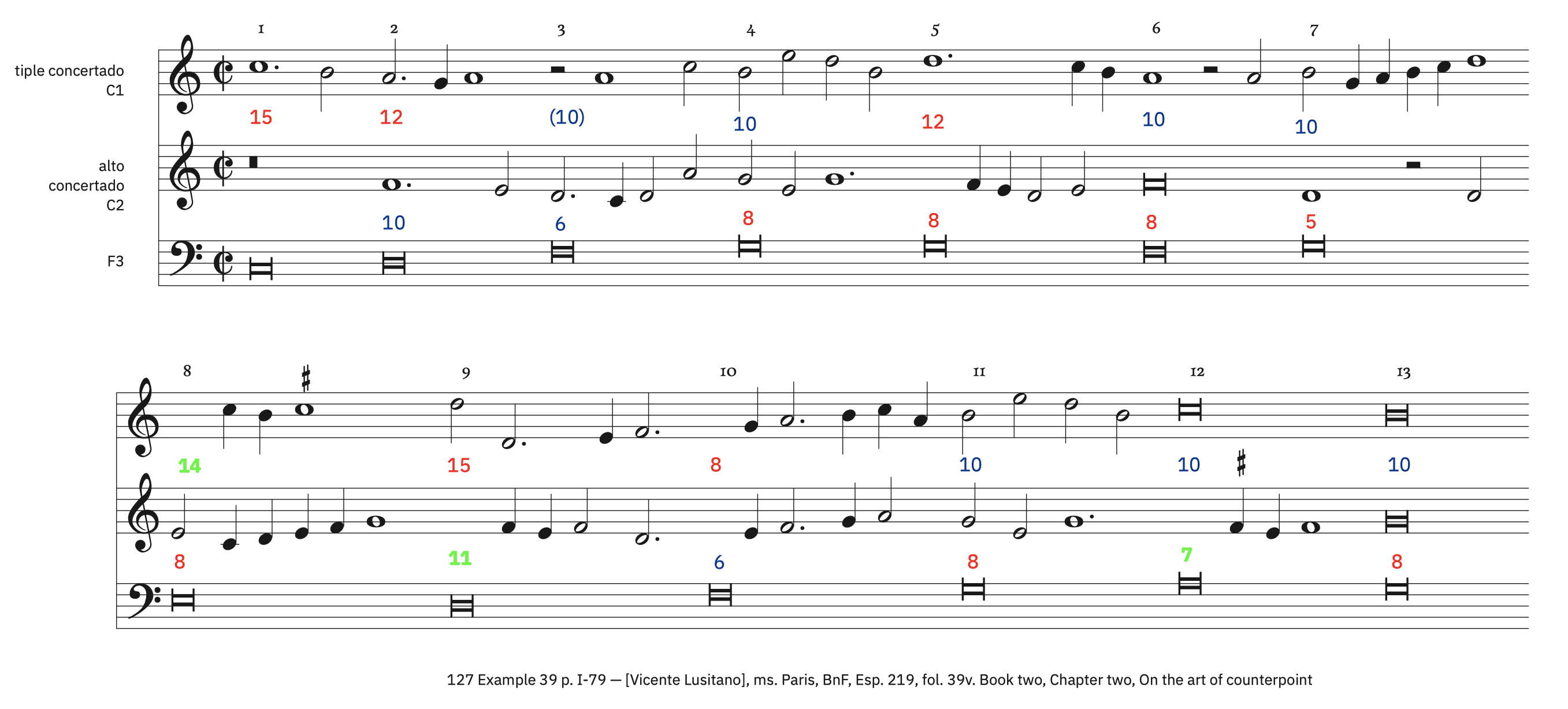
Mas artificioso se puede echar el conçertado usando de mas ymitaciones, como se veera abaxo.
[Ex. 39] Exemplo
We can make a more elaborate concerted counterpoint by using more imitations, as shown below.
[Ex. 39] Example
On peut faire un contrepoint concerté plus élaboré en utilisant plus d’imitations, comme on le voit ci-dessous.
[Ex. 39] Exemple
[Marg. Nota]
Nota que quanto el contrapunto concertado fuere mas llano y ymitado, tanto meior por que las ymitaciones entonçe avran mas suavidad.
[Marg. Conçierto de tiple y tenor]
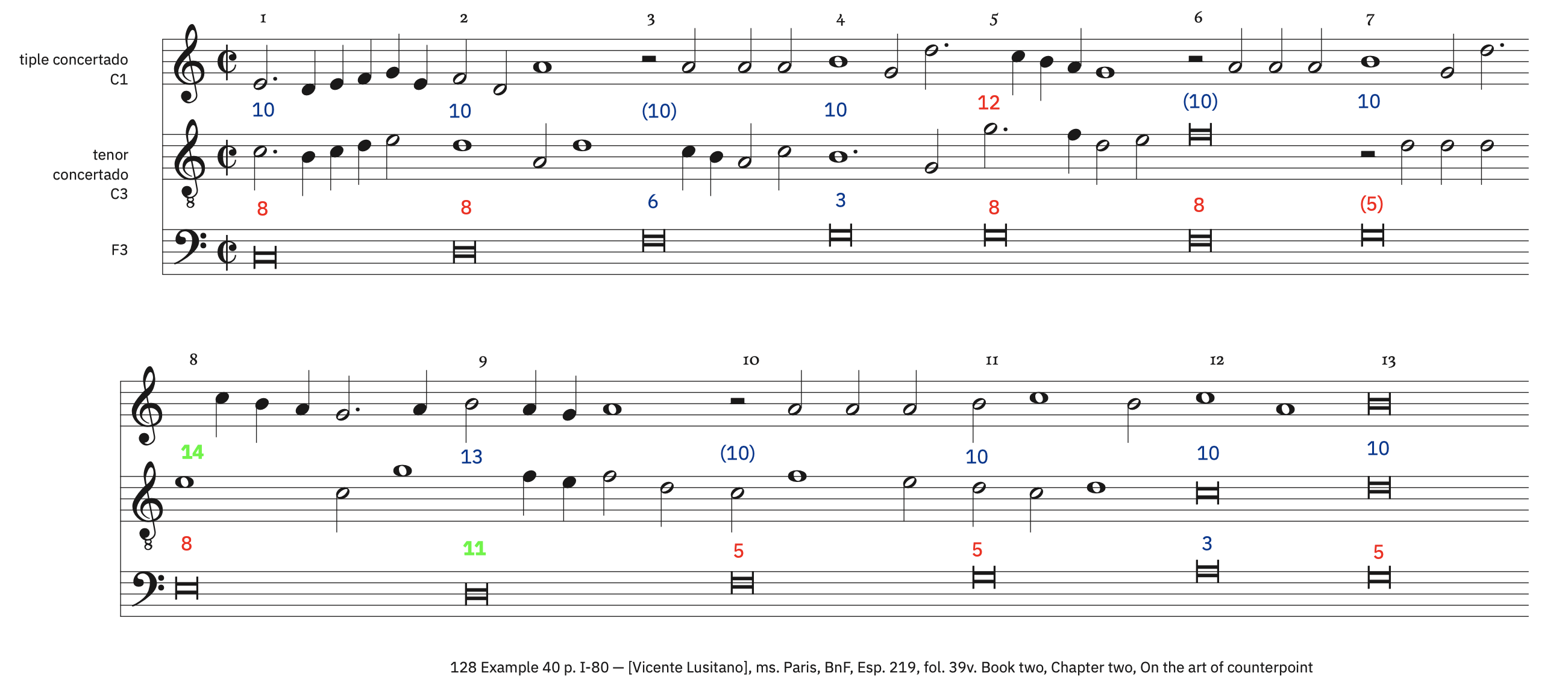
El concertado de tiple y tenor quasi es semejante al de alto y tiple, excepto que no dara dos sextas, o quasi ninguna vez, [ni] dara dos terçeras, por que seran dos octavas con el tiple. Mas andara con quintas, octavas, terçeras. Esto se entiende en el principio del conpas, ca las otras pueden ser yndiferentes.
[Ex. 40] Exemplo
[Marg. Note]
Note that the more concerted counterpoint is plain and abundant in imitations, so much better it will be because the imitations will emerge more smoothly.
[Marg. Concerted soprano and tenor]
The concerted counterpoint of soprano and tenor almost resembles that of alto and soprano, except that it is not possible to make two consecutive sixths, or hardly ever, [nor] two thirds, because it will make two octaves with the soprano. But fifths, octaves and thirds will work. Note that this only affects the beginning of the beat; the rest of consonances can be any other.
[Ex. 40] Example
[ Marg. Note]
Remarquez que plus le contrepoint concerté sera simple et imité, meilleur il sera, parce qu’alors, les imitations seront plus suaves.
[ Marg. Concert de soprano et ténor]
Le contrepoint concerté de soprano et ténor ressemble presque à celui d’alto et soprano, mis à part que l’on ne pourra presque jamais faire deux sixtes, [ni] deux tierces, parce que cela fera deux octaves avec le soprano, mais on ira en quintes, octaves et tierces au début de la battue ; les autres consonances peuvent être indifférentes.
[Ex. 40] Exemple
Nota que si el tenor da clausula de octava con el tiple, dando el tiple onzena sobre el canto llano, la figura que viene con la primera [f. 40] onzena…
Note that if the tenor makes an octave cadence with the soprano, the soprano making an eleventh on the plainchant, the note that comes with the first [f. 40] eleventh…
Remarquez que si le ténor fait une cadence d’octave avec le soprano, celui-ci faisant une onzième sur le plain-chant, la note qui vient avec la première [f. 40] onzième…