fol. 39r
Book two, chapter two: On concerted counterpoint
contrabaxo, y en otra tiple y contralto, aonque alguna conformidad an entre si, otra el tiple con el baxo y el canto llano por tenor, y en otra contralto y contrabaxo y en otro tenor y baxo, y en otra tiple, alto y tenor sobre el canto llano en boz baxa. Y aon lo que mas es dos bozes por baxo del canto llano, lo qual se dize sobre tiple, por que el tiple lleva el canto llano. Mas tres sobre el mismo canto en boz de tiple es mucho, lo qual mal se haze de inproviso, por que es como conpostura.
Y el aviso que en todo conçertado se deve tener [es] que despues de los pasos forçados y con ayre se de luego alguna clausula o antes della usen de algunas consonancias gruesas y luego la clausula que es refoçiliamento de la boz y descansa el oydo en la tal clausula.
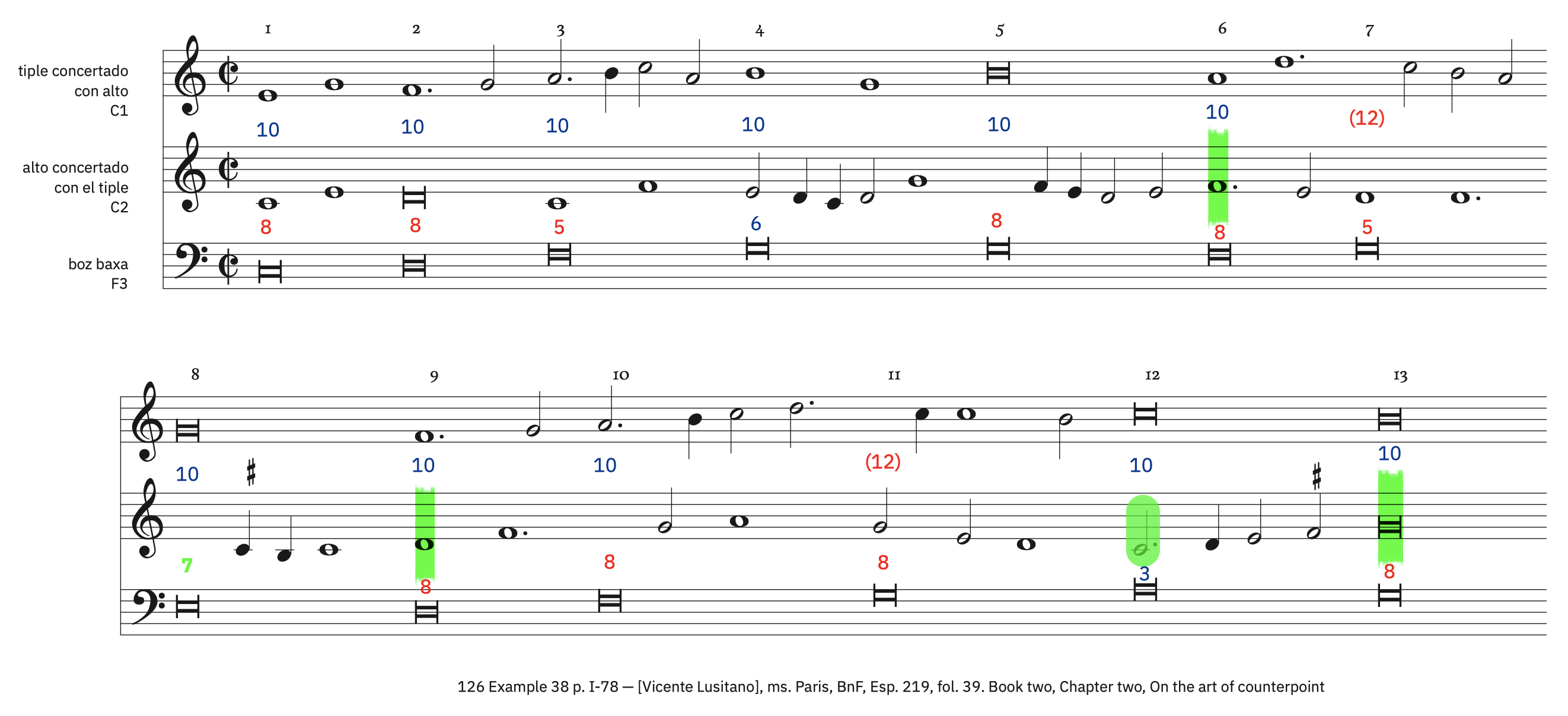
Exemplo de como se deven aver tiple y alto sobre el canto llano en boz baxa, guardando sienpre que el tiple siga las dezenas y sus clausulas y el alto las octavas, quintas con las mas species y haga clausulas de terçeras, como se vera en la dozena nota del canto fermo, y las de octava, como se vera en la 6ª y en la nona y en la trezena notas del canto llano, guardando enpero que el alto no de dos sextas con el canto llano, por que seran dos quintas con el tiple.
[Ex. 38] Exemplo [Conçierto de tiple y alto]
and another to make a soprano and an alto, although they have some points in common; [and there is] another way to make the soprano with the bass when the plainchant is in the tenor, another for alto and bass, and another for tenor and bass; and yet another to make a soprano, alto and tenor parts when the plainchant is written in the bass part.[^*] Finally, we can have two lower voices under the plainchant, which is called “on the soprano,” because it is the soprano part that carries the plainchant. But three voices on the same plainchant in the soprano is a lot and it is not done well when improvising because it is rather like a composition.
Notice that whenever you do concerted counterpoint, you must either make a cadence right after ostinato and graceful motives, or use some consonances in long values before it, and just afterwards one must do the cadence, which is delightful for the voice and a rest for the ear.
Example that shows how to make a soprano and an alto line on the plainchant in the bass voice, taking care that the soprano moves always in tenths and follows its cadences, and the alto moves in octaves, fifths, and other intervals, and that it has both the thirds in the cadences, as can be seen in the twelfth note of the plainchant, and the octave, as shown in the sixth, ninth, and thirteenth notes of the plainchant. But one must be careful that the alto does not make two consecutive sixths with the plainchant, because that would make two fifths with the soprano.
[Ex. 38] Example [Concerted soprano and alto]
la basse, et une autre pour faire un soprano et un alto, bien qu’elles aient des points communs ; une autre pour faire le soprano avec la basse lorsque le plain-chant est au ténor, une pour faire l’alto et la basse, une encore pour faire le ténor et la basse ; une autre pour faire le soprano, l’alto et le ténor sur le plain-chant à la voix de basse ; et enfin, on peut avoir deux voix inférieures sous le plain-chant, ce qu’on appelle « sur le soprano », car c’est le soprano qui chante le plain-chant. En revanche, trois voix sur le même plain-chant au soprano, cela fait beaucoup et cela se fait mal à l’improviste parce que c’est comme une composition.
Et le conseil qu’on peut donner pour tout contrepoint concerté est qu’après les motifs obstinés et les belles formules mélodiques, on utilisera certaines consonances en valeurs longues après une cadence ou avant celle-ci, et juste après on fera la cadence, qui est une satisfaction pour la voix et un repos pour l’oreille.
Exemple qui montre comment on doit avoir un soprano et un alto sur le plainchant à la voix de basse, en faisant attention à ce que le soprano ait toujours des dixièmes et ses cadences, et l’alto des octaves, des quintes, et d’autres intervalles, et qu’il fasse des cadences de tierces comme on le verra dans la douzième note du plain-chant, et des cadences d’octave comme on le verra dans les sixième, neuvième et treizième notes du plain-chant. Mais il faut faire attention à ce que l’alto ne fasse pas deux sixtes consécutives avec le plain-chant, parce que cela ferait deux quintes avec le soprano.
[Ex. 38] Exemple [Concert de soprano et alto]
Las dos clausulas hechas en fefaut y dsolre son del modo; la 3ª y 4ª, scilicet en csolfaut y gsolreut son del octavo, aonque la quarta pueda ser del mismo modo, scilicet del primero.
The two cadences made in fefaut and dsolre belong to the plainchant mode; the third in csolfaut and the fourth in gsolreut belong to the eighth mode, although the fourth may be in the same mode, i.e., the first.
Les deux cadences faites en f faut et d solre appartiennent au mode du plainchant ; la troisième en c solfaut et la quatrième en g solreut appartiennent au huitième mode, bien que la quatrième puisse être du même mode, à savoir du premier.
[^*]: [Due to the complexity of the original text, it may be useful to check another translation of this paragraph: “The third thing they need to know is with what voices they will sing contrapunto concertado, because it is one thing to perform a soprano and tenor line on a plainchant written in the bass, and another to make a soprano and alto line, although they have points in common; and another to make the soprano and bass on a tenor plainchant, another to make the alto and bass, another to make the tenor and the bass; yet another to make the soprano, alto and tenor upon a chant in the bass.” From Canguilhem 2011, p. 81.—Tr.]