fol. 45v
Book two, chapter three: On canons
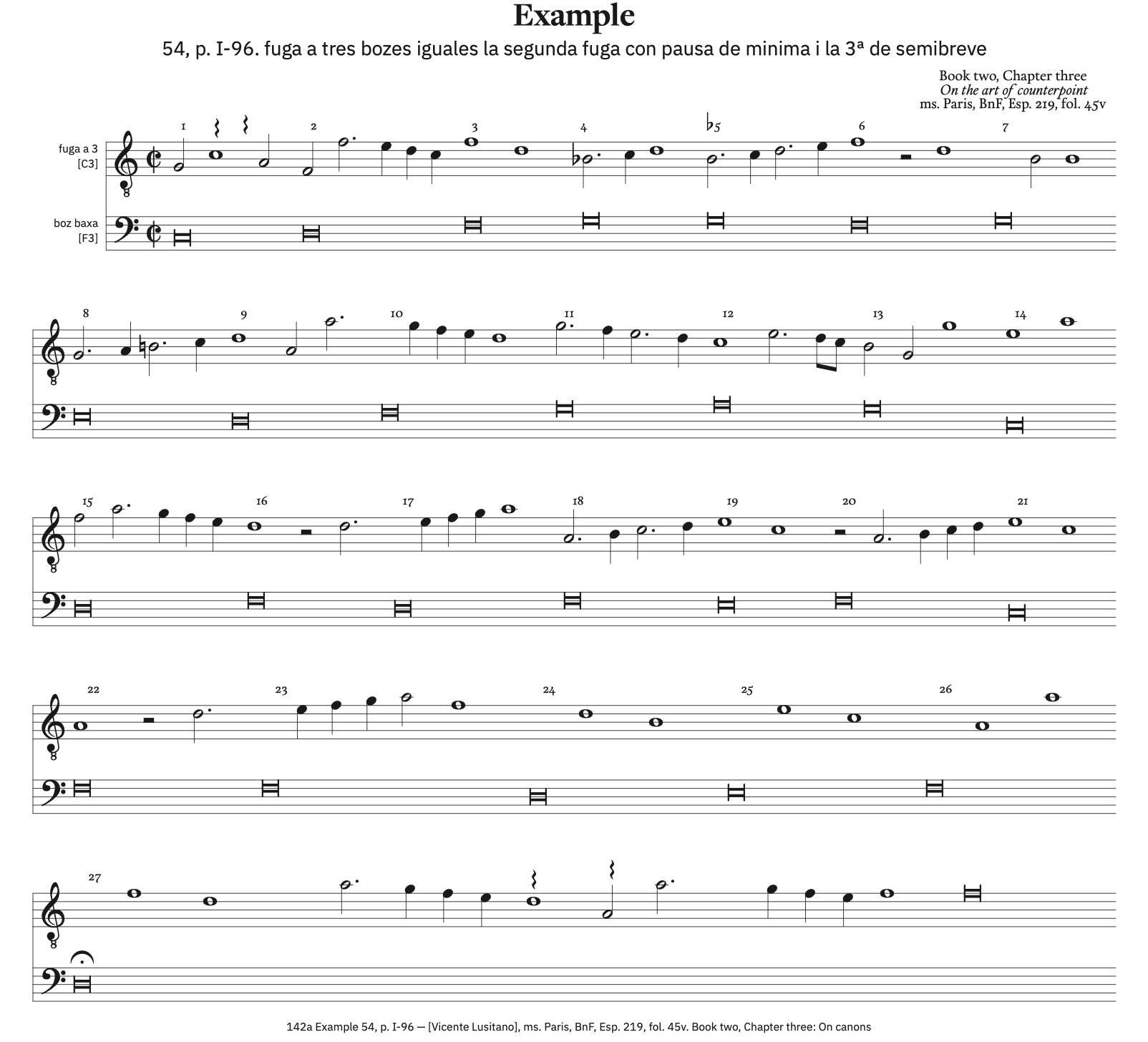
Si quisieremos hazer esta fuga a tres [con pausa de minima en la 2ª boz], devemos guardar que todos los semibreves y minimas sean buenas, por que la minima, que podra ser conpasible a la primera y terçera boz, sera mala a la segunda, por que, si la segunda y quarta minima son conpasibles a la primera y 3ª boz, a la segunda vienen a ser primera y terçera, las quales no son conpasibles a ninguna; mas el modo de la hazer es el siguiente:
[Ex. 54] Exemplo [Marg. Fuga a 3]
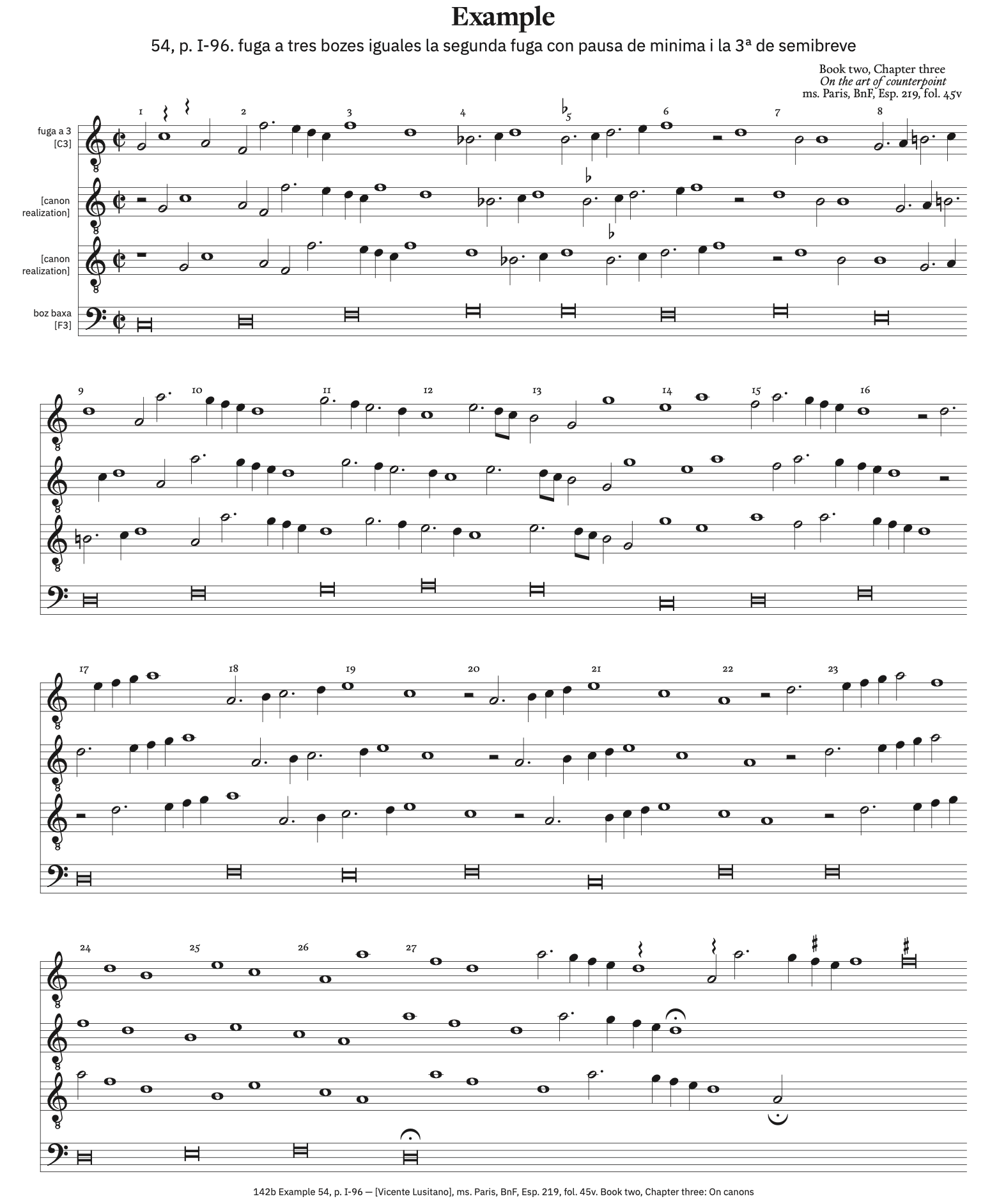
If we want to make this canon in three voices [with a minim rest in the second voice], we must make sure that all semibreves and minims are consonant because the minim that may be consonant with the first and the third voices will be dissonant with the second; for if the second and fourth minims are consonant with the first and the third voices, they will become the first and third minims in the second voice, and these are not consonant with any voice. The procedure is as follows:
[Ex. 54] Example [Marg. Three-voice canon]
Si nous voulons faire ce canon à trois voix [avec un silence de minime à la deuxième voix], nous devons veiller à ce que toutes les semi-brèves et les minimes soient consonantes, parce que la minime qui pourra être consonante avec la première et la troisième voix sera dissonante avec la deuxième; car si la deuxième et la quatrième minimes sont consonantes entre la première et la troisième voix, elles deviennent première et troisième minime dans la deuxième voix, et celles-ci ne sont consonantes avec aucune voix. La façon de procéder est la suivante :
[Ex. 54] Exemple [Marg. Canon à trois voix]
142 Ex. 54[^*]
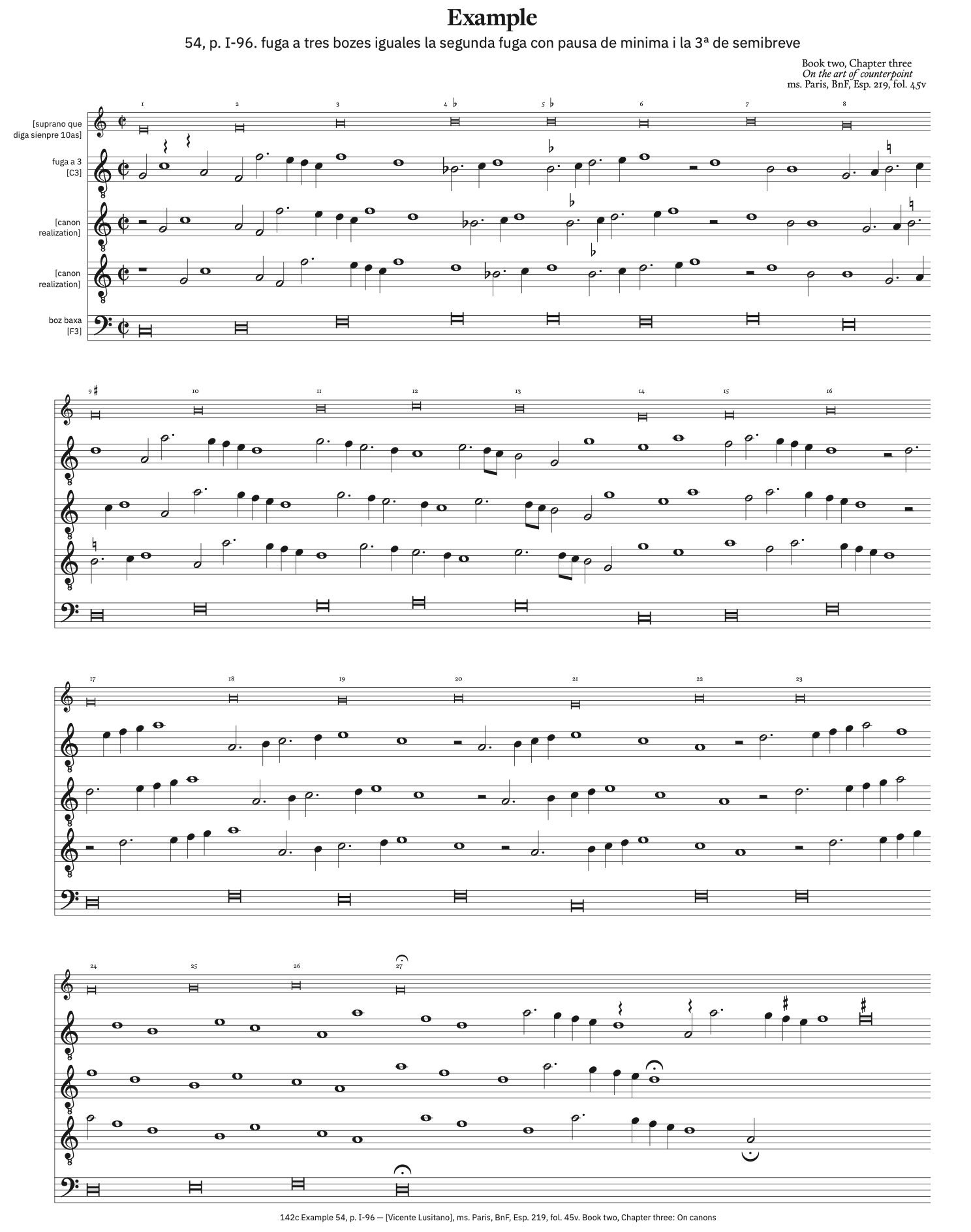
Esta fuga se puede hazer a cinquo si juntaren a las sobredichas quatro un suprano [sic] que diga sienpre dezenas, mas deve guardar el que haze la fuga que no de dos dezenas con el canto llano, por que seran dos unisonus con el tiple; en todas las otras cosas puede estar seguro que no dara mala alguna con el.
En dyatesaron se pueden hazer fugas [en tres] maneras [borrado: en dos], scilicet con pausa de breve y de semibreve y de minima; mas por ser trabajosa la de minima no es tanto en uso.
[Ex. 55a] Exemplo[^**]
This canon can be made in five parts if one adds a soprano part, always making tenths, to the previous four; but the one who makes the canon must be careful not to make two [consecutive] tenths with the plainchant, because that will produce two unisons with the soprano; in any other case, they can be sure that they will not make any dissonance with it.
Canons at the fourth can be made in [three] [strikethrough: two] ways, i.e., with a breve, semibreve, or minim rest, but as it is laborious the minim rest is little used.
[Ex. 55a] Example[^**]
Ce canon peut se faire à cinq parties si l’on ajoute aux quatre précédentes un soprano qui chante toujours des dixièmes, mais celui qui fait le canon doit veiller à ne pas faire deux dixièmes avec le plain-chant, parce que cela fera deux unissons avec le soprano ; dans tous les autres cas, il peut être sûr qu’il ne fera aucune dissonance avec lui.
On peut faire des canons à la quarte de [trois] [biffé: deux] manières, à savoir avec un silence de brève, de semi-brève ou de minime, mais la minime s’utilise peu, car elle est laborieuse.
[Ex. 55a] Exemple[^**]
[^*]: [See below for two additional versions of Example 54: 142b Example 54 displays the canon resolution; written in five parts, 142c Example 54 includes Lusitano’s suggestion regarding the addition of a soprano part always making tenths—Tr.]
142 Ex. 54
Example 142c
[^**]: [Only the plainchant melody is notated at the bottom of folio 45v in the manuscript. For this reason, it appears here on the next page (folio 46r) as part of the three-voice example.—Tr.]