fol. 30r
Book two, chapter one: On the art of counterpoint
…por que el numero sotopuesto declara las figuras pasadas; el sobrepuesto denotara las por venir. Y desta manera las proporciones seran faciles de entender quando con numeros se mostraran las figuras que an de pasar en un conpas].
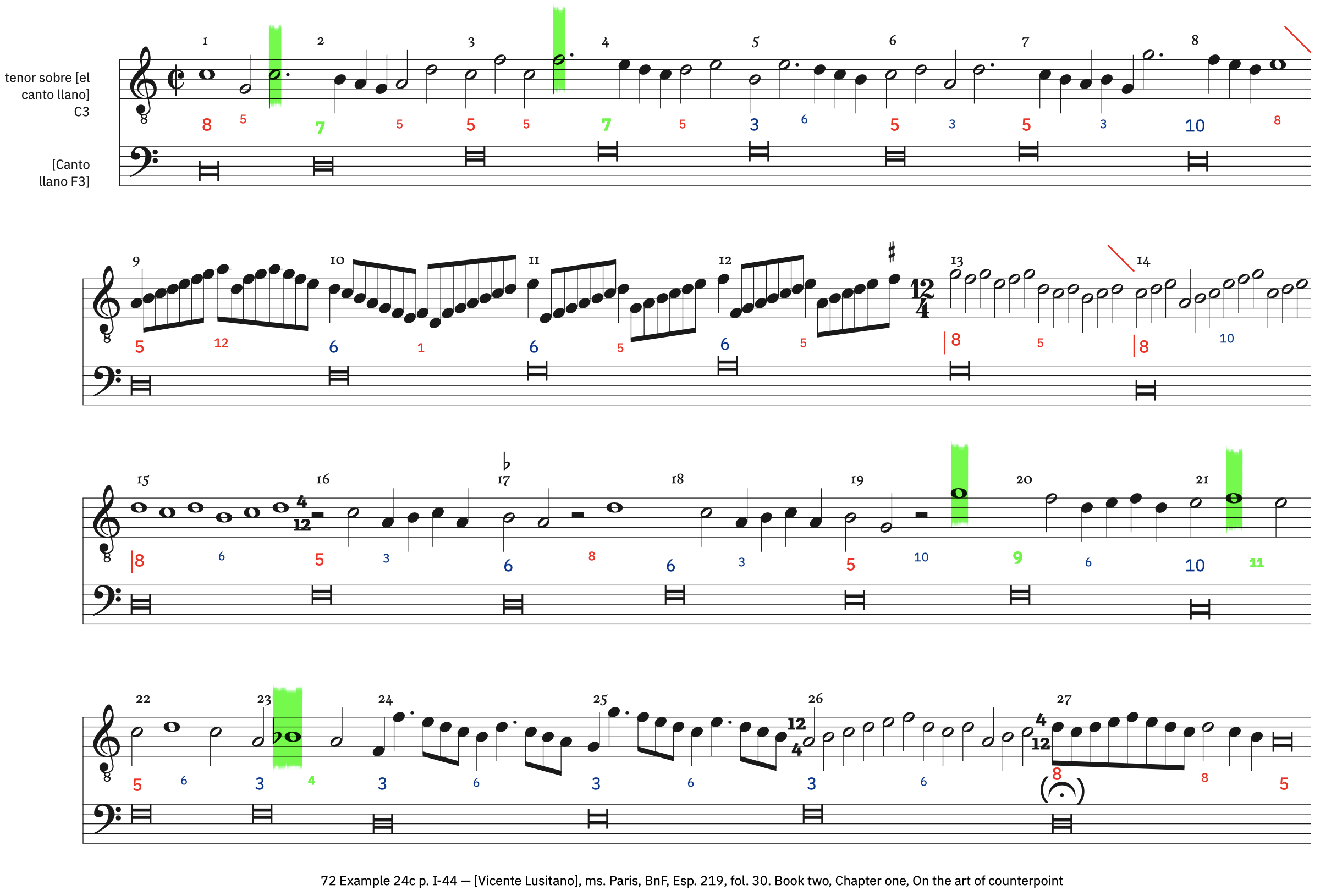
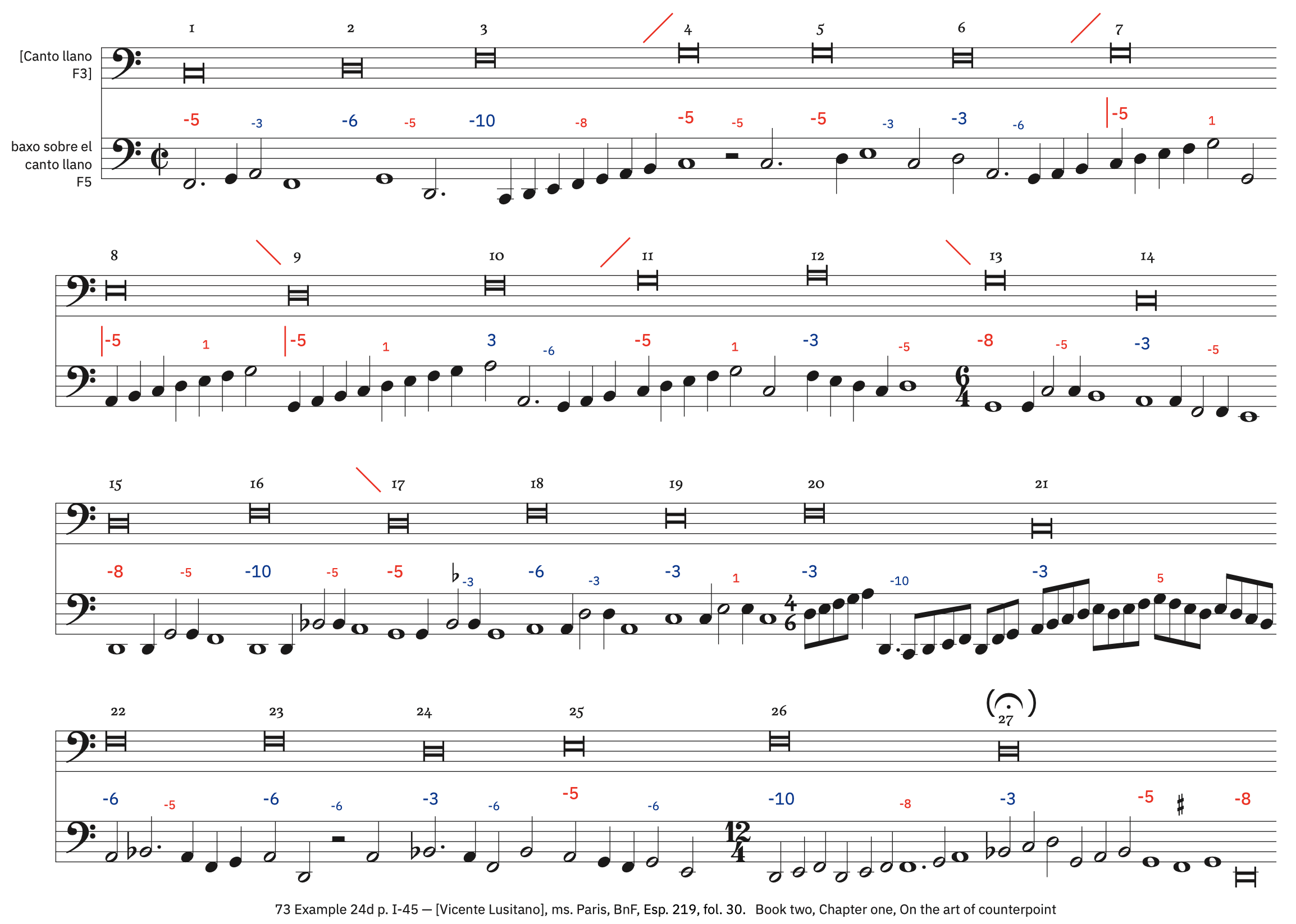
[Ex. 24c-d]
…because the denominator refers to the previous number of notes per measure, and the numerator refers to the next. And in this way, proportions will be easy to understand by showing with numbers the number of figures that must be placed within a measure].
[Ex. 24c-d]
…car le dénominateur désigne les notes précédentes, et le numérateur les notes à venir. Et de cette façon, les proportions seront faciles à comprendre quand on montrera à l’aide de chiffres les figures de notes qui doivent passer dans une mesure].
[Ex. 24c-d]
Llaman los musicos paso forçado quando sienpre se dize [f. 30v] un paso…
Musicians call ostinato motive the constant repetition of [f. 30v] a motive…
Les musiciens appellent motif obstiné le fait de toujours prononcer [f. 30v] un motif…
[^*]: [As in previous cases (see folios 18v, 19, 21, and 22v), the characteristics of this note’s handwriting suggest it is a later addition. In addition, the different colours of ink and the varying thickness of the stroke suggest this note could be divide into two parts: first, starting at the bottom of folio 29v, from “La rrazon - The reason is” until “exemplos infra puestos - the examples below;” second, from “Y aon Jusquin en la Missa di dadi - Also in Josquin’s Missa di dadi” until “que an de pasar en un conpas - that must be placed within a measure” at the top part of folio 30.—Tr.]