fol. 56v
Book two, chapter four: Counterpoint on mensural music
Exemplo de como se echara una terçera boz en baxo, en la qual se puede hazer todo lo sobre dicho.
ejemplo. tercera boz baxa sobre et resurexit de gomberth
Example: how to add a third voice in the bass part, in which you can do everything that has been said before.
Example. Third voice in the bass part upon Gombert’s Et resurrexit
Exemple qui montre comment chanter une troisième voix à la basse, dans laquelle on peut faire tout ce qui a été dit auparavant.
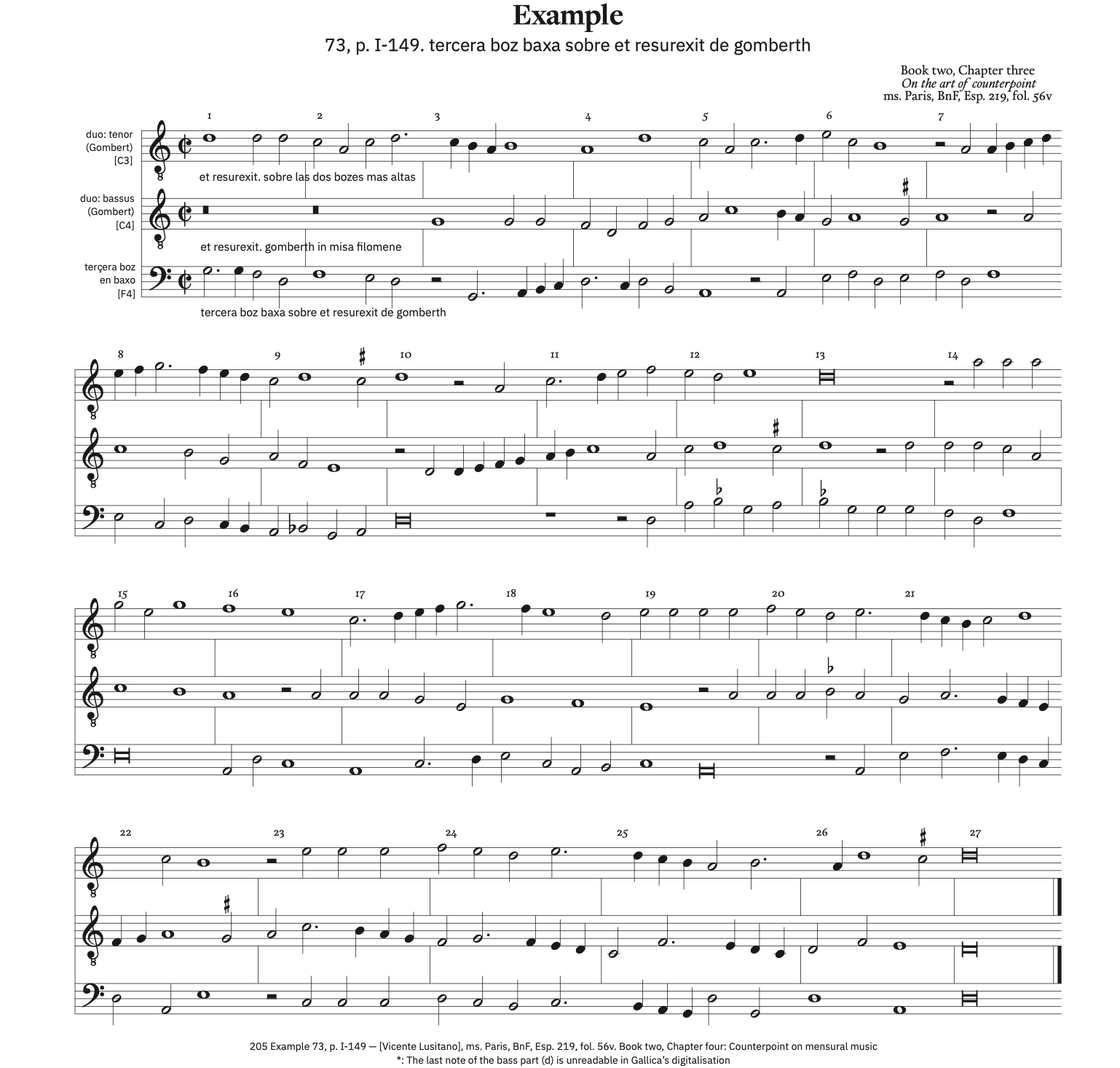
Si la boz que es echada de inproviso pudiere buenamente ymitar a las otras, develo de hazer; y si no, deve tomar algun paso, el qual deve replicar algunas vezes, segun que se mostro en las boxes arriba puestas sobre el duo, por que esta es la meior manera para cantar con graçia de inproviso.
Sobre tres bozes se puede echar una que sea quarta parte, y esta, si fuere en alto, o es contralto, tiple o tenor. Si tiple, usara de muchas dezenas con la boz mas baxa. Si contralto, de muchas octavas con algunas dezenas y quintas, de manera que a las clausulas venga hazer clausula de octava un punto antes de la clausula de la boz alta. Esto se entiende quando hazen la boz mas alta con la mas baxa clausula de quinzena con dezena antes de la clausula un punto, en el qual el contralto viene en octava con el baxo. Mas si fuere tenor la boz que se echa y las otras tres tiple, contralto y baxo, el tenor usara con el baxo de quintas, terceras y octavas, mas a las clausulas sobre dichas de quinzena, el tenor usara de quinta sobre el baxo, y luego octava con el baxo y tiple. Mas, si la quarta parte se echa en baxo, aqui no ay otro aviso que dar sino que la quarta parte deve ser avisado de guardar a todas las tres y aver grande oydo para los pasos que pueden responder y a las [f. 57] clausulas
If the improvised voice could easily imitate the others, it must do so; if not, it should take a melodic pattern and repeat it sometimes, as was shown above in the voices added to the duet, because this is the best way to sing with grace improvising.
Upon three voices, one voice can be added to make a fourth part, and if it is a high one, it could be an alto, a soprano, or a tenor. If it was a soprano, it should introduce many tenths with the lowest voice; if it was an alto, it should introduce many octaves [with the lowest voice] with some tenths and fifths, so that in cadences, it will cadence at the octave a note before the cadence of the highest voice. This applies in the case where the two extreme voices make a cadence on a fifteenth and a tenth one note before the cadence, on which the alto makes an octave with the bass. But if the improvised voice was a tenor part, and the other three were soprano, alto, and bass, then the tenor must introduce fifths, thirds, and octaves with the lowest voice, but on the above-mentioned cadences on a fifteenth, the tenor must make a fifth over the bass, and then an octave with the bass and soprano. But if the fourth voice is done in the lowest voice, there is no other advice to be given re the fourth voice than to pay attention to the other three voices and to have a sharp ear for the patterns that it can respond to and for the cadences
Si la voix qui est faite à l’improviste peut correctement imiter les autres, elle doit le faire ; sinon, elle doit prendre un motif mélodique qu’elle doit répéter plusieurs fois, comme cela a été montré dans les voix placées sur le duo, parce que c’est la meilleure manière de chanter à l’improviste avec grâce.
Sur trois voix, on peut en ajouter une qui servira de quatrième partie, et si elle est à l’aigu, elle pourra être un alto, un soprano ou un ténor. Si c’est un soprano, elle fera beaucoup de dixièmes avec la voix basse ; si c’est un contralto, beaucoup d’octaves avec la basse, avec quelques dixièmes et quelques quintes, de manière à ce que dans les cadences, elle vienne cadencer à l’octave une note avant la cadence de la voix supérieure. Ceci dans le cas où les deux voix extrêmes font une cadence de quinzième et de dixième une note avant la cadence, sur laquelle le contralto fait une octave avec la basse. Mais si la voix que l’on ajoute est un ténor, et les trois autres sont soprano, contralto et basse, le ténor fera des quintes, des tierces et des octaves avec la basse, mais sur les cadences susdites de quinzième, le ténor fera une quinte sur la basse, puis une octave avec la basse et le soprano. Mais si la quatrième voix se fait à la basse, il n’y a pas d’autre conseil à donner ici que de faire attention aux trois autres voix et de bien ouvrir les oreilles pour faire des motifs qui puissent leur répondre, et d’être attentif aux cadences