fol. 54v
Book two, chapter four: Counterpoint on mensural music
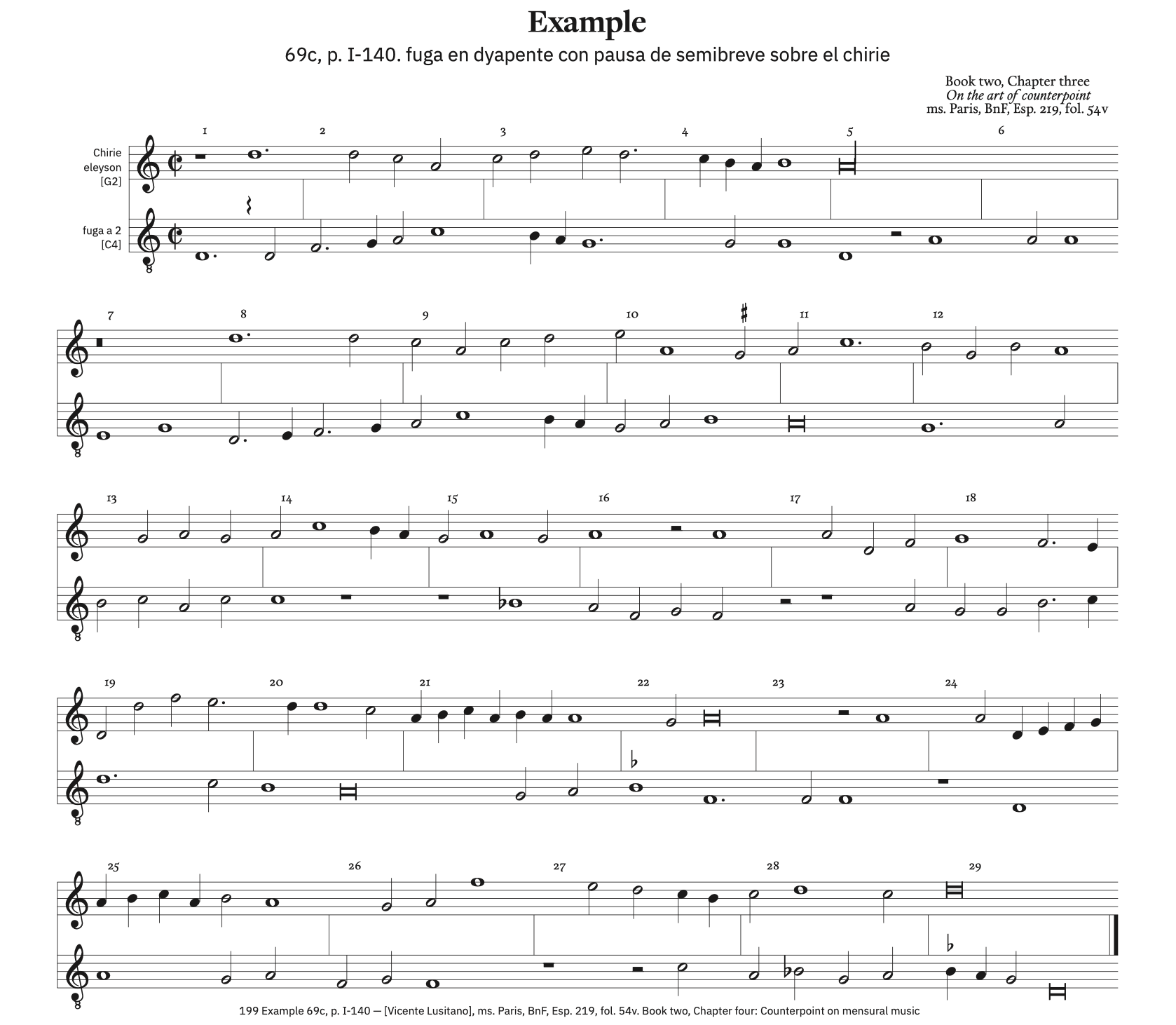
Fuga en diapente con pausa de semibreve, sobre el Chirie [Marg. fuga a 2]
Canon at the fifth above after a semibreve rest, on the Kyrie [Marg. canon a 2]
Canon à la quinte avec pause de semi-brève sur le Kyrie [ Marg. Canon à 2 voix]
199 Ex. 69c[^*]
[Marg. Notabile]
Puedese aon hazer una fuga en unisonus con pausa de minima y señalar un canto llano de breves o semibreves, de manera que sean quatro por todos, el qual canto llano se puede mostrar en arriba del canto de organo, o por la mano; mas por que no lo podemos en otra manera mostrar que escrito, se pondra aqui por exemplo.
Fuga en unisonus con pausa de minima sobre el Chirie y la boz de canto llano. [Marg. fuga a 2]
[Marg. Notable]
One can also make a canon at the unison after a minim rest and indicate a plainchant melody made of breves or semibreves, so that there are four voices in all, and this plainsong can be shown either above the mensural melody[^14], or on the hand. But since we can only show it here in writing, here is an example.
Canon at the unison after a minim rest on the Kyrie plus a plainchant melody [Marg. canon a 2]
[Marg. Notable]
On peut encore faire un canon à l’unisson avec une pause de minime et indiquer un plain-chant de brèves ou de semi-brèves, de façon à ce qu’il y ait quatre voix en tout, et ce plain-chant peut se montrer soit au-dessus du chant figuré[^14], soit avec la main, mais parce qu’on ne peut le montrer autrement que par écrit, en voici un exemple.
canon à l’unisson avec pause de minime sur le Kyrie avec la voix de plain-chant. [ Marg. Canon à 2 voix]
200 Ex. 70a[^*]
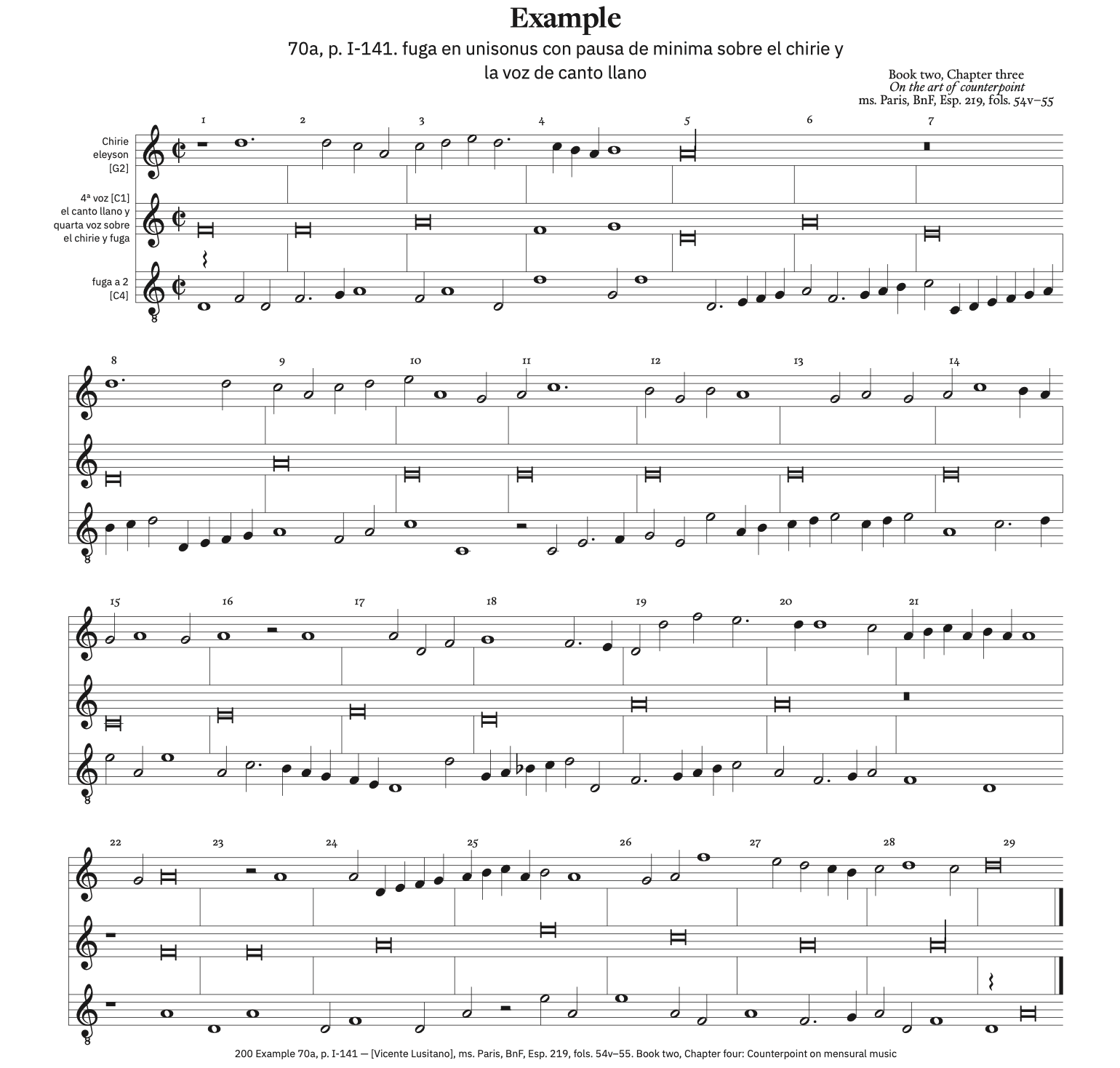
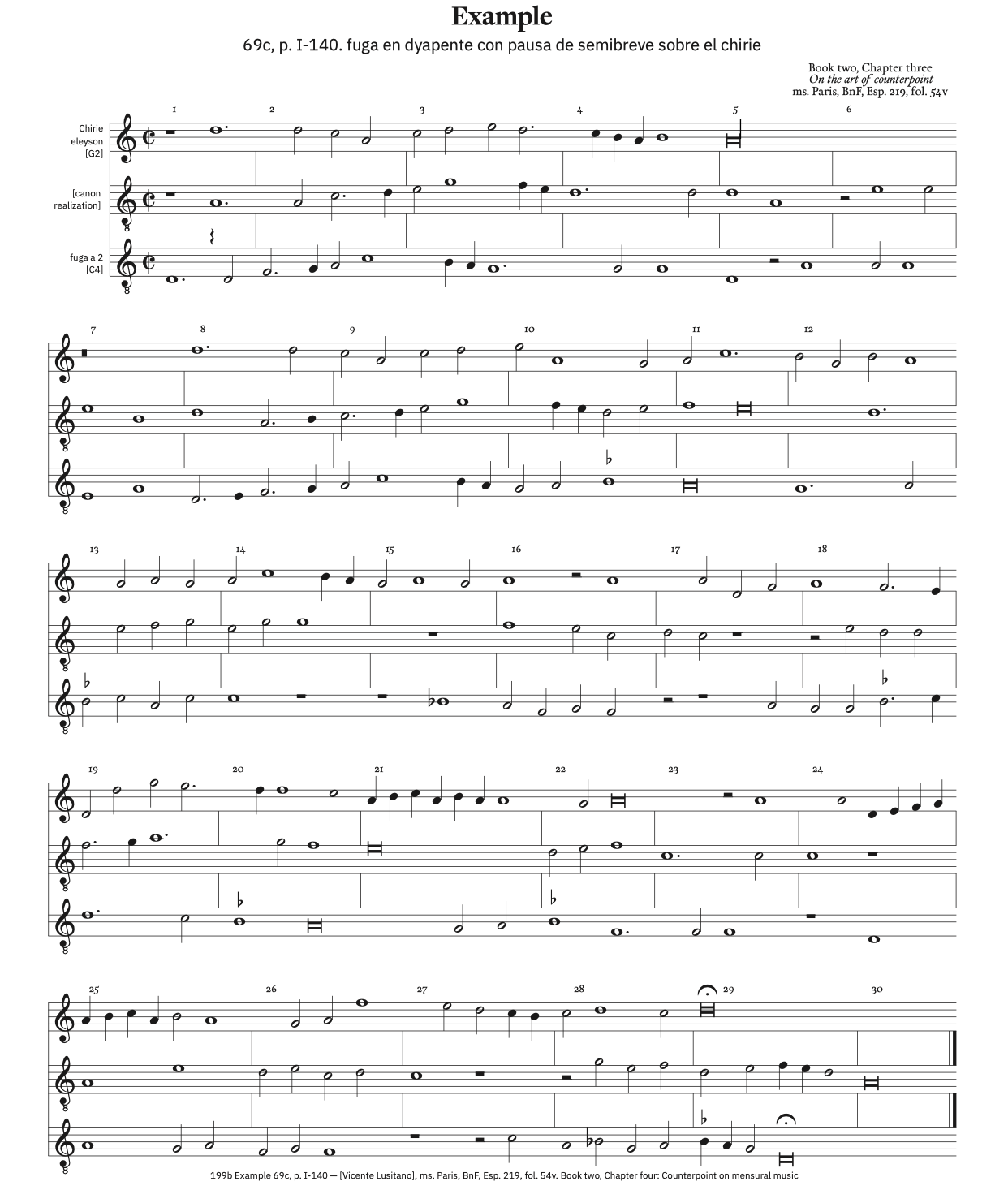
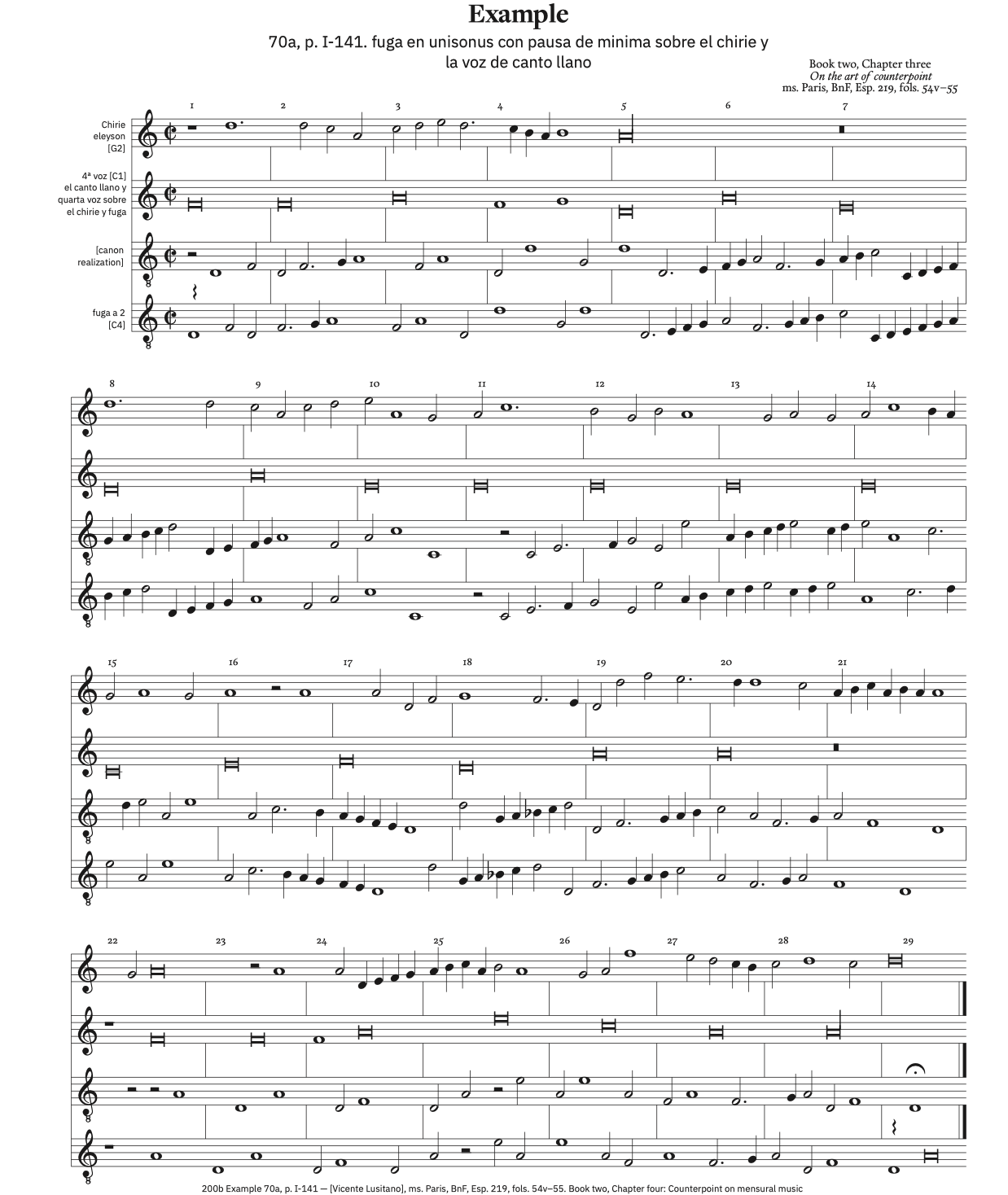
[^*]: [The plainchant melody (fourth voice) appears in the manuscript at the top of folio 55, but I have added it here to make the score complete. See below for another version of examples 69c and 70a with canon resolutions—Tr.]
[^14]: C’est-à-dire, sur la portée de la mélodie en chant figuré qui sert de référence. [That is, on the staff of the mensural melody that serves as a reference (my translation).—Tr.]