fol. 54r
Book two, chapter four: Counterpoint on mensural music
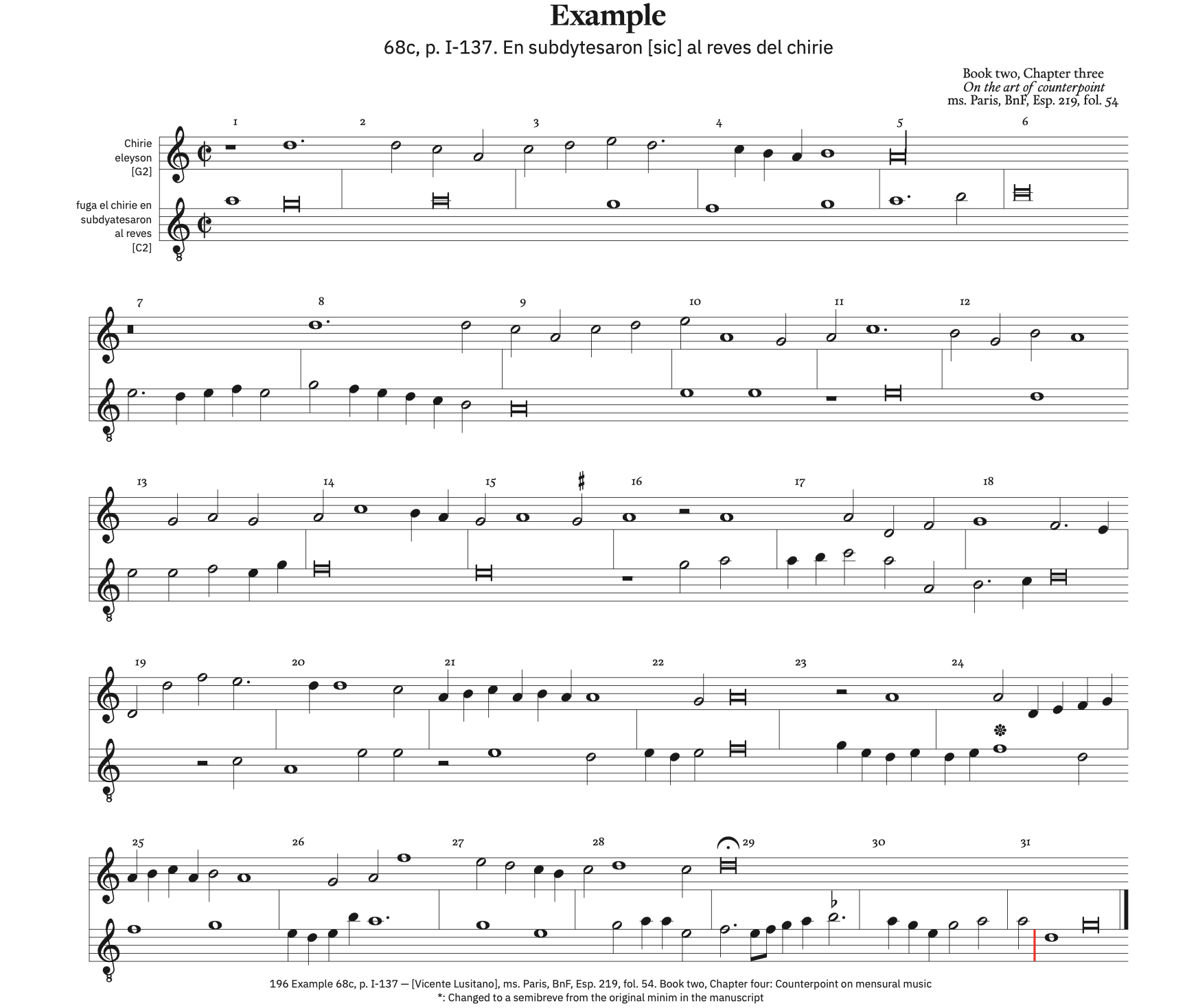
En subdytesaron [sic] al reves del Chirie. [Marg. Fuga el Chirie en subdyatesaron al reves]
At the fourth below in retrograde with itself on the Kyrie. [Marg. Canon on the Kyrie at the fourth below in retrograde with itself]
À la quarte inférieure à l’envers du Kyrie [ Marg. Le Kyrie en canon à l’envers à la quarte inférieure]
196 Ex. 68c[^*]
[Marg. nota]
Depues desto, puede un abil hazer una fuga sobre canto de organo a dos, scilicet en unisonus, o en dyapason o en diapente, las quales no se hazen sino con mucha continuacion. Y aonque las tales fugas no aprovechen para otro que para avivar el ingenio, es grande cosa aver pasado un musico por todas estas cosas, por que de la frequentaçion de semejantes cosas viene un hombre a ser muy esperto en su profesion de la musica.
Exemplo de como se hacen las fugas sobre canto de organo.
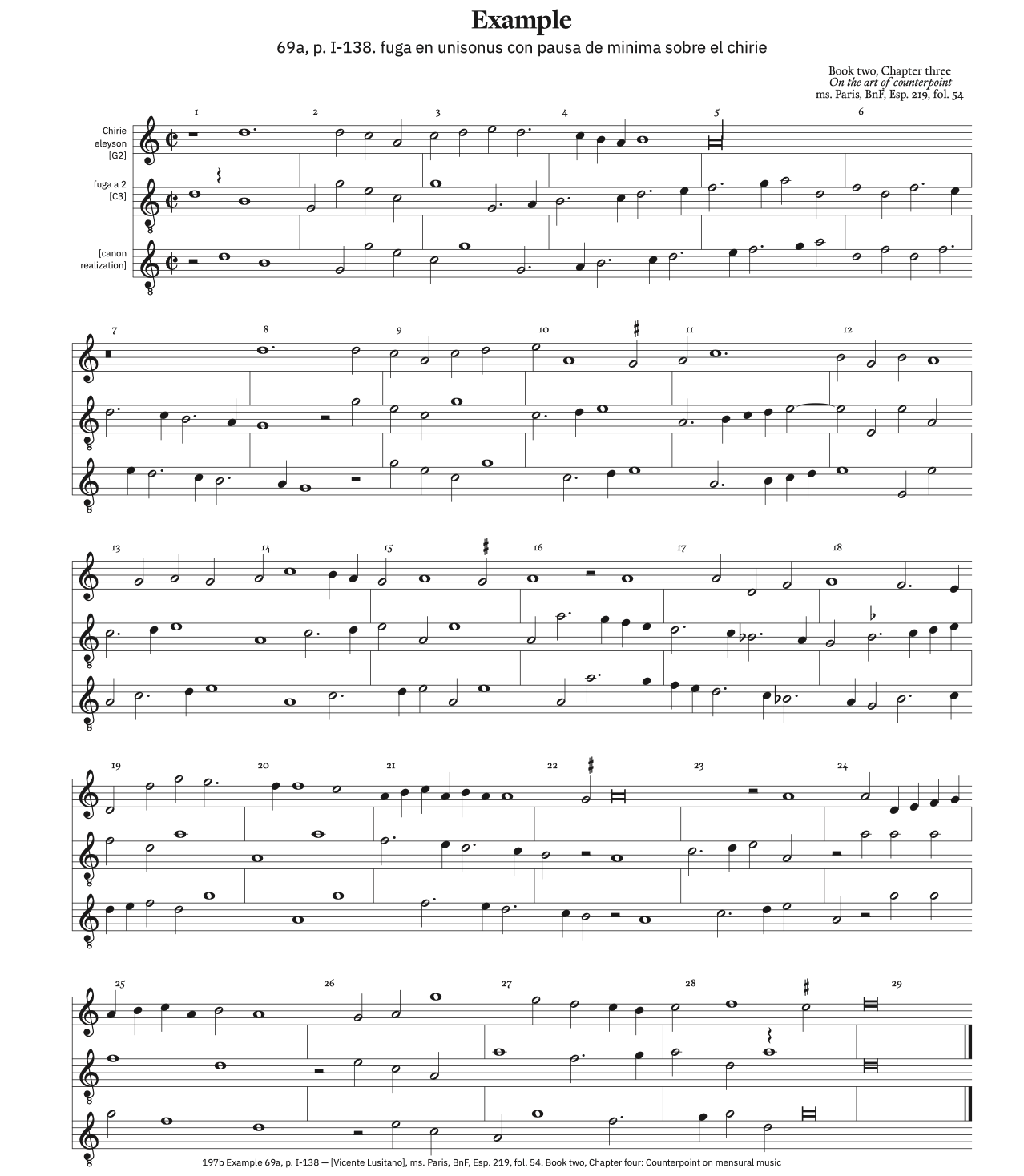
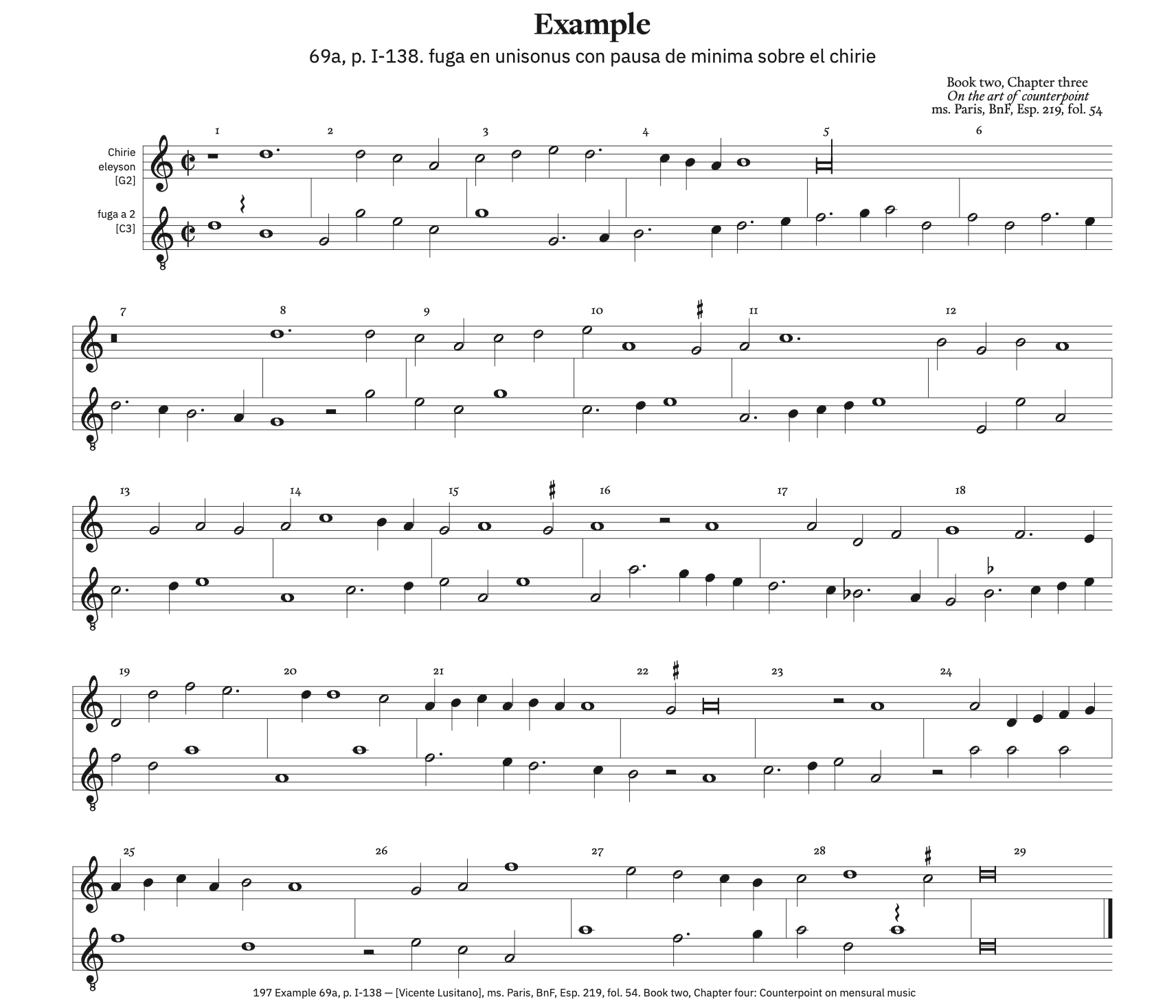
Fuga en unisonus con pausa de minima, sobre el Chirie. [Marg. fuga a 2]
[Marg. note]
After that, a skilled one will be able to make a two-part canon on the plainchant, namely, at the unison, at the octave above, or at the fifth above, which cannot be achieved without perseverance. And though these canons serve no other purpose than to sharpen one’s wits[^***], it is a great thing for a musician to have experienced these things, because it is through frequent contact with such things that a man becomes an expert in the musical profession.
Example: how to make canons upon mensural music.
Canon at the unison after a minim rest, on the Kyrie [Marg. canon a 2]
[Marg. note]
Après cela, quelqu’un d’habile pourra faire un canon à deux voix sur le chant figuré, soit à l’unisson, soit à l’octave[^**] ou à la quinte, ce qui ne se fait pas sans persévérance. Et bien que ces canons ne servent à rien d’autre qu’à rendre l’esprit plus vif, c’est une grande chose pour un musicien d’être passé par toutes ces choses, car c’est de la fréquentation de choses semblables qu’un homme devient expert dans la profession de la musique.
Exemple qui montre comment faire les canons sur le chant figuré
Canon à l’unisson avec pause de minime sur le Kyrie [ Marg. Canon à 2 voix]
197 Ex. 69a[^****]
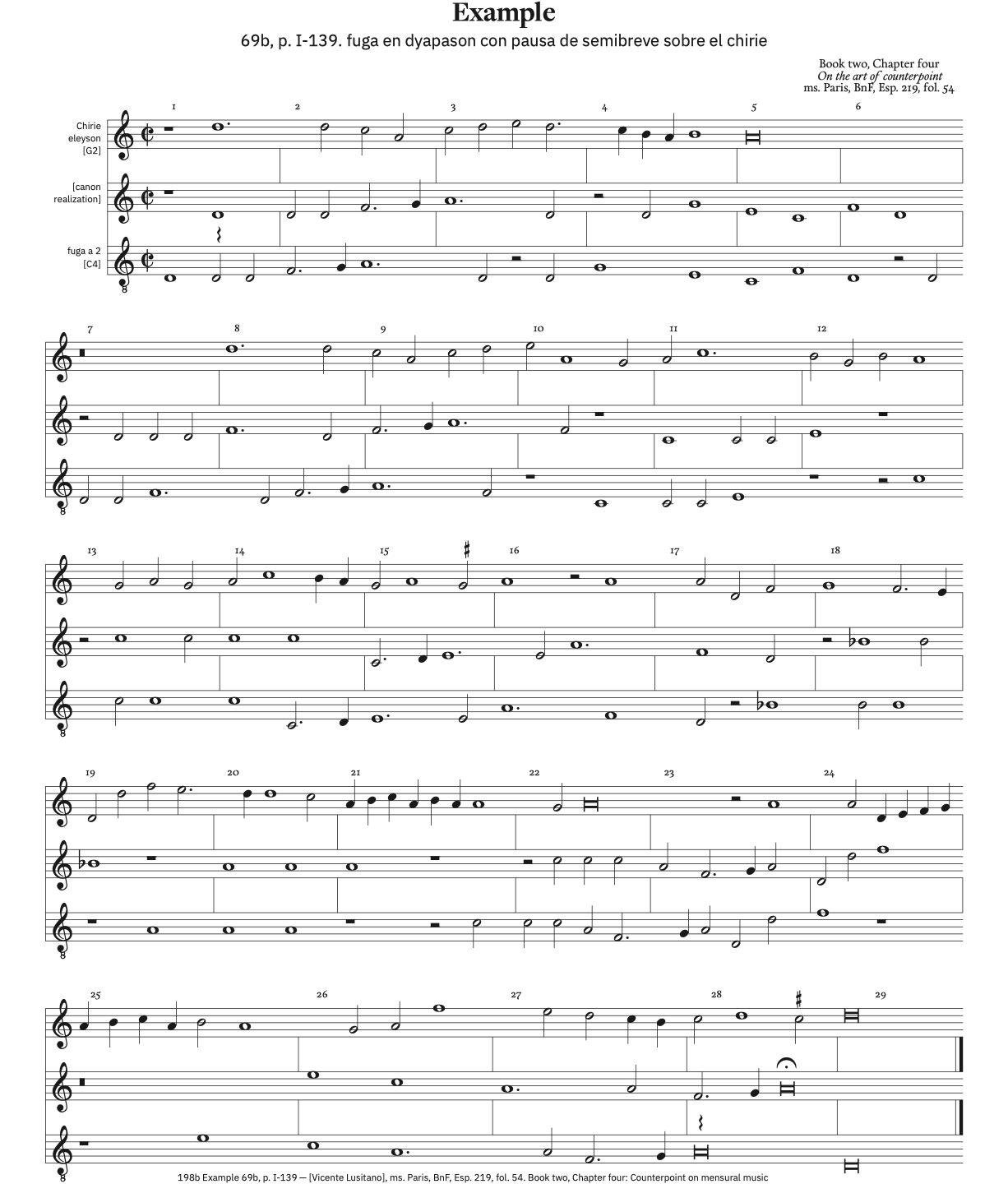
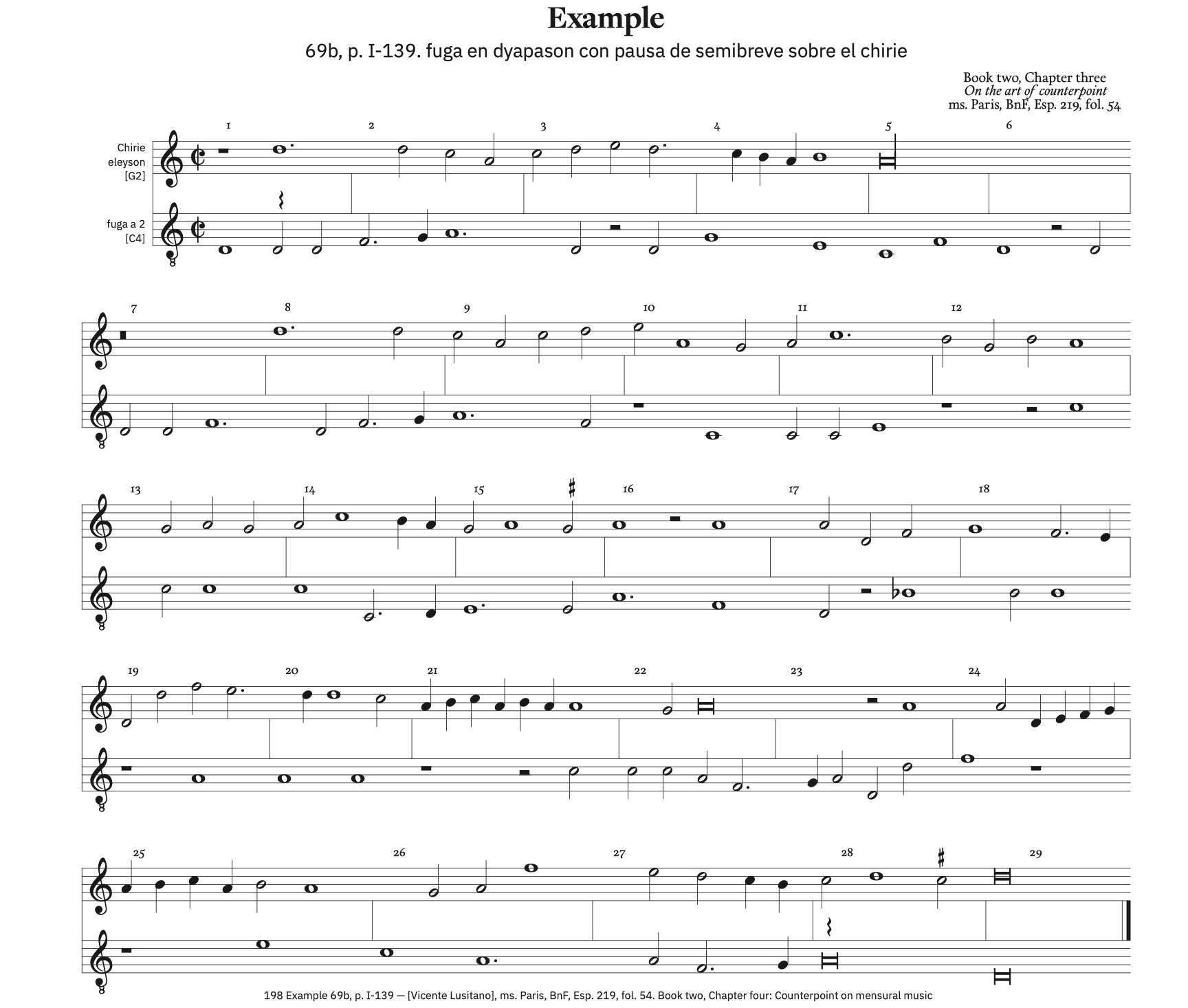
Fuga en dyapason con pausa de semibreve, sobre el Chirie. [Marg. fuga a 2]
Canon at the octave above after a semibreve rest, on the Kyrie [Marg. canon a 2]
Canon à l’octave avec pause de semi-brève sur le Kyrie [ Marg. Canon à 2 voix]
198 Ex. 69b[^****]
[^*]: [Example 68c works fine until bar 24, where dissonances start to appear as the result of an apparently mistaken note value in the manuscript. Canguilhem (2013, p. 273) has managed to solve the problem by changing the value of only one note in bar 24: from the original minim d to semibreve d. I am following his solution here except for a minor modification: I have chosen to modify the penultimate note of the bar (f) instead of the last one (d). This example is noteworthy in that it is the first apparent mistake in the musical notation of the manuscript’s section on counterpoint that was not detected and corrected by Lusitano.—Tr.]
[^**]: [Missing in the original French translation (Canguilhem 2013, p. 274).—Tr.]
[^***]: [Lusitanos’ expression “avivar el ingenio” appears translated as “to enliven the spirit” in Canguilhem 2011, pp. 90 and 98.—Tr.]
[^****]: [See below for another version of examples 69a–b with canon resolutions—Tr.]