fol. 59v
Book two, chapter 5: On composition
el tiple y contrabaxo.
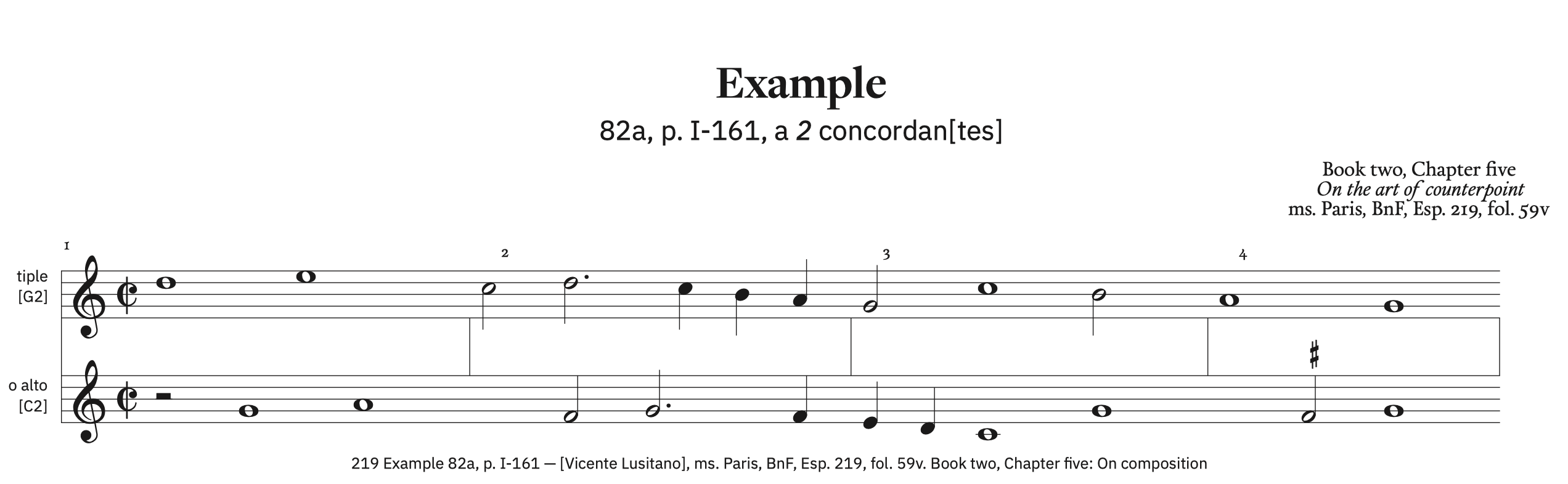
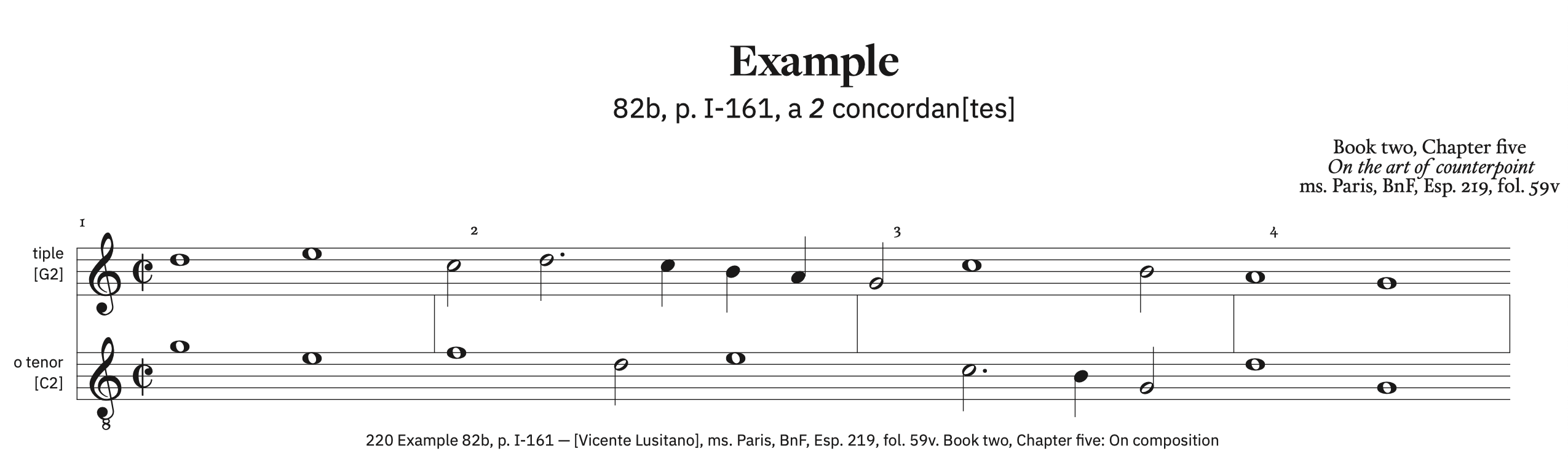
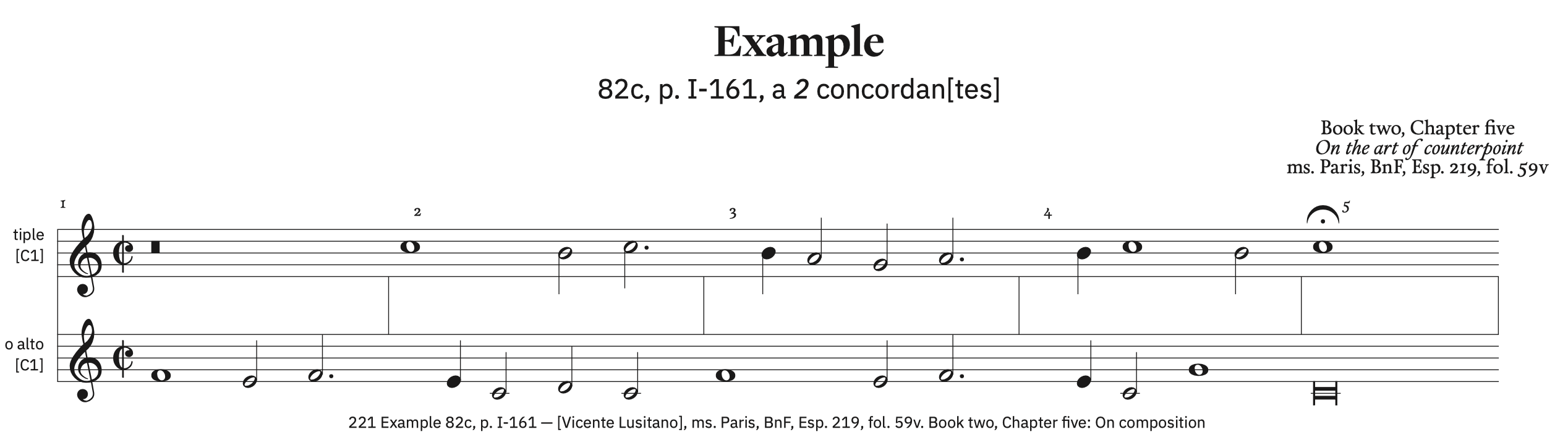
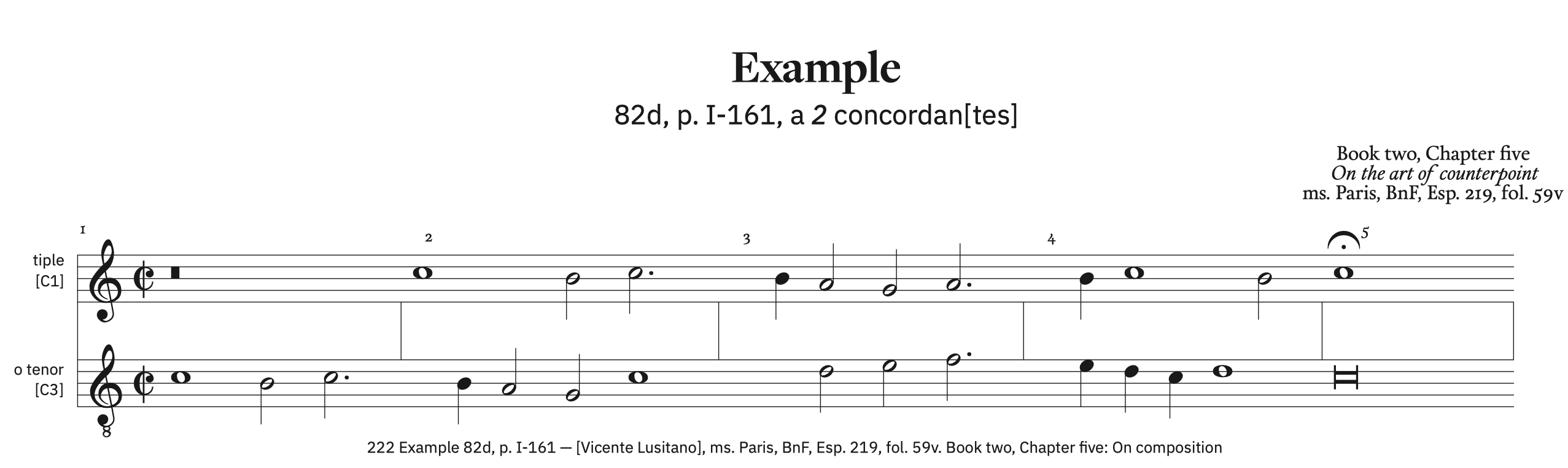
Exemplo de como clausulan tiple y contralto o tiple y tenor. [Marg. a 2 concordan[tes]]
the soprano and the bass.
Example: how the soprano cadences with the alto or with the tenor. [Marg. in 2 concordant voices]
le soprano et la basse.
Exemple : comment le soprano cadence avec l’alto ou avec le ténor. [ Marg. À 2 voix concordantes]
En la misma manera hazen las clausulas el alto y aon el tenor con el baxo.
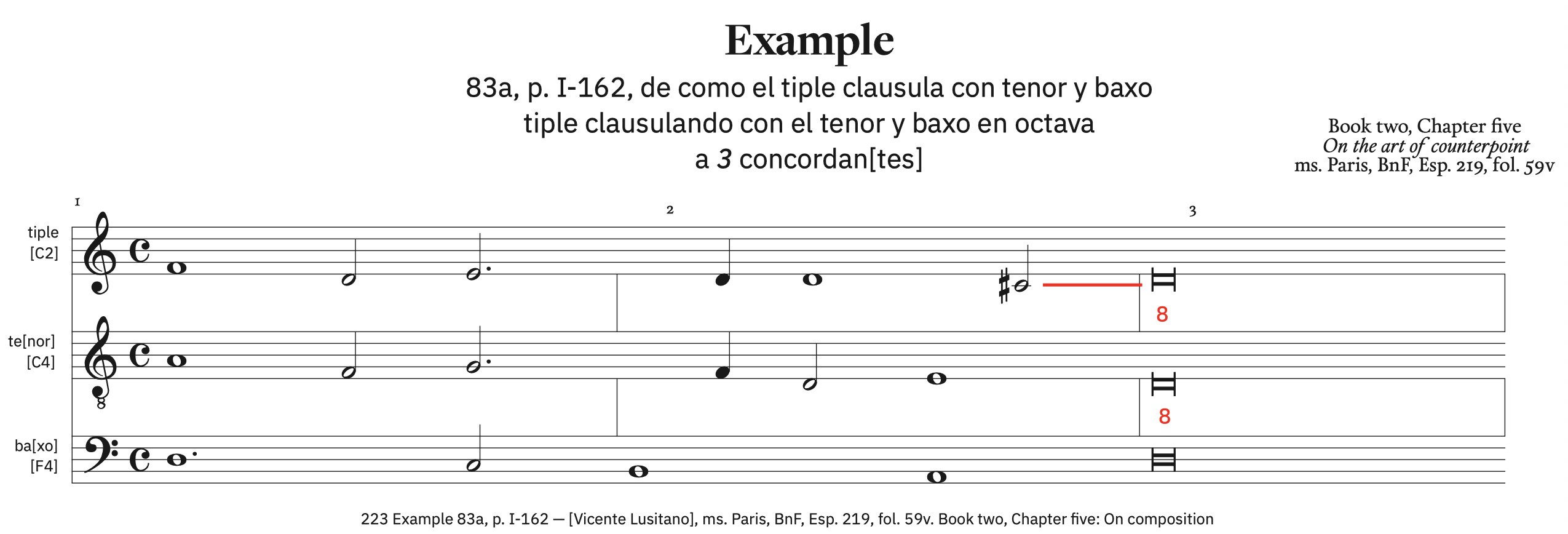
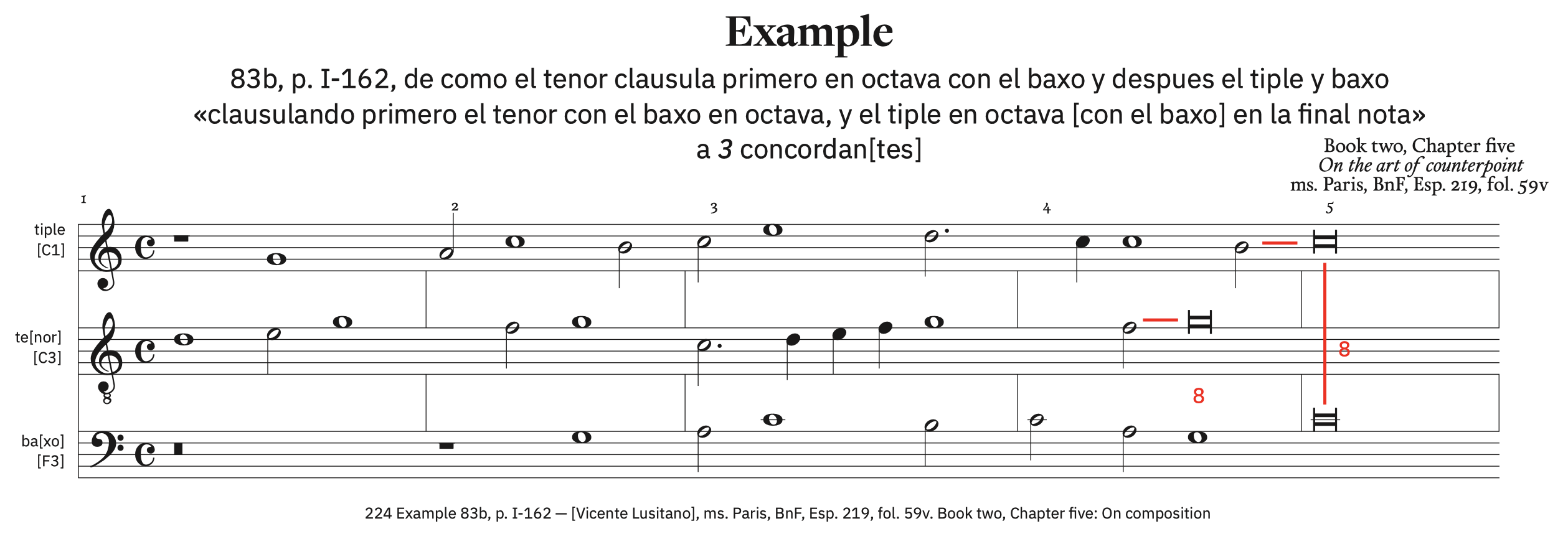
A tres se hazen las clausulas en diverso modo: o se hazen con tiple clausulando con el tenor y baxo en octava; o se haze clausulando primero el tenor con el baxo en octava, y el tiple en octava [con el baxo] en la final nota, como se vera abaxo.
Exemplo de como el tiple clausula con tenor y baxo. [Marg. a 3 concordan[tes]]
Alto and tenor cadences with the bass proceed in the same way.
Three-part cadences are done differently: either the soprano cadences while making an octave with tenor and bass, or the tenor cadences first making an octave with the bass followed by the soprano making an octave [with the bass] on the final note, as shown below.
Example: how the soprano cadences with the tenor and bass. [Marg. in 3 concordant voices]
Les cadences de l’alto et du ténor avec la basse procèdent de la même façon.
Les cadences à trois voix se font d’une façon différente : soit le soprano cadence en octave avec le ténor et la basse, soit le ténor cadence d’abord en octave avec la basse et le soprano vient à l’octave [de la basse] sur la note finale, comme on le voit ci-dessous.
Exemple : comment le soprano cadence avec le ténor et la basse. [ Marg. À 3 voix concordantes]
Exemplo de como el tenor clausula primero en octava con el baxo y despues el tiple y baxo. [Marg. a 3 concordan[tes]]
Example: how the tenor cadences first, an octave above the bass, and is then followed by soprano and bass. [Marg. in 3 concordant voices]
Exemple : comment le ténor cadence d’abord en octave avec la basse, avant que n’arrivent le soprano et la basse. [ Marg. À 3 voix concordantes]
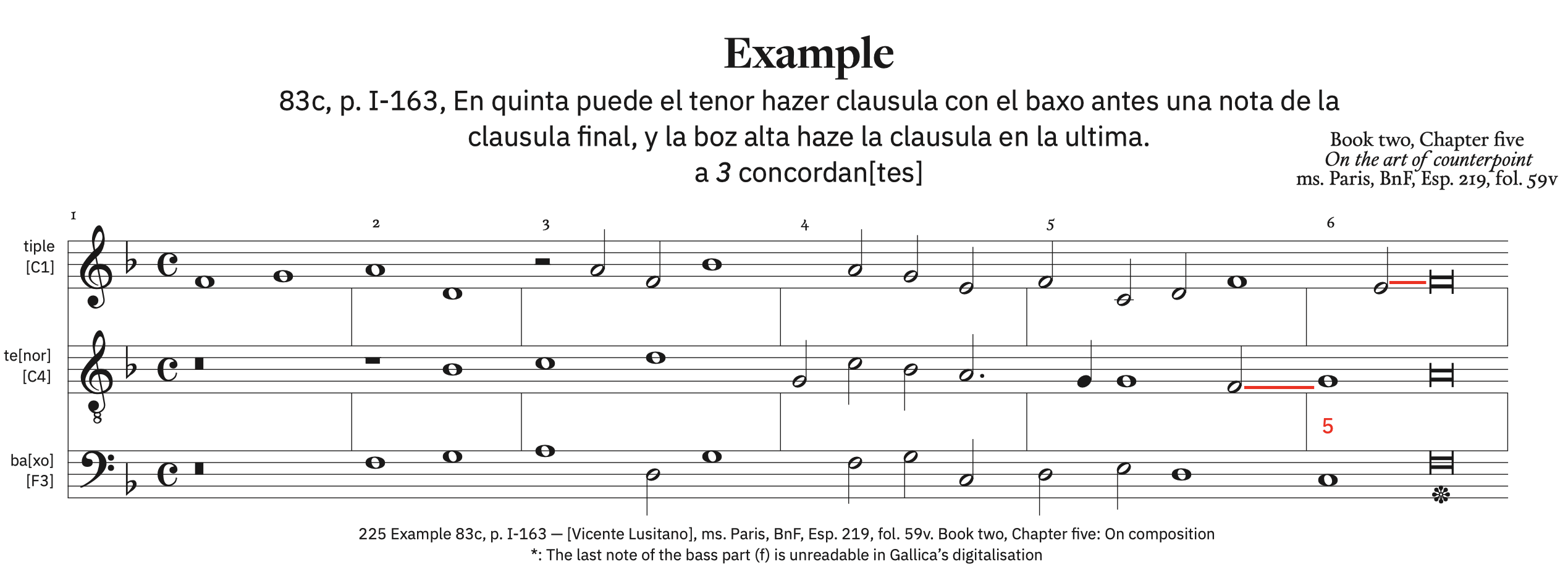
En quinta puede el tenor hazer clausula con el baxo antes una nota de la clausula final, y la boz alta haze la clausula en la ultima.
Exemplo. [Marg. a 3 concordan[tes]]
The tenor can cadence at the fifth above the bass one note before the final cadence, and the upper voice will cadence on the last note.
Example [Marg. in 3 concordant voices]
Le ténor peut faire une cadence à la quinte de la basse une note avant la cadence finale, et la voix aiguë fera la cadence sur la dernière note.
Exemple [ Marg. À 3 voix concordantes]
A quatro se clausula diversamente, mas la frenquentada es quando el contralto y baxo hazen la clausula de octava en la penultima figura estando el tenor en quinta del baxo, mas en la ultima el tiple la haze de octava con el baxo [y tenor], segun hizo en la de tres bozes y abaxo se muestra, la qual aonque muy continua empero muy suave.
In four parts, cadences are done in different ways, but the most usual form is when alto and bass move to an octave at the cadence on the penultimate note, and the tenor is a fifth above the bass, while in the last note, the soprano cadences with the bass [and tenor] an octave lower, which is shown below, and was previously done in three voices. Although very continuous [common], this cadence is nevertheless very smooth.
À quatre parties, on cadence différemment, mais le plus souvent, l’alto et la basse font une cadence d’octave sur l’avant-dernière note, pendant que le ténor est à la quinte de la basse et que le soprano fait la cadence d’octave avec la basse [et le ténor], comme il le fait à trois voix, ce qui est montré ci-dessous. Bien qu’étant très continue, cette cadence est cependant très suave.