fol. 48v
Book two, chapter three: On canons
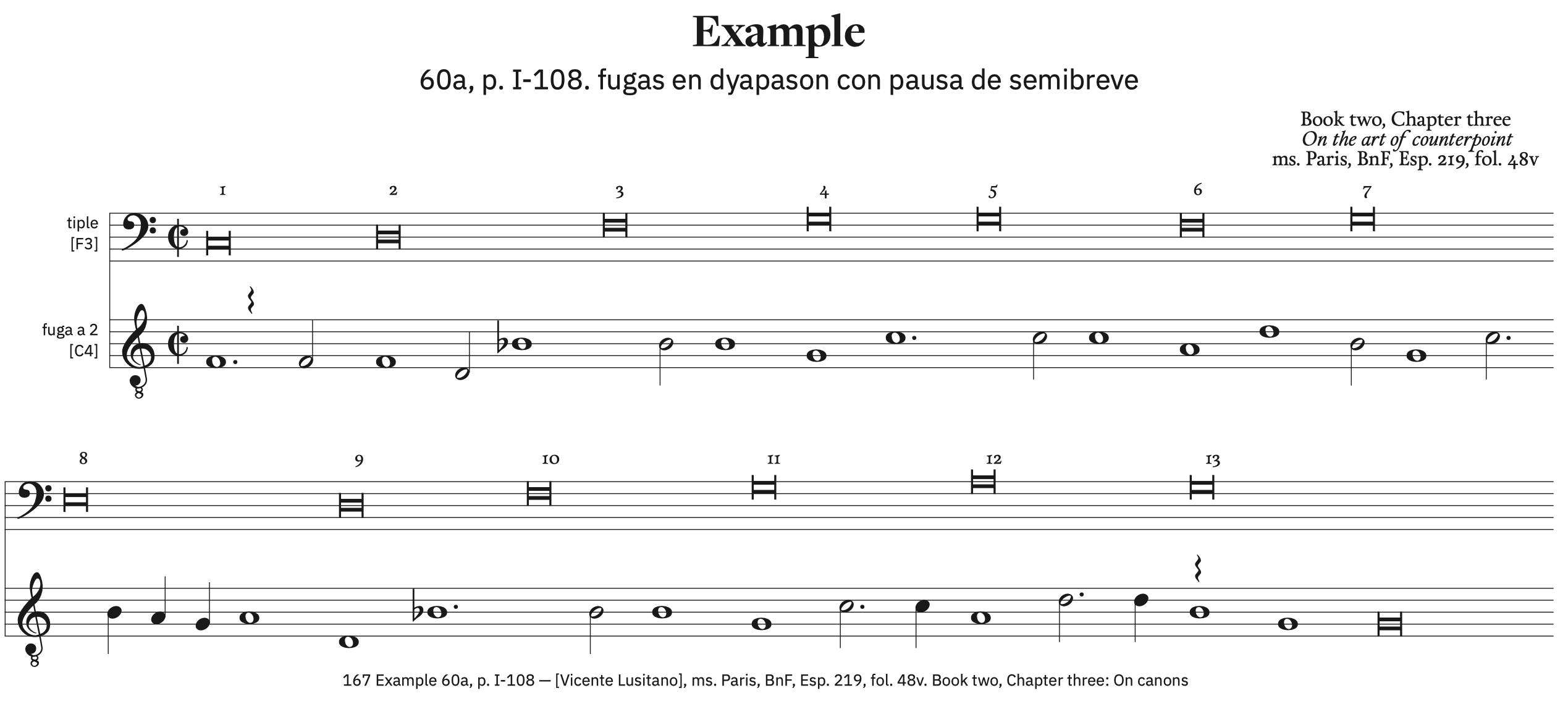
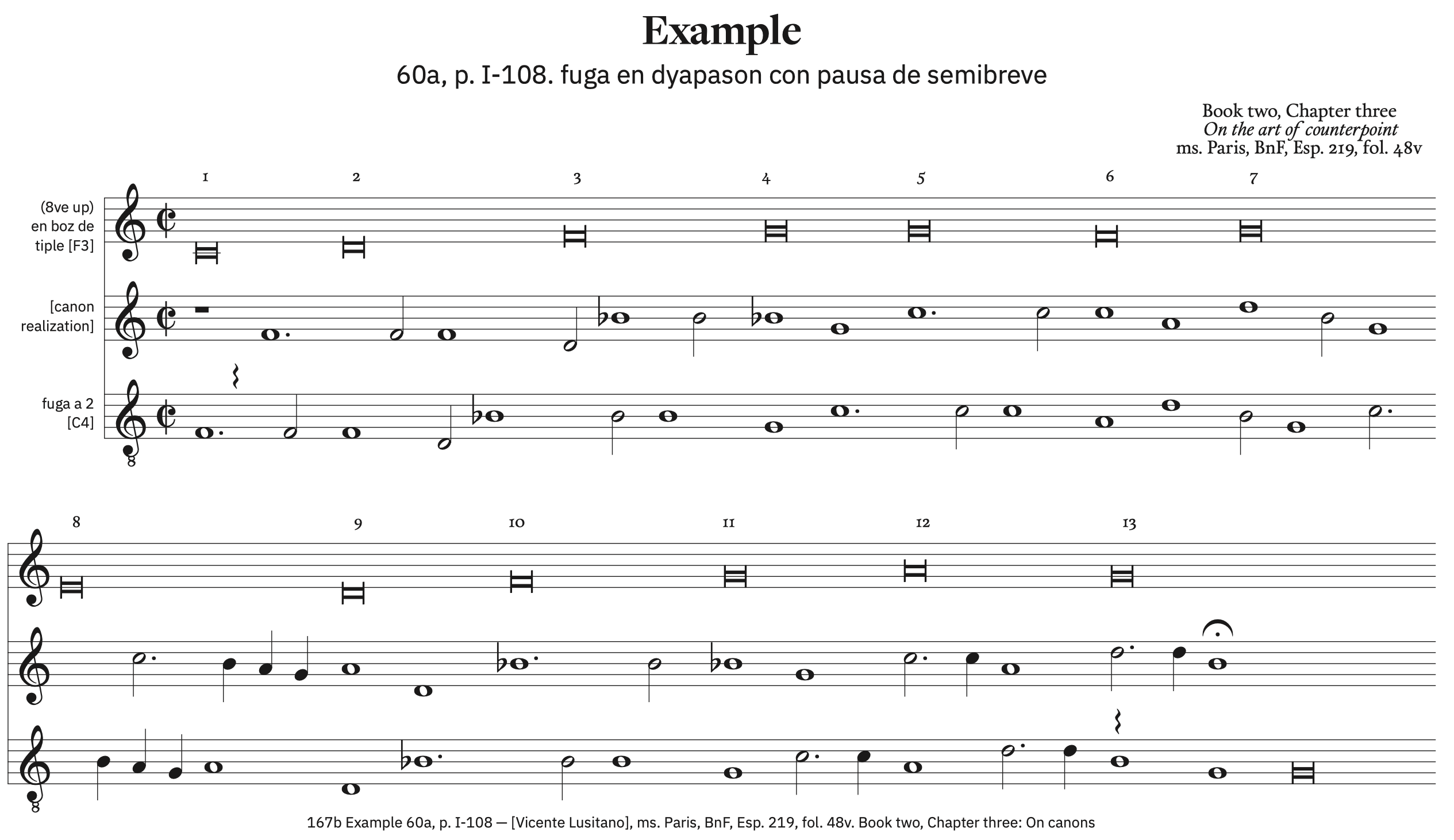
Fuga en dyapason con pausa de semibreve, yendo el canto llano en boz de tiple, segun que abaxo se muestra.
Exemplo. Tiple. Fuga en diapason con pausa de semibreve. [Marg. fuga a 2]
Canon at the octave above after a semibreve rest. The plainsong is placed in the soprano voice, as shown below.
Example. Soprano. Canon at the octave above after a semibreve rest [Marg. canon a 2]
Canon à l’octave avec silence de semi-brève, le plain-chant étant à la voix de soprano, ainsi qu’on le montre ci-dessous.
Exemple. Soprano. Canon à l’octave avec silence de semi-brève [Marg. canon à 2]
167 Ex. 60a[^*]
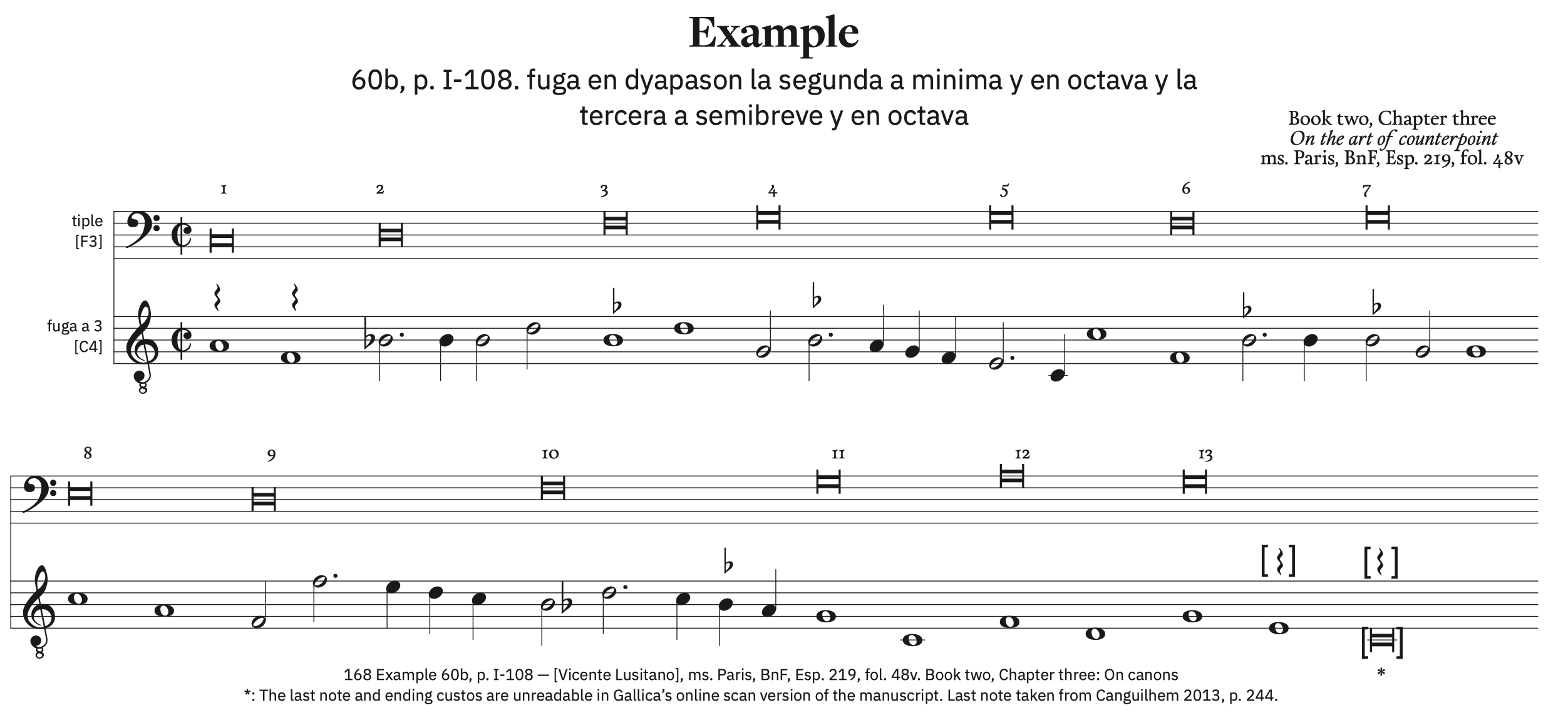
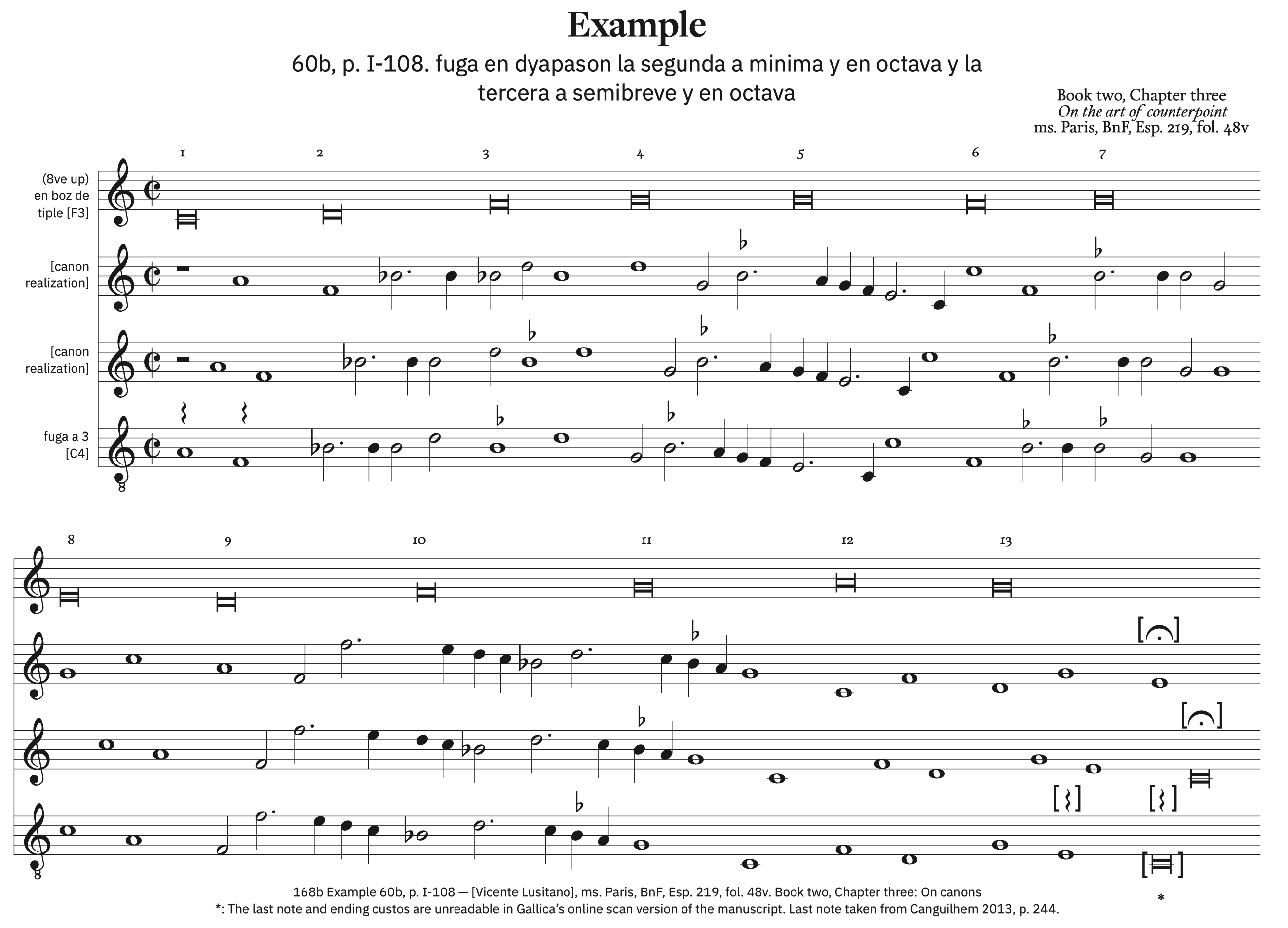
fuga en dyapason la segunda a minima y en octava y la tercera a semibreve y en octava [Marg. fuga a 3]
canon at the octave, the second voice enters after a minim rest at the octave above, the third voice enters after a semibreve rest at the octave above [Marg. canon a 3]
canon à l’octave, la deuxième voix entre après un silence de minime à l’octave supérieure, la troisième voix entre après un silence de semi-brève à l’octave supérieure. [Marg. fuga a 3]
168 Ex. 60b[^*]
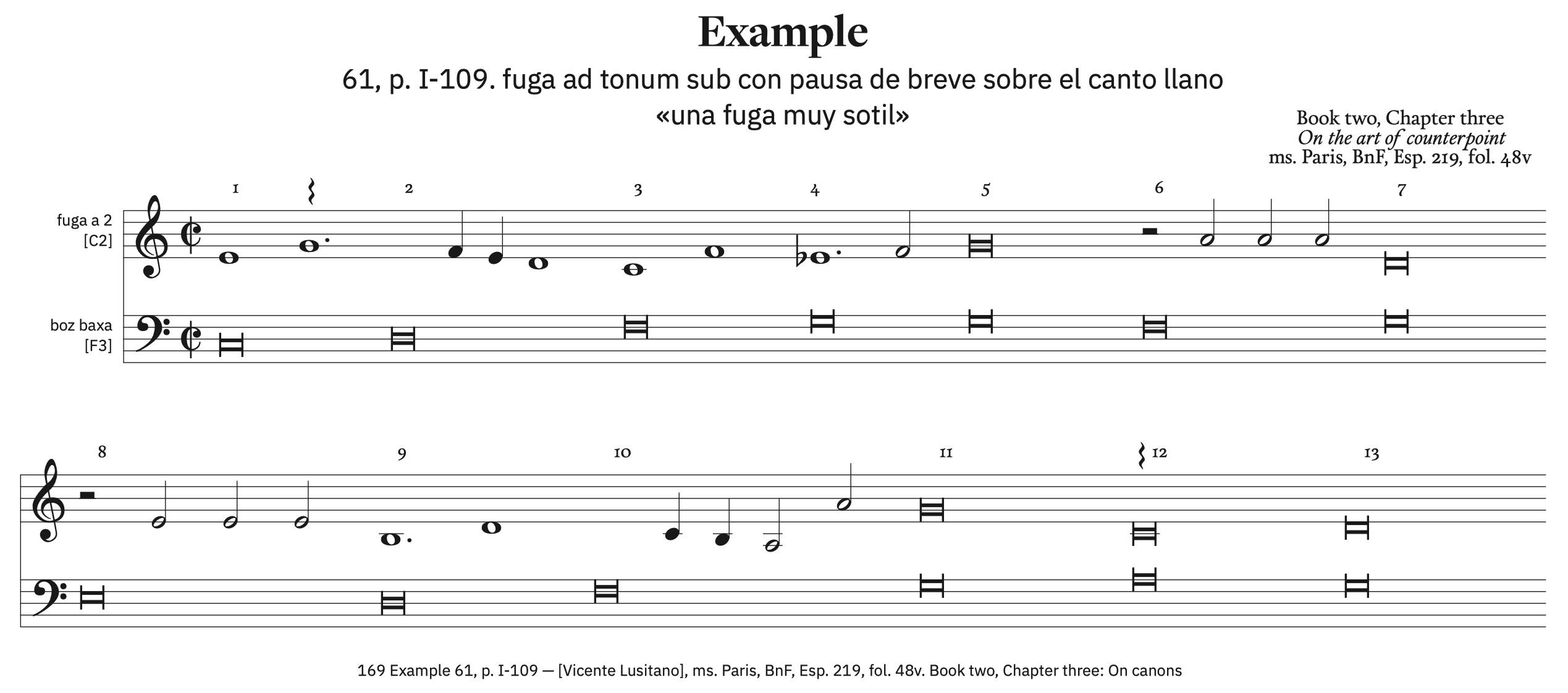
Nota que algunas vezes puede venir sobre canto llano una fuga muy sotil, y tanto que por lo ser ansi la ponemos aqui en fin, para que della se pueda tomar exemplo en que modo se hara en los otros cantos llanos.
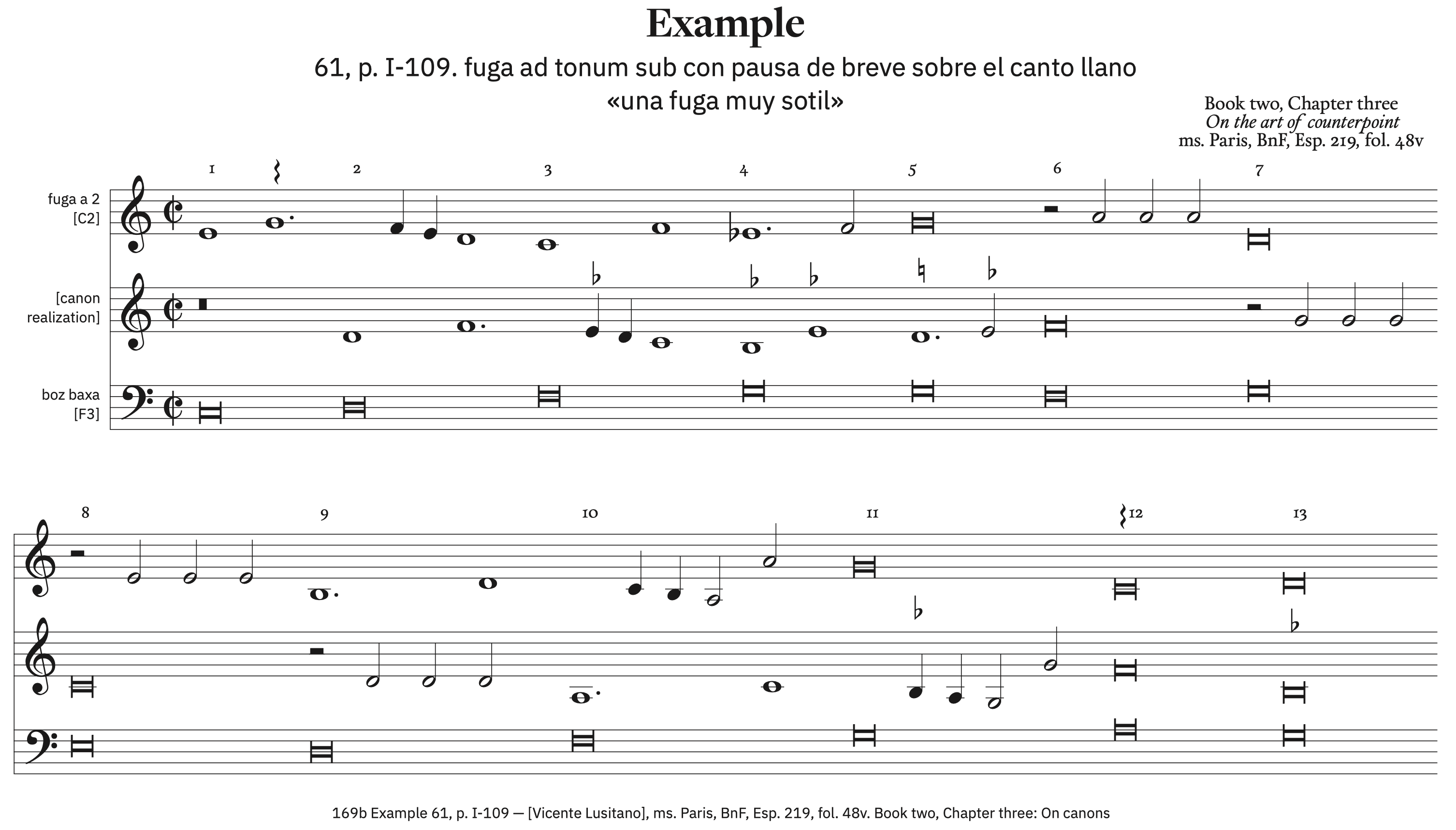
Exemplo boz baxa. fuga ad tonum sub con pausa de breve sobre el canto llano
Note that sometimes a very subtle canon can be made on the plainsong and because it is so subtle, we place it here at the end so that it can be used as an example of how one should proceed with other plainsongs.
Example. [The plainsong is placed in the] low voice. Canon at the second below after a breve rest on the plainsong
Remarquez que quelquefois, on peut faire un canon très subtil au-dessus du plain-chant, et il est si subtil qu’on le mettra ici à la fin, afin qu’il puisse servir d’exemple pour savoir de quelle manière on devra procéder sur d’autres plains-chants.
Exemple [Le plain-chant étant à la] voix basse. Canon à la deuxième ci-dessous avec un silence de brève sur le plain-chant
169 Ex. 61[^**]
Capitolo quarto: del contrapunto sobre canto d’organo
Vista pues la orden que se deve tener en hazer las fugas sobre canto llano, conviene saber en que manera nos devemos aver sobre canto de organo, y el modo que se deve tener en algunas abilidades que se hazen sobre el dicho canto de organo, para lo qual es de saber que la orden que es dada en cantar sobre canto llano, esa misma sirve sobre canto de organo, scilicet las ymitaciones con [f. 49] sus pasos largos
Chapter four: Counterpoint on mensural music
Having seen the order we must follow to make canons on the plainchant it is convenient to know how to proceed with mensural music and the way to proceed with certain skills that are made on mensural music. For this, you should know that the order that has been given for singing on the plainchant is also the one used for mensural music, i.e., imitations with [f. 49] wide-range passages
Chapitre 4 : Du contrepoint sur le chant figuré
Après avoir vu l’ordre que l’on doit suivre pour faire les canons sur le plainchant, il convient de savoir de quelle manière nous devons nous y prendre sur le chant figuré, et la façon de faire certaines habiletés sur ce même chant figuré. Pour cela, il faut savoir que l’ordre qui a été donné pour chanter sur le plain-chant — les imitations avec leurs [f. 49] passages de grand ambitus
[^*]: [See below for another version of examples 60a-b with canon resolutions—Tr.]
[^**]: [See below for another version of example 61 with canon resolution—Tr.]
169 Ex. 61[^**]