fol. 57v
Book two, chapter four: Counterpoint on mensural music
Quarta boz en baxo
Quarta boz baxa sobre el Crucifixus de Gomberth
Fourth voice in the bass part
Fourth voice in the bass part upon Gombert’s Crucifixus
Quatrième voix basse sur le Crucifixus de Gombert
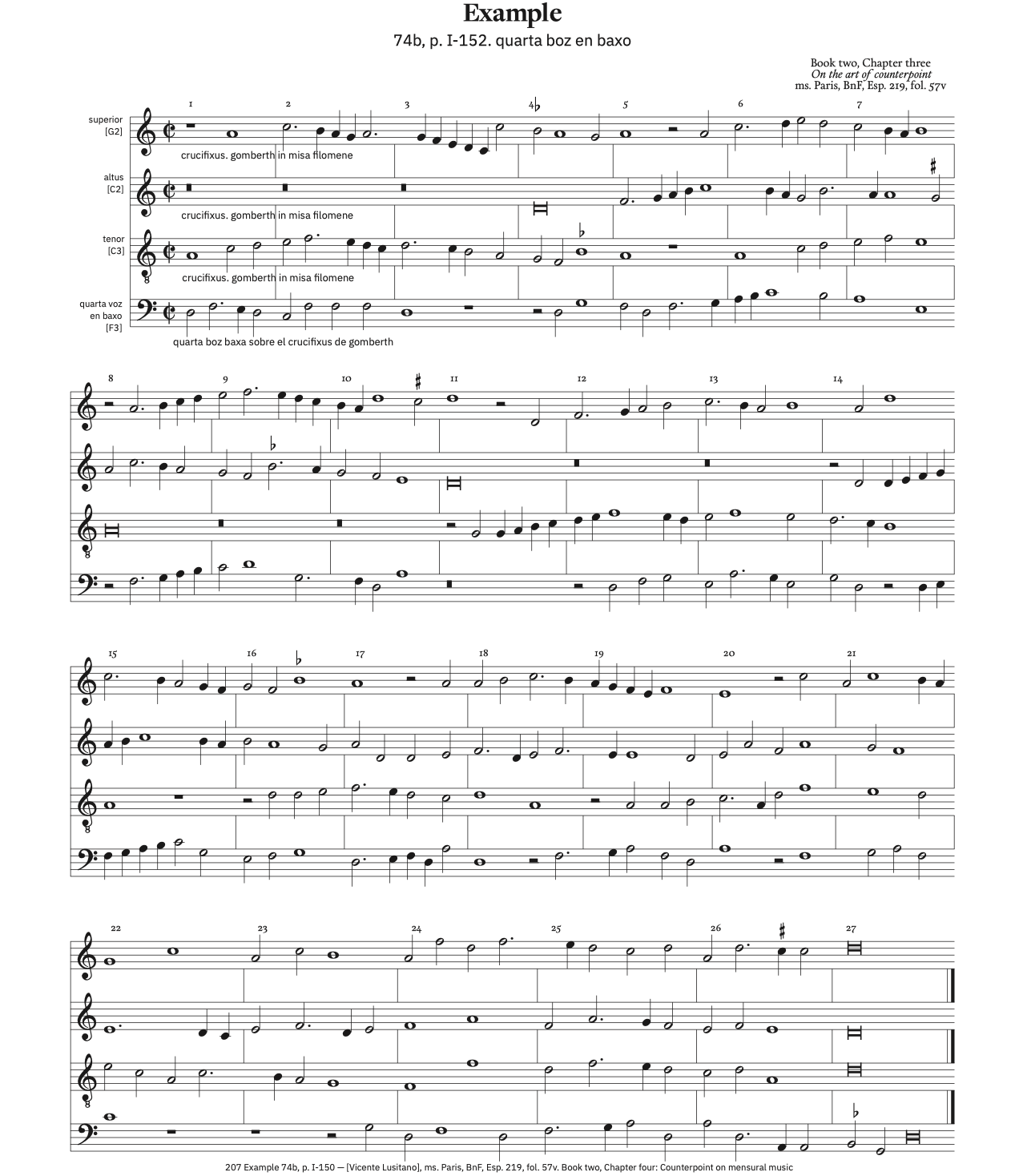
Una quinta boz sobre un quarto es mucho, mas es cosa que depende de la mucha conpostura y su grande uso, con la qual se sabe en que manera se metera una quinta boz sin mucho fastidio y con gracia; ca echarla sin gracia muchos lo haran. Para lo qual es menester que se tenga aviso que quando las quatro bozes clausulan, scilicet el alto y baxo de octava y el tenor y el tiple estan en sexta, come si fuese en estos sinos o en otros semejantes, scilicet en desolre el baxo, en alamire el tenor, en delasolre el alto, en fefaut el tiple, scilicet dezena del baxo. En tal parte, la quinta parte vendra a la octava en elami, antes de la clausula que hazen las dos bozes en desolre. Mas por que seria parlar al ayre, començemos mostrar brevemente la via de la conpostura.
De la conpostura: Capitolo quinto
[Marg. de la conpostura: capitolo 5°]
para lo qual es de saber que a dos no se muestra la via, por que no es otra cosa un duo sino contrapunto, una boz sobre otra. Mas a tres y a 4 y 5 y a 6 se muestra la via, scilicet en los prinçipios y en las clausulas; para cuio proçeso es menester tomar algunos avisos en la memoria, para evitar los yerros que pueden venir en las bozes. Para lo qual es de saber que no somos obligados a començar en specie perfeta, como esta dicho en el arte de contrapunto y abaxo se mostrara.
Adding a fifth voice to a four-part piece is quite something, but it depends on the diligent and frequent use of composition, by which one will know how to fit a fifth voice without too much trouble and with grace; because, gracelessly, there are many who can do it. For this, you must know that when the four voices make a cadence, namely with the alto is an octave apart from the bass and the tenor a sixth below the soprano (as if they were written in these solmization notes or in equivalent ones, namely the bass on Dsolre, the tenor on alamire, the alto on delasolre and the soprano on fefaut, i.e., a tenth apart from the bass), then the fifth voice will be an octave apart on elami before the two voices’ cadence to desolre. But in order not to speak in vain, let us begin to briefly show the way of composition.
Chapter five: On composition
[Marg. On composition: Chapter five]
It is important to know that we will not show the way of composition on a two-part piece because a duo is nothing more than a counterpoint line on top of another voice. Instead, the way of composition is shown through compositions for three, four, five, and six parts, namely, how to start and how to make cadences. To do this, it is necessary to keep certain tips in mind to avoid voice-leading errors. To this end, it is important to know that we are not obliged to start with a perfect consonance, as has been said in the art of counterpoint and as will be shown below.
Il est difficile de faire une cinquième voix sur un quatuor, mais cela dépend de l’usage fréquent et assidu de la composition, grâce à laquelle on saura comment placer une cinquième voix sans trop de peine et avec grâce : car ils sont nombreux, ceux qui la feront sans grâce. Pour cela, il est nécessaire de retenir le conseil suivant : quand les quatre voix font la cadence, à savoir alto et basse à l’octave, ténor et soprano en sixte — comme s’il y avait ces notes ou d’autres équivalentes, à savoir la basse sur d solre, le ténor sur a lamire, l’alto sur d solre et le soprano sur f faut, à la dixième de la basse —, alors, la cinquième voix viendra à l’octave sur e lami avant la cadence que font les deux voix sur d solre. Mais pour ne pas parler en l’air, commençons à montrer brièvement la voie de la composition.
Chapitre 5 : De la composition
[ Marg. De la composition. Chapitre 5]
Il faut savoir que l’on ne montrera pas le fonctionnement à deux voix, car un duo n’est rien d’autre que du contrepoint, à savoir une voix sur une autre. On montrera en revanche le fonctionnement à 3, 4, 5 et 6 voix, à savoir comment commencer les pièces et comment faire les cadences. Il est nécessaire pour cela de garder certains conseils en mémoire, afin d’éviter les erreurs qui peuvent survenir dans les voix. Ainsi, il faut savoir que nous ne sommes pas obligés de commencer par une consonance parfaite, comme on l’a dit dans l’art du contrepoint et comme on le montrera ci-dessous.
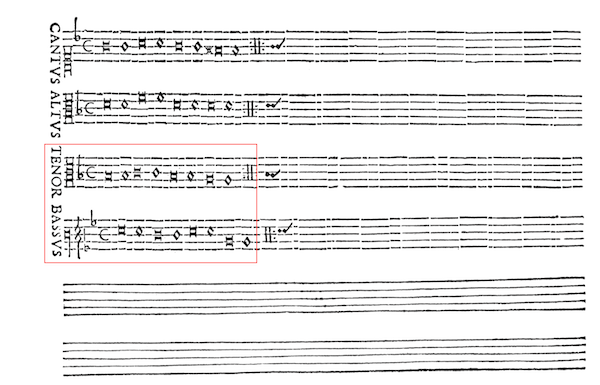
208 Ex. 75a[^**]
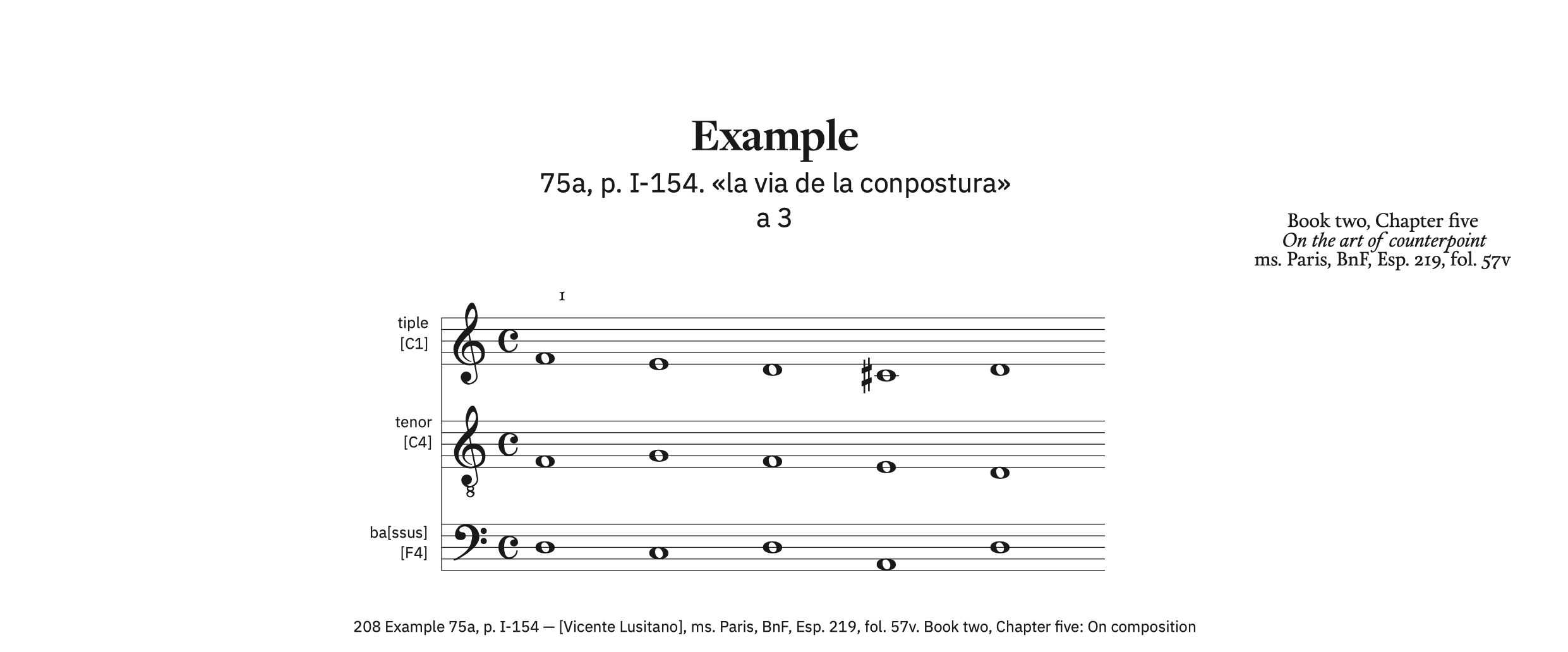
Solo el final esta encomendado que sea perfecta, segun que fue dicho en el arte de contrapunto, o al menos 3ª maior, y no en otra manera.
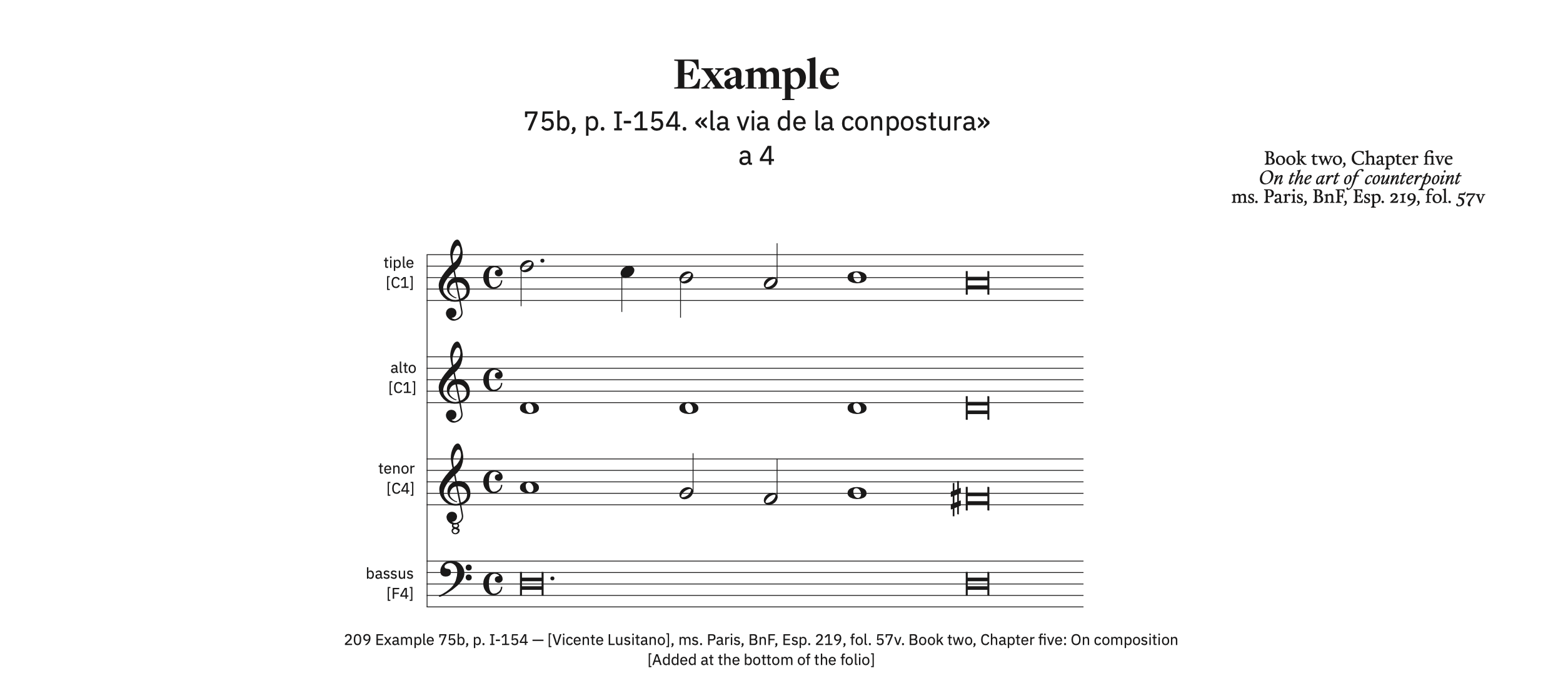
§ El tenor no hara dos tercias con el baxo si el tiple haze dos
Exemplo [Marg. Ojo]
[Ex. 75b, añadido al final de la página]
It is only at the end that we must finish on a perfect consonance, or at least on a major third (and nothing else), as has been said in the art of counterpoint.
§ The tenor will not move in two consecutive thirds with the bass when the soprano moves in two [f. 58] consecutive tenths with the bass
Example [Marg. Attention]
Il est recommandé que seule la dernière consonance soit parfaite, selon ce qui a été dit dans l’art du contrepoint, ou à la rigueur qu’elle soit une tierce majeure, et rien d’autre.[^*]
§ Le ténor ne fera pas deux tierces avec la basse si le soprano fait deux
Exemple [ Marg. Attention]
[Ex. 75b, rajouté en bas de page.]
209 Ex. 75b[^***]
[^*]: [Traduction proposée : « C’est seulement à la fin qu’il faut terminer sur une consonance parfaite, ou au moins sur une tierce majeure (et rien d’autre), selon ce qui a été dit dans l’art du contrepoint ».—Tr.]
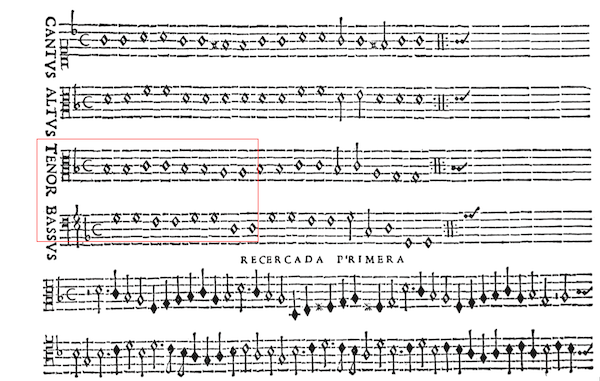
[^**]: [Although Lusitano does not name it, the compositional formula presented here corresponds to the passamezzo antico, a well-known harmonic pattern, ostinato bass, or tenor, as referred to by Lusitano’s contemporary Diego Ortiz. This tenor appears twice in Ortiz’s 1553 Trattado de glosas as the basis for recercadas first and fifth sobre tenores (upon tenors). Although they appear in slightly different forms (with a longer elaboration in the first recercada and in ternary rhythm in the fifth one; both at the fourth above and in four voices), it is remarkable that, in Lusitano’s example (75a), all notes in the two lowest parts (tenor and bass) are identical to Ortiz’s recercadas. See below—Tr.]
[^***]: [Added at the bottom of the folio.—Tr.]