fol. 58r
Book two, chapter 5: On composition
dezenas, esto por que seran dos octavas, ny menos dos sextas por que seran dos quintas.
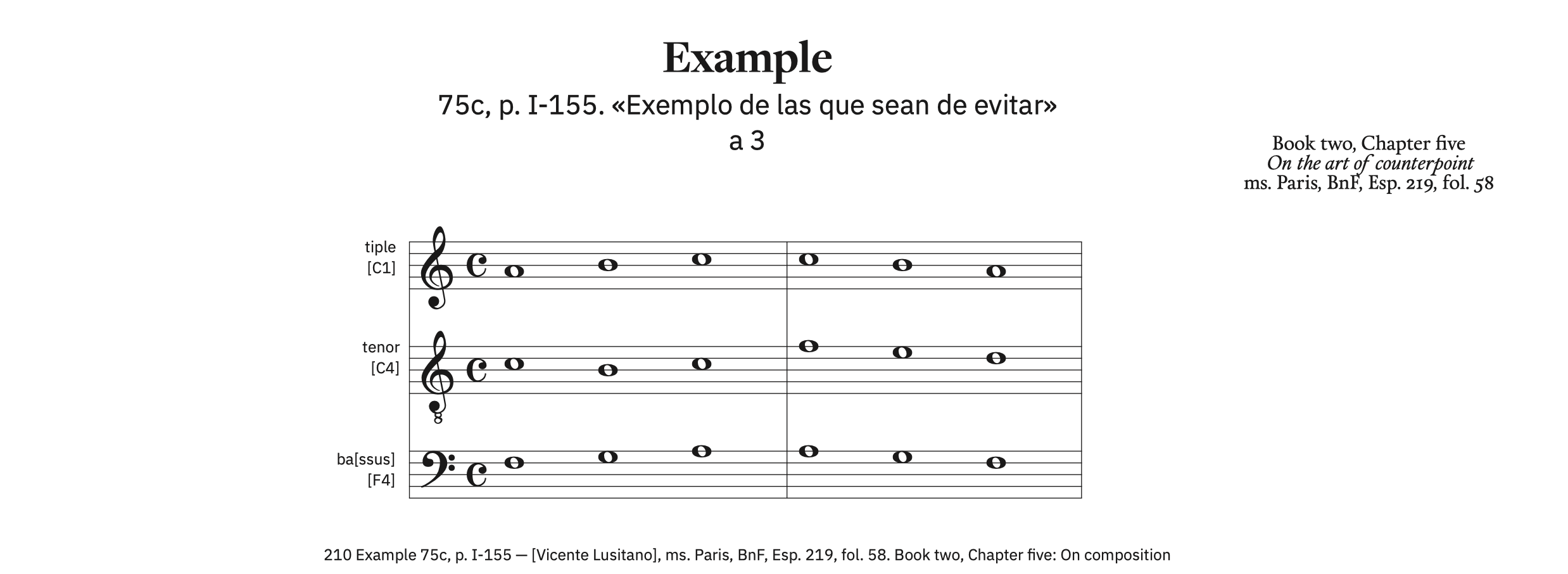
Exemplo de las que sean de evitar [Marg. Notabile…, párrafo tachado]
consecutive tenths with the bass and this is because it will introduce two octaves, nor will it not move in two consecutive sixths with the bass, as it will introduce two fifths.
Example of those to avoid [Marg. Notable…, crossed-out marginal note]
dixièmes, et ceci parce que l’on aura deux octaves, et il ne fera pas deux sixtes non plus, car cela fera deux quintes avec le soprano.
Exemple des choses à éviter [ Marg. Remarque…: rubrique biffée]
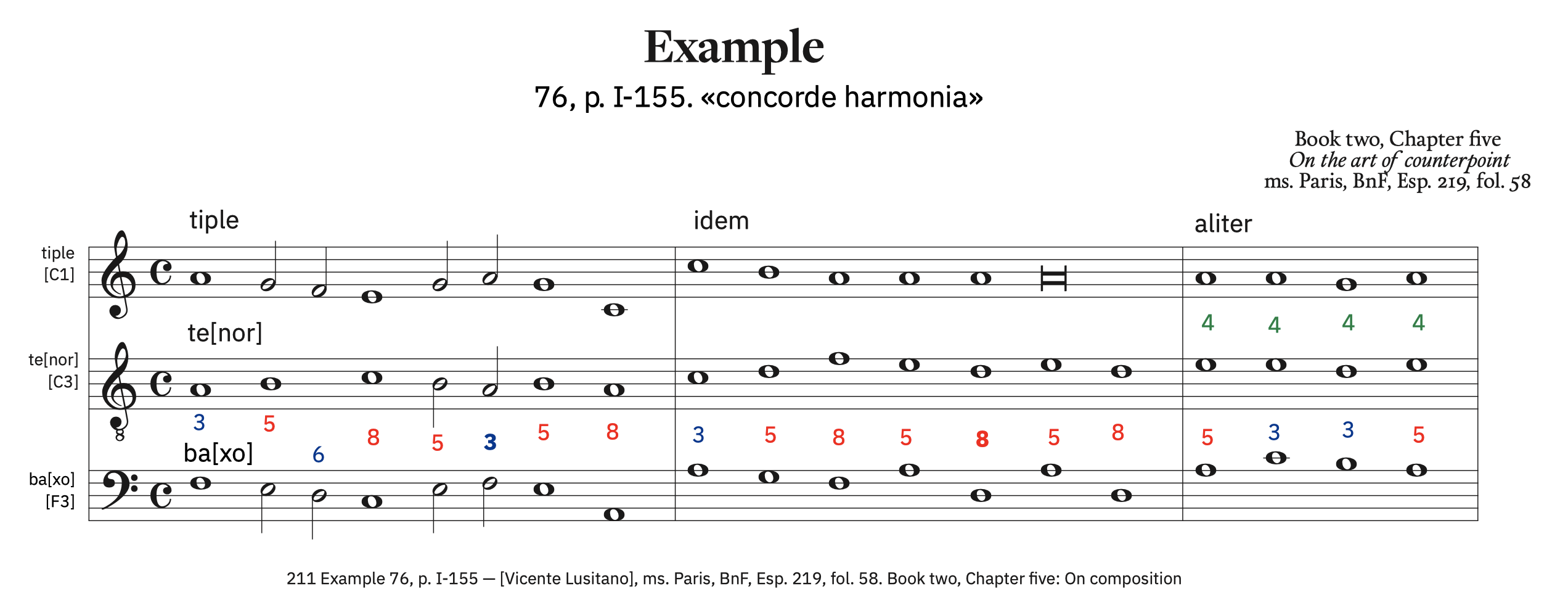
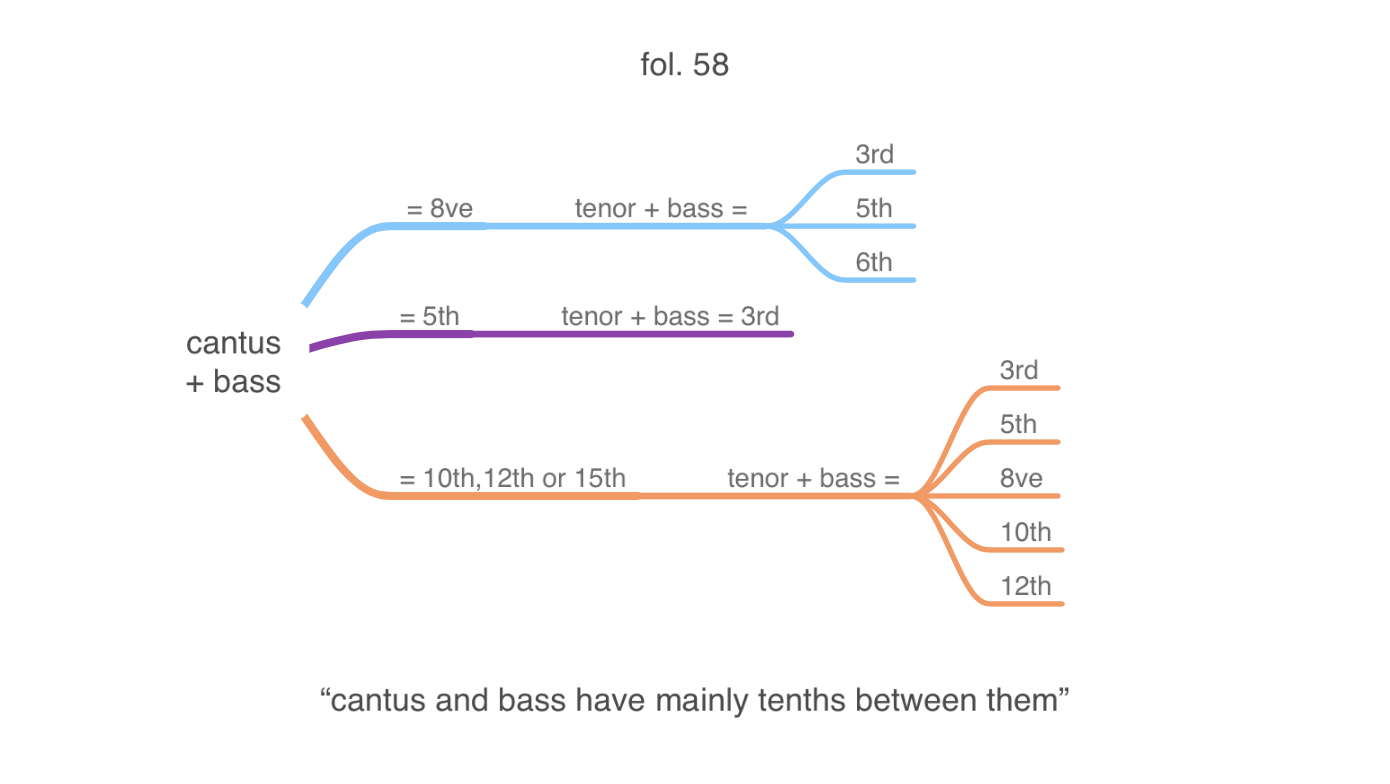
Mas es de notar a los prinçipios que si la boz mas alta con la mas baxa esta en octava la del medio estara [en terçera o] en quinta [o en sexta], mas si estuviere en quinta, la del medio estara en tercera; mas si estuviere en dezena o dozena o quinzena, la del medio podra estar en terçera o quinta o octava o dezena o dozena con el baxo. E nota que la boz mas alta con la mas baxa quasi sienpre frequentan las dezenas que otras species.[^*] Esto se halla ser ansi ser [sic] verdad, para lo qual si hizieremos una 3ª y 5ª y 6ª y 8ª y 5ª y 3ª o 8ª o [corregido: y] 5ª y 8ª con el tenor sobre el baxo, y de baxo el tiple, o hizieremos 5ª, 3ª y 3ª y 5ª con el baxo, y con el tiple todas diatesaron: del tal ajuntamiento resultara concorde harmonia, segun que abaxo se muestra.
Exemplo
However, it should be noted that in the beginning [of the pieces] if the highest voice makes an octave with the lowest one, the middle voice will make [a third or] a fifth [or a sixth], but if it makes a fifth, the middle voice will make a third; and if it makes a tenth or a twelfth or fifteenth, the middle voice may make a third, a fifth, an octave, a tenth or a twelfth with the bass. And notice that the highest voice has mainly tenths, rather than other intervals, with the lowest one.[^*] This is so true, for if we make a third and then a fifth, a sixth, and octave, a fifth, a third or octave[^**], a fifth and an octave among tenor and bass below a soprano voice; or if we make a fifth and then a third, another third and a fifth on top of the bass and only fourths with the soprano, a concordant harmony will result, as shown below.[^xv]
Example
Il faut cependant remarquer, concernant le début des pièces, que si la voix la plus aiguë est à l’octave de la voix la plus grave, celle du milieu sera [à la tierce ou] à la quinte [ou à la sixte], mais si elle est à la quinte, celle du milieu sera à la tierce ; et si elle est à la dixième ou douzième ou quinzième, celle du milieu pourra être à la tierce, à la quinte, à l’octave, à la dixième ou à la douzième avec la basse. Et remarquez que la voix la plus aiguë et la voix la plus grave sont presque toujours en dixièmes plutôt qu’à d’autres intervalles. Ceci se trouve être ainsi vrai, car si l’on enchaîne tierce – quinte – sixte octave – quinte – tierce, ou octave – quinte – octave avec le ténor sur la basse et sous le soprano, ou si nous faisons quinte – tierce – tierce – quinte avec la basse, et uniquement des quartes avec le soprano, une harmonie concordante résultera d’un tel enchaînement, selon ce qui est montré ci-dessous.[^xv]
Exemple
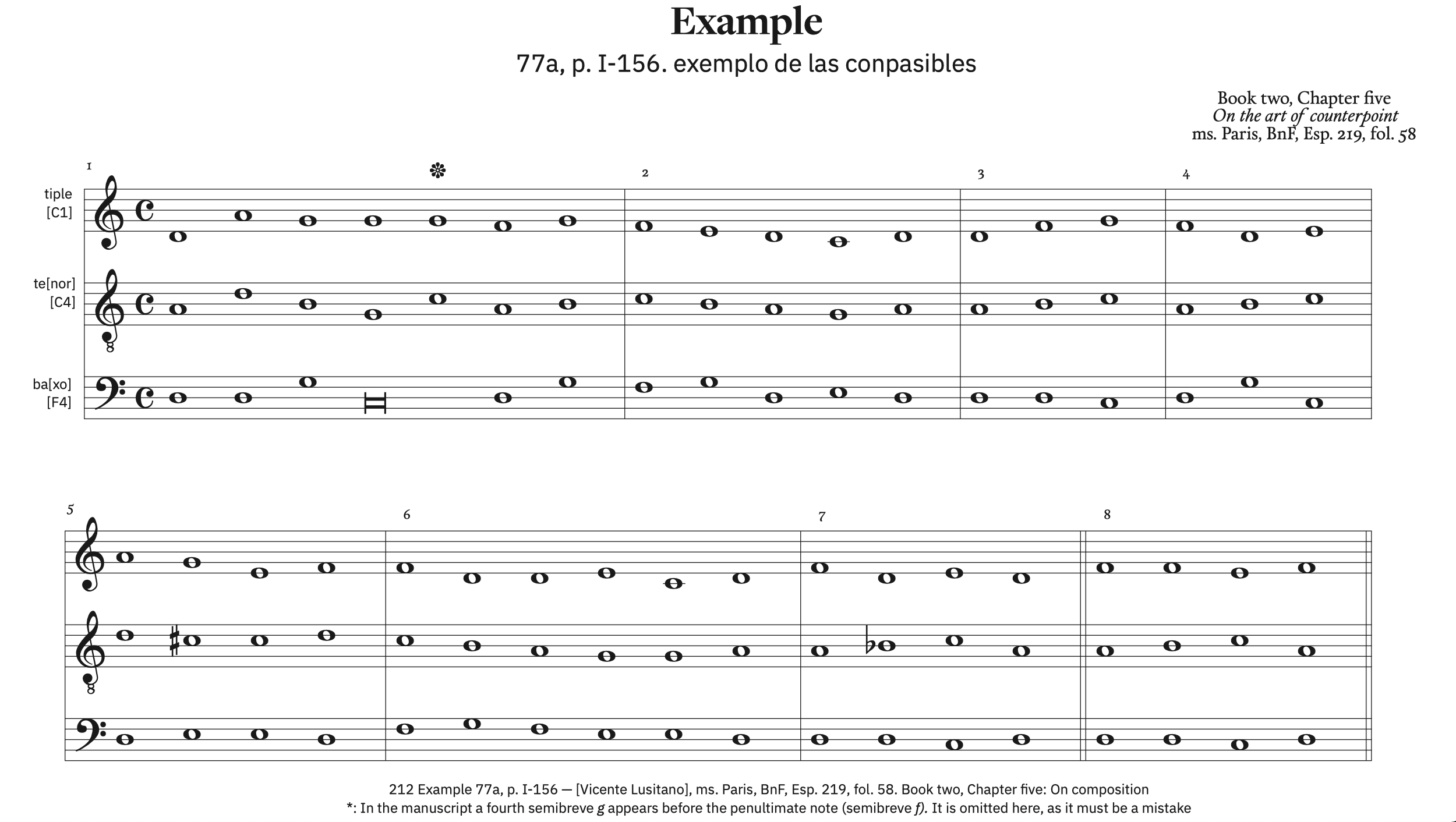
Nota que las cosas que en el contrapunto son encomendadas, en la conpostura no se pueden perfectamente guardar, por caso de las muchas bozes y de los diferentes pasos; ansi como si viniesen algunas bozes a especie perfecta de salto, si diese la octava con sexta de salto antes de la tal octava y otras semejantes cosas, las [quales] se pasan por caso de las muchas bozes.
Exemplo de las conpasibles
Note that things which are recommended in counterpoint cannot be perfectly preserved in composition because of the large number of voices and different melodic motives; as, for example, if several voices make a perfect consonance by skip, or if one made an octave with a sixth by skip, and other similar things, which are accepted because there are many voices.
Example of acceptable consonances
Remarquez que les choses qui sont recommandées dans le contrepoint ne peuvent pas être parfaitement conservées dans la composition dans le cas où il y aurait un grand nombre de voix et différents motifs mélodiques, comme par exemple si plusieurs voix arrivaient à une consonance parfaite par mouvement disjoint, ou si l’on arrivait à l’octave avec une sixte par mouvement disjoint, et d’autres choses semblables, qui se produisent lorsqu’il y a de nombreuses voix.
Exemple des consonances acceptables
212 Ex. 77a[^***]
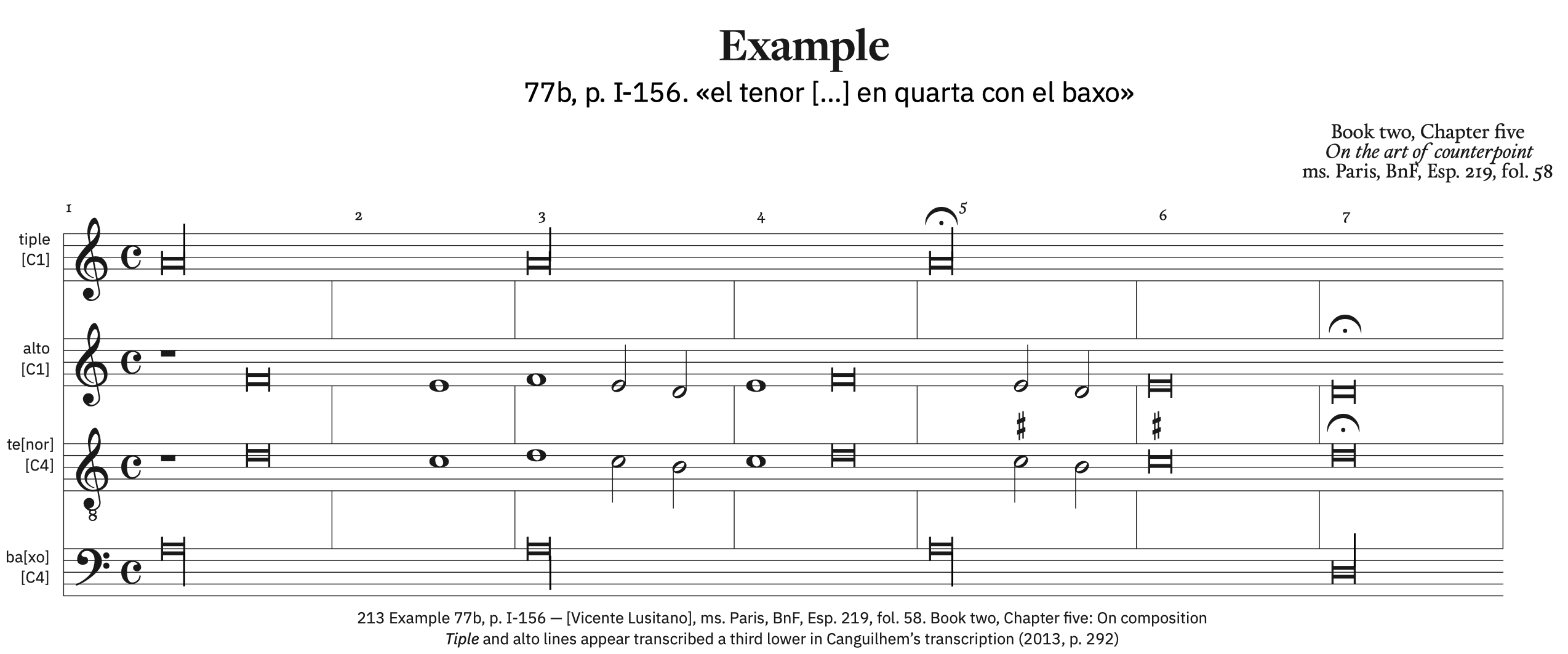
Pueden aon quatro bozes estar de manera que el tenor este en quarta con el baxo.
Exemplo [Marg. ojo]
It is also possible to arrange four voices in such a way that a fourth occurs between the tenor and the bass.
Exemplo [Marg. Attention]
On peut également agencer quatre voix de telle manière que le ténor fasse une quarte avec la basse.
[ Marg. Attention]
213 Ex. 77b[^****]
[^*]: [See below for a visual representation of the different interval combinations described by Lusitano:—Tr.]
[^xv]: Afin de respecter le sens de la phrase et sa cohérence avec l’exemple musical 76, on a traduit un « o » en « y » dans le texte espagnol. [In order to respect the meaning of the sentence and its coherence with musical example 76, an “o” has been translated as “y” in the Spanish text (my translation).—Tr.]
[^**]: [The octave variant is exemplified in the second bar of Example 76.—Tr.]
[^***]: [In the manuscript a fourth semibreve g appears before the first example’s penultimate note (semibreve f). It is omitted here, as it must be a mistake.—Tr.]
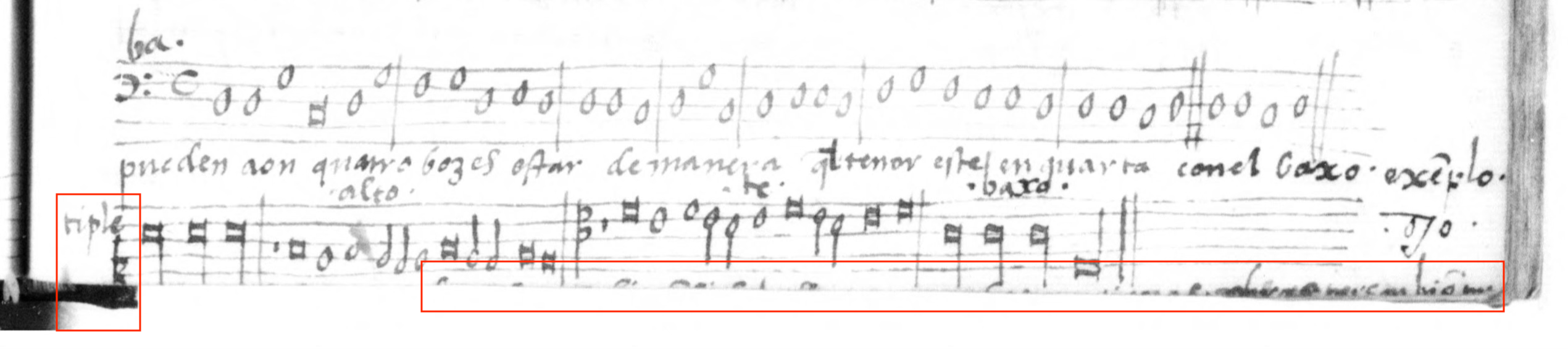
[^****]: [Example 77b’s tiple and alto lines appear transcribed a third lower in Canguilhem’s transcription (2013, p. 292), because of reading them in C2 clef instead of C1. This is understandable given that the example appears at the bottom section of a folio (f. 58) whose lower end appears to be mutilated. Below the music example, some text seems to be missing too. See image below.—Tr.]