fol. 47r
Book two, chapter three: On canons
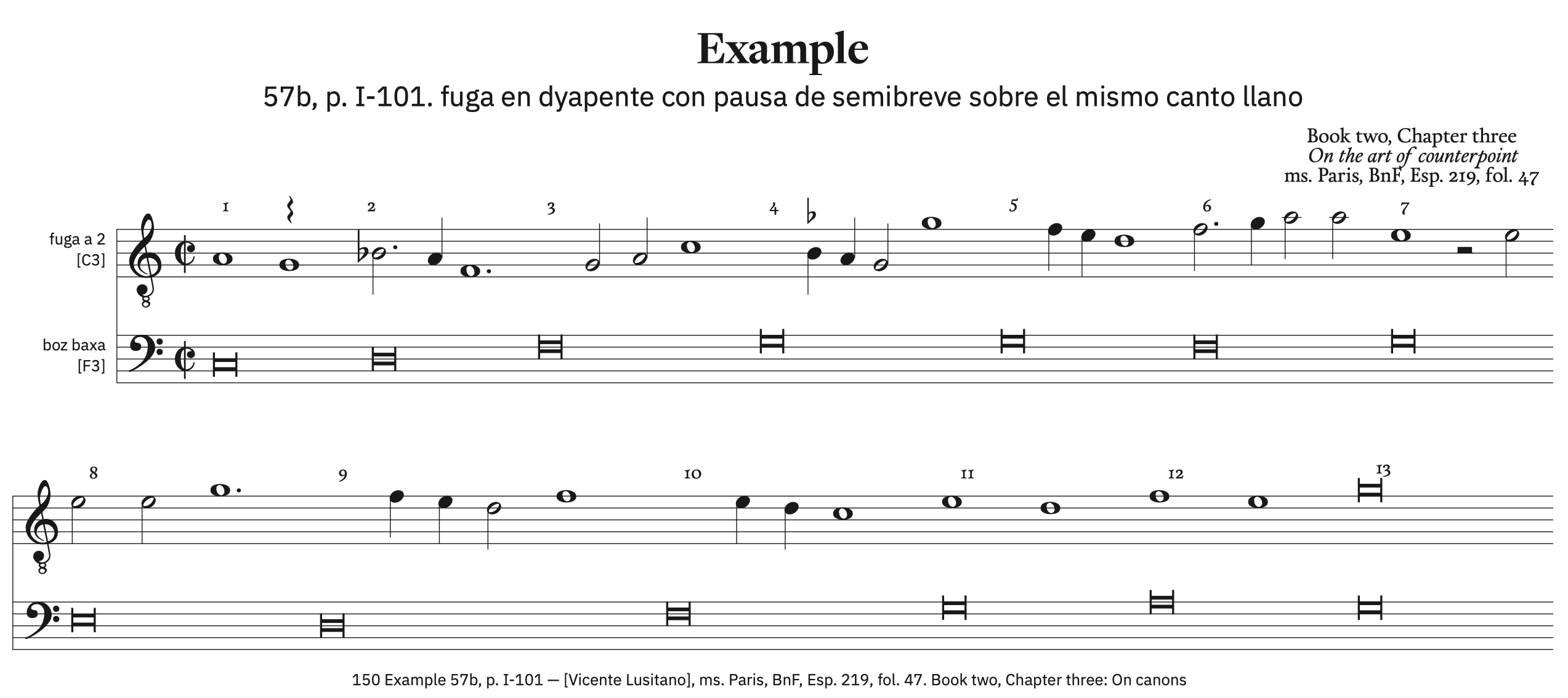
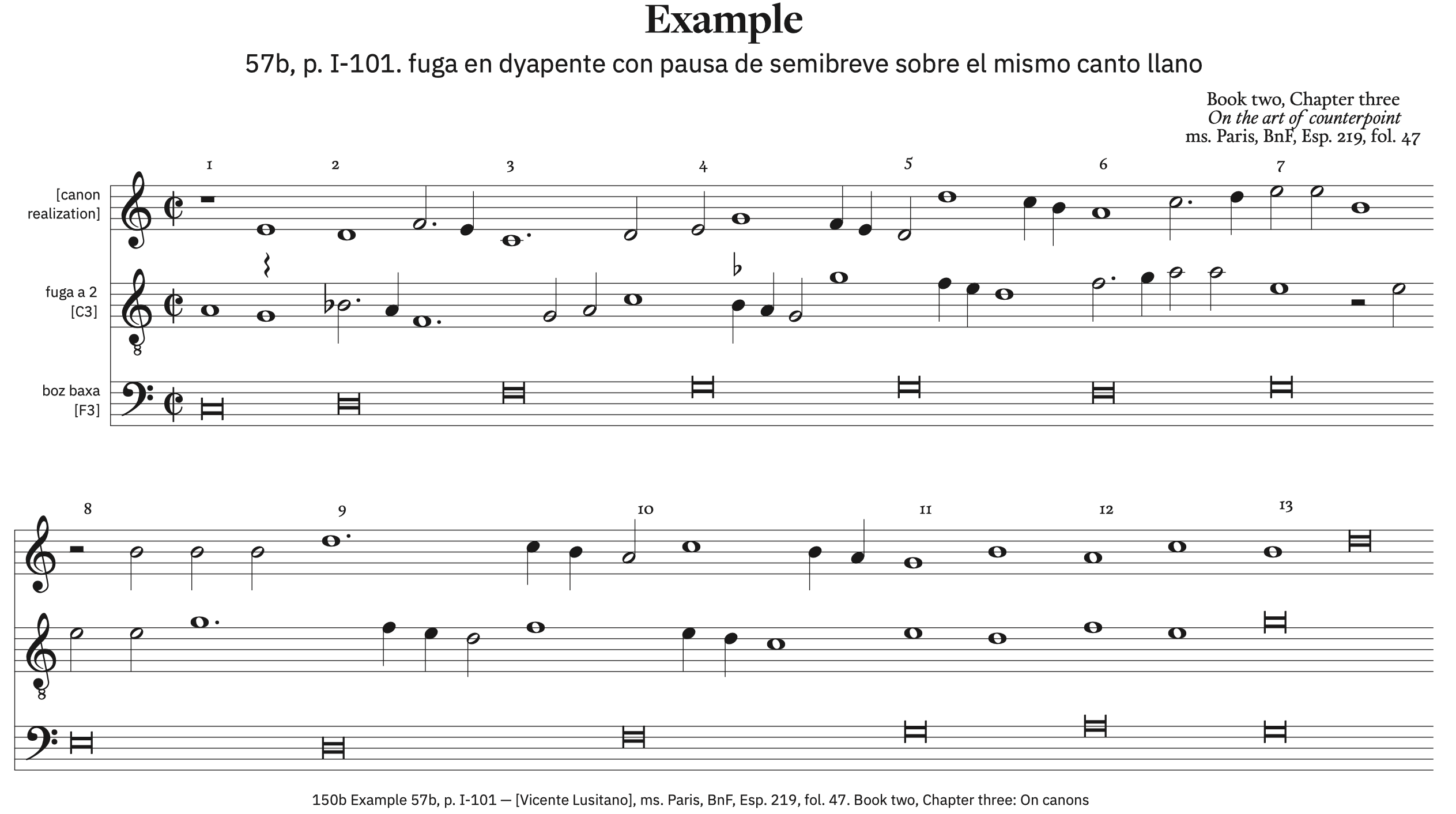
150 Ex. 57b[^*]
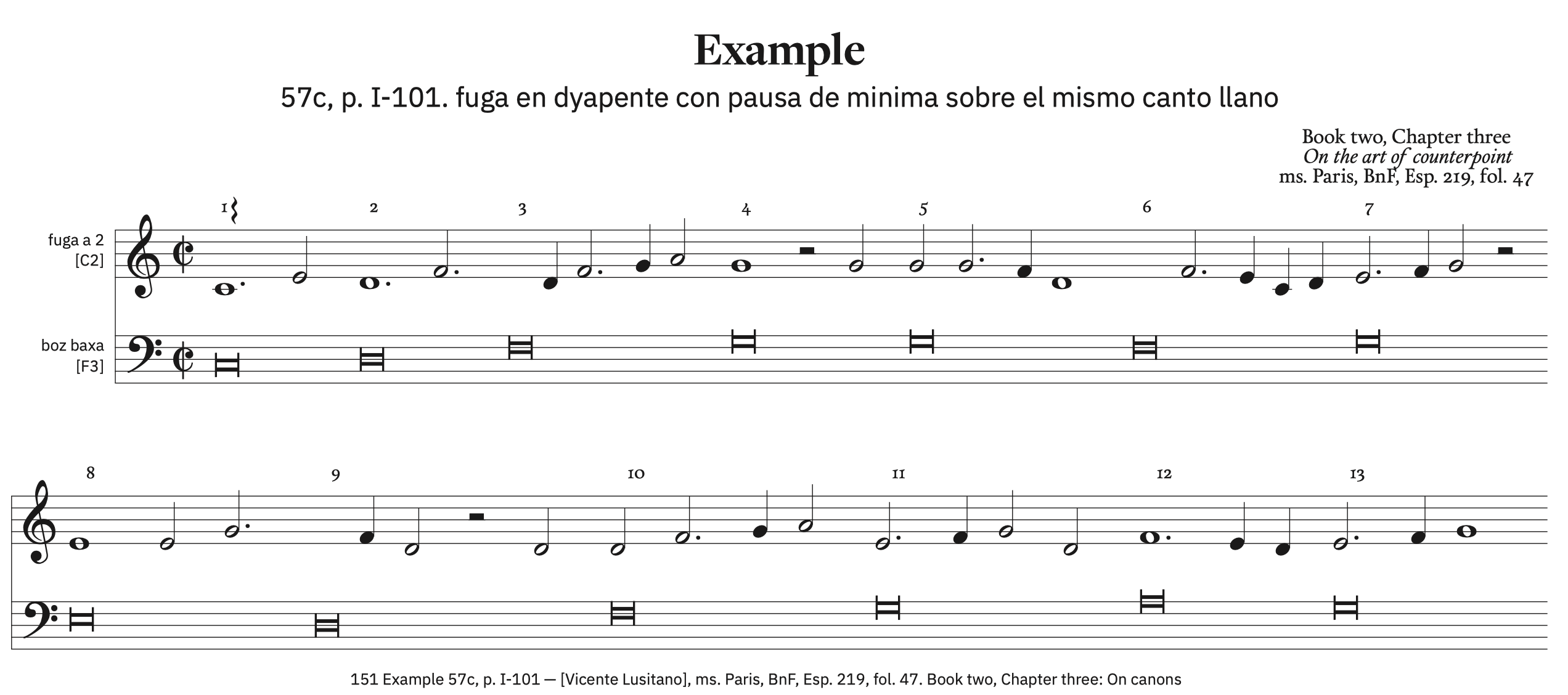
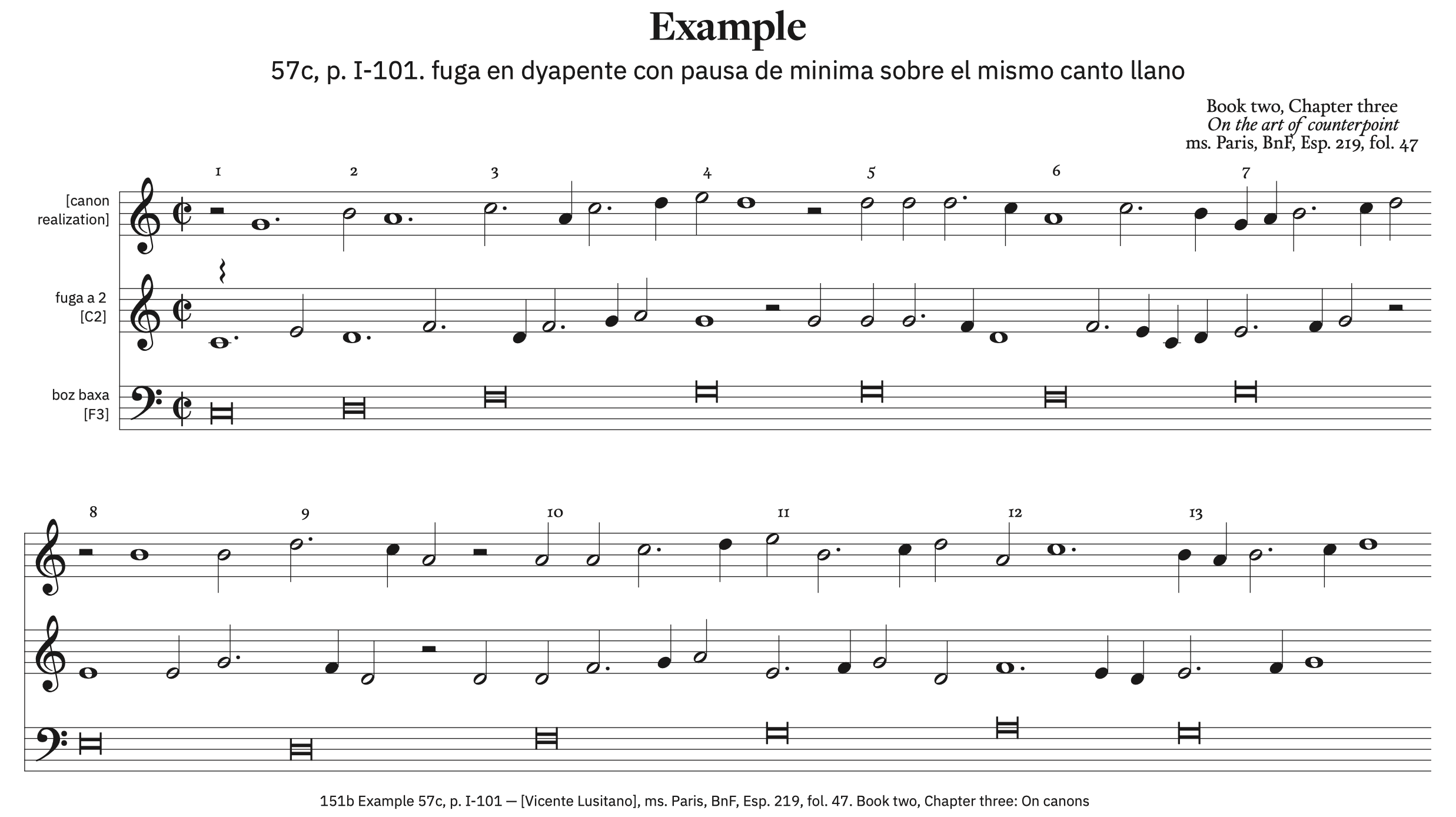
151 Ex. 57c[^*]
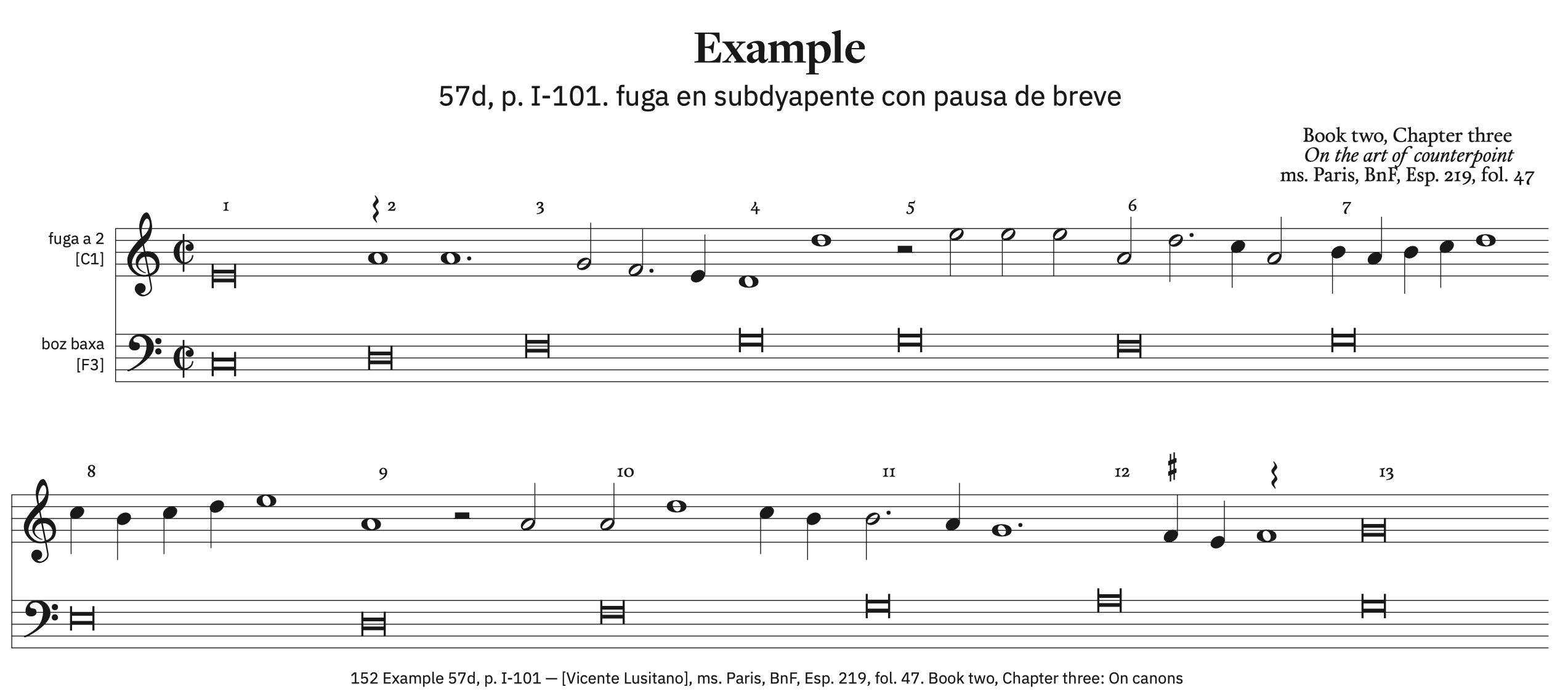
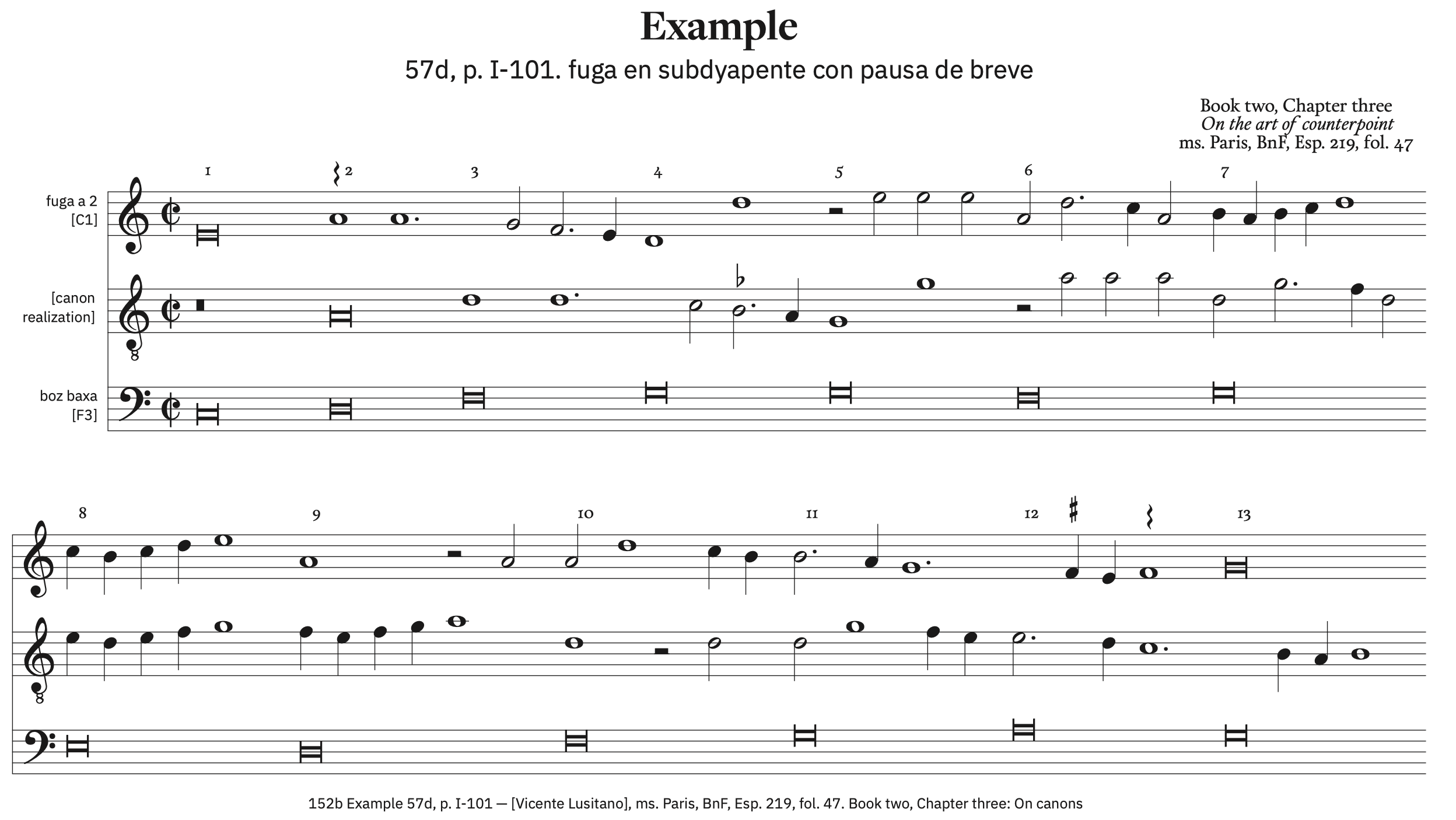
152 Ex. 57d[^*]
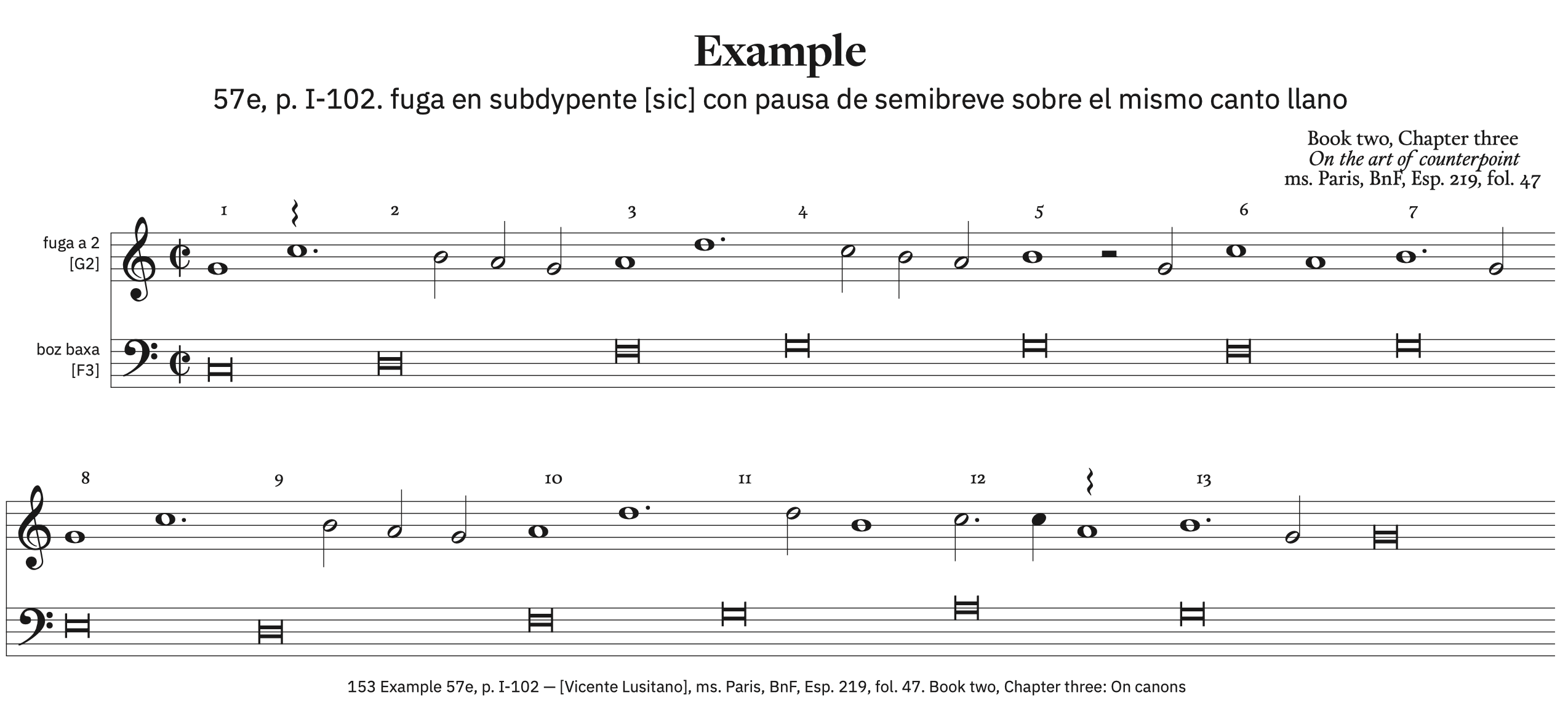
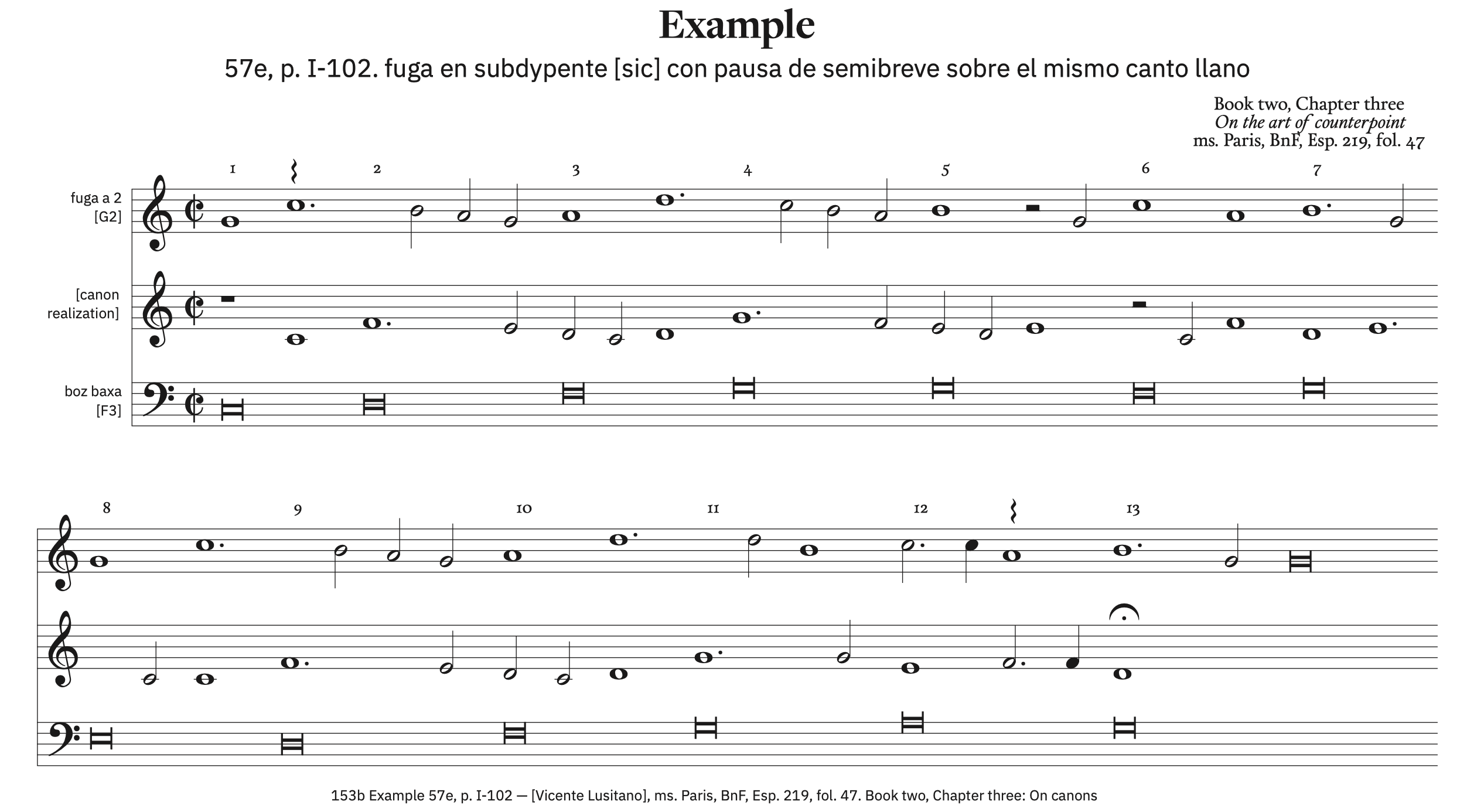
153 Ex. 57e[^*]
Todas las cosas sobrescritas son para avivar el ingenio, y son muy provechosas para muchas neçesidades que vienen en la musica. Y tanto quanto mas sotiles, tanto mas deven ser trilladas y muy continuas en la memoria, por que de la mucha continuaçion se hazen façiles. Mas quanto mas delicadas sean las tales fugas hechas con el canto llano en boz de tiple, ellas por si lo demostran por que no las pueden hazer bien los que no tuvieren grande curso de la conpostura. De donde claro pareçe que pues para ellas es menester conpostura que dellas se puede aprender, por cuia causa se pondra la orden de la conpostura brevemente, por que es el camino diverso, y tanto quanto son los juizios de los componedores. Mas, de las cosas puestas y por poner, puede el que algun ingenio tuviere alcançar la alteza de la conpostura.
Exemplo de como se deven hazer las fugas sobre tiple, esto es cantando el canto llano en boz de tiple o otra boz alta, para que las tales fugas ayan lugar en baxo del canto llano. Mas es de saber que quando la primera boz da quarta con el canto llano, a la segunda dara tal consonancia o especie que aconche aquella quarta como
All the things written above are to enliven the wit and are very profitable for many necessities that arise in music. And the more subtle they are, the more they must be trite and the more often they must be present in the memory because frequenting them will make them easy. How much more delicate these canons are when done with the plainsong placed in the soprano voice, they prove themselves, for those who have no great experience in composition cannot do them well. From which it seems clear that, since it is necessary to have knowledge of composition to be able to do them, one can learn from them. Therefore, the stages of composition will be briefly explained because there are different ways of doing it, and the criteria of composers are diverse.[^**] Nevertheless, regarding both the things explained and the things to be explained, anyone who has some ingenuity will be able to reach the top [in the art] of composition.
Example: how canons should be made on the soprano voice, that is, by singing the plainchant in the soprano or another high voice, so that these canons are placed under the plainchant. But one must know that when the first voice makes a fourth with the plainsong, it will produce a consonance in the second voice that accommodates this fourth, as
Toutes les choses qui ont été écrites ci-dessus permettent de rendre l’esprit plus alerte et sont très profitables pour de nombreux besoins qui se présentent en musique. Et plus ces choses sont subtiles, plus elles doivent être rebattues et très présentes à la mémoire, parce qu’à force d’être utilisées, elles deviennent faciles. Mais que ces canons soient encore plus délicats lorsque le plain-chant se trouve à la voix de soprano, ils le démontrent par eux-mêmes, parce que seuls ceux qui ont suivi un enseignement approfondi de la composition peuvent bien les faire. Il apparaît donc clairement que pour arriver à les inventer, la composition est indispensable à leur apprentissage, et c’est pour cela que l’on expliquera brièvement les étapes de la composition, car les chemins sont variés, comme le sont les jugements des compositeurs. Mais grâce aux choses qui ont été dites et qui le seront, il est possible que celui qui ait quelque talent atteigne les sommets de la composition.
Exemple qui montre comment on doit faire les canons sur un soprano, c’est-à-dire en chantant le plain-chant au soprano ou à une autre voix aiguë, afin que ces canons se placent sous le plain-chant. Mais on doit savoir que lorsque la première voix fait une quarte avec le plain-chant, elle fera naître une consonance à la seconde voix qui accommode cette quarte, comme
[^*]: [See below for an alternative version of examples 57b–57e with canon resolutions—Tr.]
151 Ex. 57c[^***]:
[^**]: [See Canguilhem 2011, p. 96, for a different, less literal but somewhat summarised translation of this passage: “When the plainchant is sung by the soprano voice, these canons are even more delicate, as is shown by the fact that only those well trained in composition can make them. It is therefore obvious that to invent them, composition is indispensable to a musician’s training, and so we will briefly explain the stages of composition, because the methods are varied as are the choices of the composers.”—Tr.]
[^***]: In the recording of example 151 (Ex. 57c) by Les Sacqueboutiers, the comes enters one semibreve later than notated (rather than after a minim), resulting in a number of vertical dissonances over the course of the example.—Tr.]