fol. 37v
Book two, chapter one: On the art of counterpoint
[Ex. 36d]
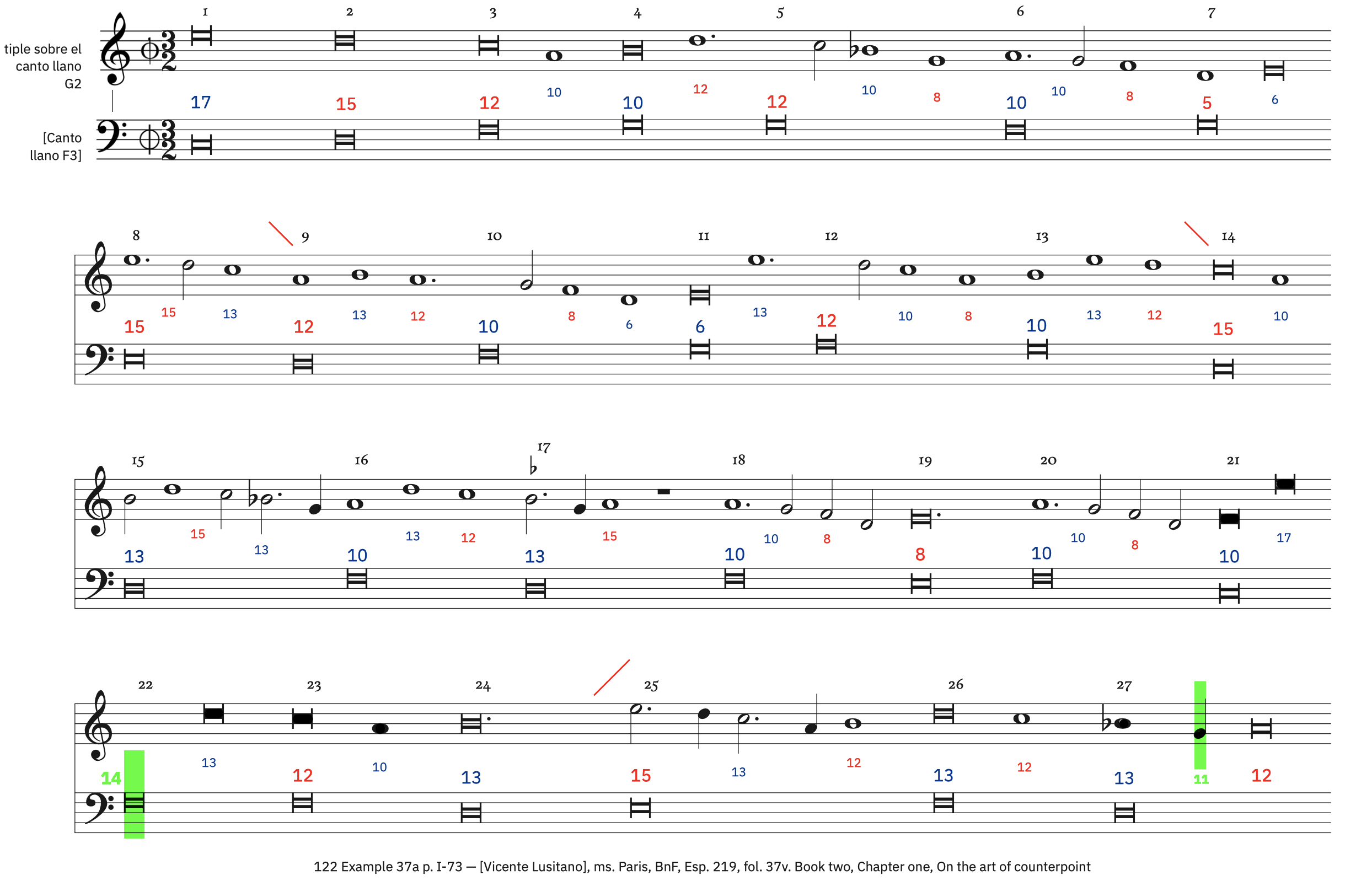
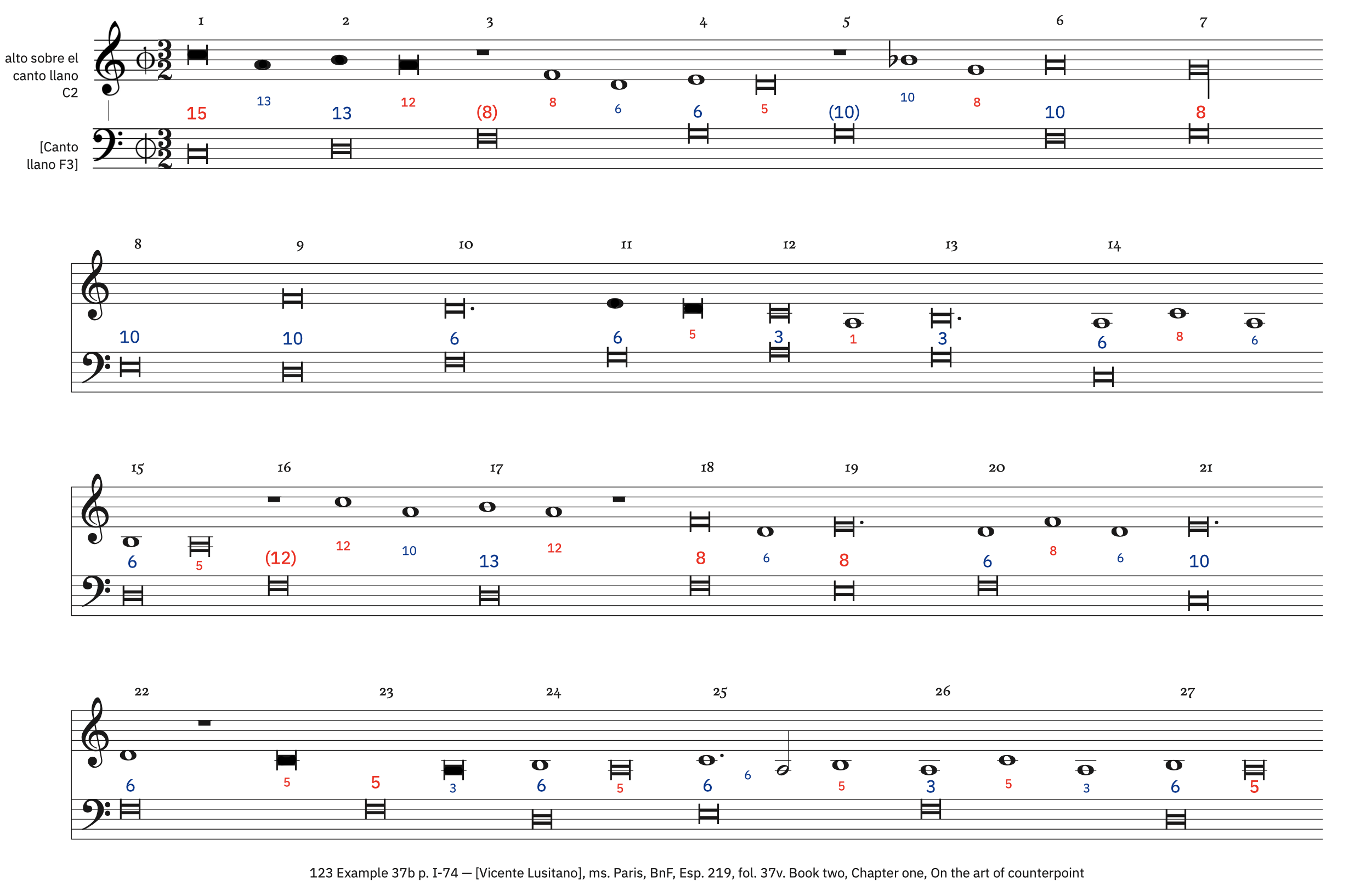
En la misma batuta se puede hazer un paso forcado, y el mismo que fue hecho en el otro conpas.[^12]
[Ex. 37a-b] Exemplo
[Ex. 36d]
In the same measure, one can make an ostinato motive and it can be the same as the one we made in the other measure [in duple meter].[^12]
[Ex. 37a-b] Exemplo
[Ex. 36d]
Dans la même battue, on peut faire un motif obstiné, le même que celui qui a été fait dans l’autre battue.[^12]
[Ex. 37a-b] Exemple
122 Ex. 37a[^*]
123 Ex. 37b[^**]
[^12]: Voir exemple 25a. Il s’agit du célèbre motif La sol fa re mi, utilisé pour la première fois par Josquin Desprez. À ce sujet, voir Haar 1976 et Fabris 1990. [See example 25a. This is the famous pattern La sol fa re mi, first used by Josquin Desprez. On this subject see Haar 1976 and Fabris 1990 (my translation). James Haar, “Some Remarks on the Missa La sol fa re mi”, Proceedings of the International Josquin Festival-Conference, ed. Edward E. Lowinsky and B. J. Blackburn (London, 1976), pp. 564–88, and Dinko Fabris, “The Tradition of the “La sol fa re mi” Theme from Josquin to the Neapolitans through an Anonymous 4-part Ricercar”, Journal of the Lute Society of America 23 (1990), pp. 37–48.—Tr.]
[^*]: [Ostinato motive: la sol fa re mi.—Tr.]
[^**]: [Ostinato motive: fa re mi re.—Tr.]